Amazingly Accurate Predictions: Cutting-Edge Technology in Chinese Agriculture
9/14/2026#农业#粮食安全#科技#预测模型
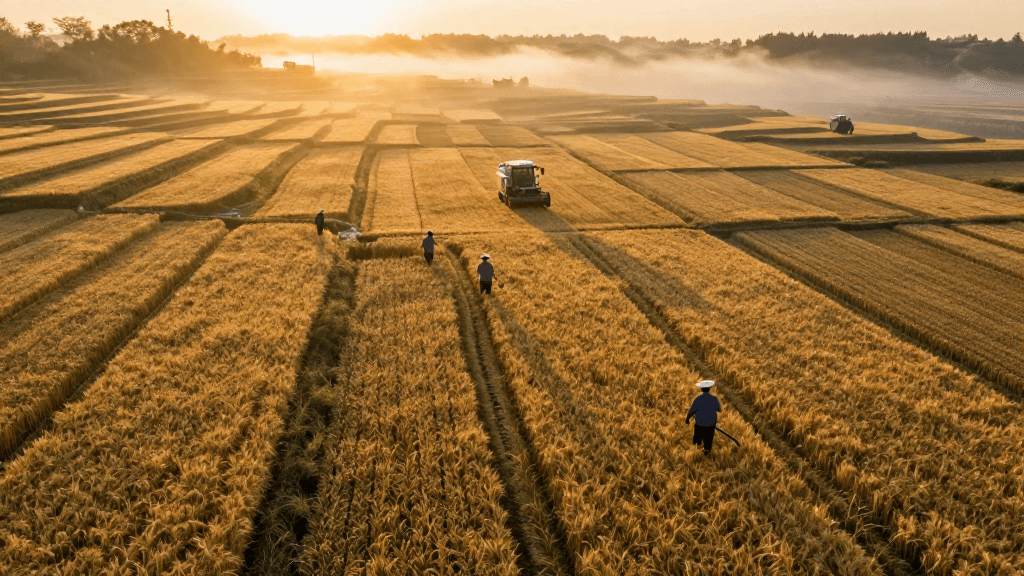
Everyone, today let’s talk about the secret weapon of Chinese agriculture—a core competency that’s crucial to our food security. Do you all remember what I said a couple of days ago about fertilizer supply? Not only is China handling this with ease, but we’ve also refined mathematical prediction models over several decades. This isn’t just simple arithmetic—it’s a complex system of equations, models, and variables. While global food supplies are tight, China isn’t just unfazed—it can accurately predict grain yields half a year in advance. This technology is incredibly precise.
Let’s first break down how this forecasting model works. Every year in late April, the Center for Prediction Science at the Academy of Mathematics and Systems Science of the Chinese Academy of Sciences submits a report to the government containing the national grain yield forecast and risk assessment for that year. This is a matter of vital importance to the livelihoods of the entire nation—even a one-percentage-point discrepancy can make a huge difference. This margin of error is influenced by variables such as fertilizer, pesticides, electricity, mechanization, arable land area, irrigated land area, labor participation, meteorological disasters, seed improvement, and policy incentives. In developed countries, a margin of error of 5% to 10% is considered normal for similar forecasts; the U.S. Department of Agriculture’s August forecast for the October harvest has historically had an error rate of around 4%, though it can reach 8% to 9% in poor years. But what about the Chinese Academy of Sciences’ margin of error? Over the past five years, it stood at 0.34%, 0.15%, 0.23%, 0.14%, and 0.19%—figures that are nothing short of legendary. Going back to 1980, over the past 46 years, their assessments of bumper, average, and poor harvests—as well as the overall trend—have been entirely accurate, with an average error of just 1.51 percent. This technology is truly no joke.
This forecasting model wasn’t cobbled together haphazardly. It was developed by mathematician Chen Xikang, who, based on the input-output analysis framework pioneered by Nobel Prize-winning economist Vasily Leontief and drawing on lessons from China’s historical experiences with grain shortages, devised a unique methodology for input-occupancy-output analysis. It not only takes into account consumable inputs such as seeds and chemical fertilizers but also incorporates the utilization of fixed assets like land and agricultural machinery, comprehensively considering production capacity and bottlenecks. This makes it more accurate than traditional models because it is backed by a vast amount of actual data. Since the 1980s, the National Bureau of Statistics has conducted annual nationwide sample surveys of grain production. This vast amount of actual data has enabled researchers to continuously refine parameters and calibrate the model, resulting in increasingly smaller errors in recent years.
So what exactly is the secret behind this? It is, in fact, a complex field of study. China’s planned economy left behind a highly detailed statistical system for physical assets—particularly land and means of production—which represents decades of accumulated data. From this perspective, stabilizing our grain supply is a breeze. Outsiders often say that China “wins by doing nothing”—that simply maintaining stability is enough to succeed—but the reality behind this is far from simple. Unexpected events are merely an illusion created by planning, and calm waters are the disguise of the deep sea; only through precise calculations behind the scenes can we maintain a calm and composed exterior.
Ladies and gentlemen, we really must not underestimate this “black technology” of Chinese agriculture. It is not only a manifestation of our technological prowess but also a guarantee of national stability and the well-being of our people. The future holds even more uncertainties, but as long as we have this predictive model at our disposal, we will be able to face any challenge with confidence.