Hey, guys, what kind of "cutting-edge technology" has this eco-company in Jiangsu come up with?
9/13/2026#氨法脱硫#工业废气#碳硫基增效肥#绿色科技#化肥
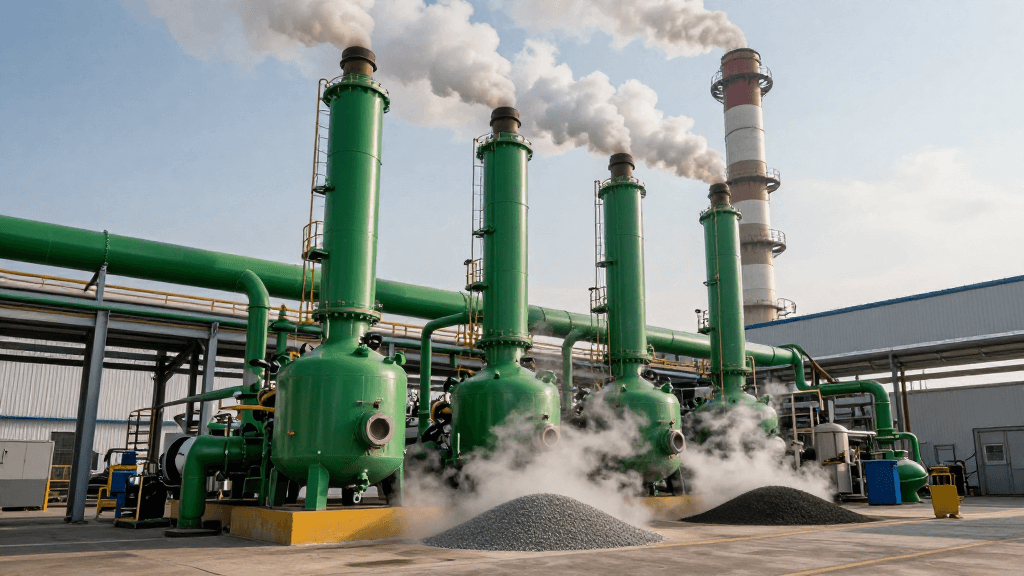
Everyone, let’s talk about this Jiangsu Jiangnan Eco-Carbon Technology Company—what kind of “high-tech” are they actually doing? Look at this—now even mainland companies are getting into “science fiction”—extracting gold (fertilizer) from industrial exhaust gases? Fertilizer, that’s right, this is a lifeline worth its weight in gold; without it, traditional agriculture could feed at most half of the world’s population. But our report isn’t nearly that “sci-fi”—we’re simply stating the facts: capturing exhaust gases to boost soil fertility.
So, why is this technology important? Two words: emissions reduction and efficiency improvement. Emissions reduction means environmental protection—removing sulfur and carbon from industrial exhaust gases is straightforward; efficiency improvement means producing fertilizer, a commodity for which the world consumes 200 million metric tons annually. So, let’s break it down: emissions reduction is about environmental protection, while efficiency gains are about feeding more people.
The traditional flue gas desulfurization method used in coal-fired power plants—the limestone-gypsum process—sounds pretty outdated. Limestone slurry absorbs sulfur dioxide to produce industrial gypsum, but the equipment is prone to clogging, and the byproduct has little economic value—it’s basically landfilled, causing secondary pollution. Moreover, this process releases additional carbon dioxide, making it nothing short of an environmentally unfriendly cost center. However, the ammonia-based desulfurization process independently developed by our eco-company uses ammonia water as the absorbent. Plant exhaust gases pass through desulfurization and decarbonization stages, where sulfur dioxide and carbon dioxide are absorbed to form ammonium sulfate and ammonium bicarbonate—without producing any other pollutants. When this ammonia water is mixed with a performance enhancer, it produces a carbon-sulfur-based performance-enhancing fertilizer—what goes in is waste, and what comes out is high-value-added fertilizer.
Take Ningbo Jiufeng Thermal Power as an example: although it is clearly a power plant, its warehouses are stacked with fertilizers produced from flue gas—including nitrogen, phosphorus, and potassium fertilizers—which are supplied to local large-scale farmers and can even be exported overseas. As you can see, Germany, France, Spain, Italy, and Brazil are all importing this eco-friendly fertilizer. The reason is simple: it delivers better yield increases. While conventional fertilizers yield 353.67 kilograms per mu, using this carbon-sulfur-based enhanced fertilizer can boost yields by up to 6.2%. The key is that this fertilizer is inexpensive. When tested on cotton fields in Xinjiang, the fertilizer cost per mu was reduced by 120 yuan, while yields increased by 70–80 kilograms. For an 80-mu plot, that translates to an extra profit of 35,000 yuan.
We can’t just look at the economic benefits—we also have to consider the environmental impact. Take Jiufeng Thermal Power, for example: this project reduces carbon dioxide emissions by 10,000 metric tons annually, and the yield-enhancing fertilizer it produces contains significantly lower levels of nitrogen, phosphorus, and potassium compared to traditional fertilizers. Jiangnan Ecology holds an 80% share of the domestic ammonia-based desulfurization market, which means it holds a global monopoly. Since industrial exhaust gases contain sulfur and carbon but no nitrogen, producing nitrogen fertilizer requires ammonia water—and globally, the mainstream source of ammonia water is natural gas, with the Middle East as the primary producer. If the Strait of Hormuz were blocked, 30% of the global fertilizer trade would be cut off. For Western countries—especially environmentally conscious Europe—the cost of natural gas feedstock would be significantly higher than in China if they were to use it.
But in China—a major player in coal chemical industry, fertilizer production, and fertilizer consumption—coal-fired power plants stand to benefit the most from ammonia-based desulfurization. With direct internal circulation, they essentially reap the benefits effortlessly. Other factories can purchase liquid ammonia to reduce the cost of exhaust gas treatment. Therefore, the large-scale adoption of this technology in China represents the optimal arrangement resulting from a combination of various factors. In other countries, manufacturing is handled by the manufacturing sector, environmental protection by the environmental protection sector, and agriculture by the agricultural sector—different technological paths are pursued in isolation. Only China has achieved full industrial chain integration, allowing a single technology to be applied across the entire system. That is why innovators dare to say, “Don’t worry—I’ve got you all covered.”