Daily Project: Taking Over the Sky
9/13/2026#空间太阳能#逐日工程#无线输电#清洁能源#中国航天
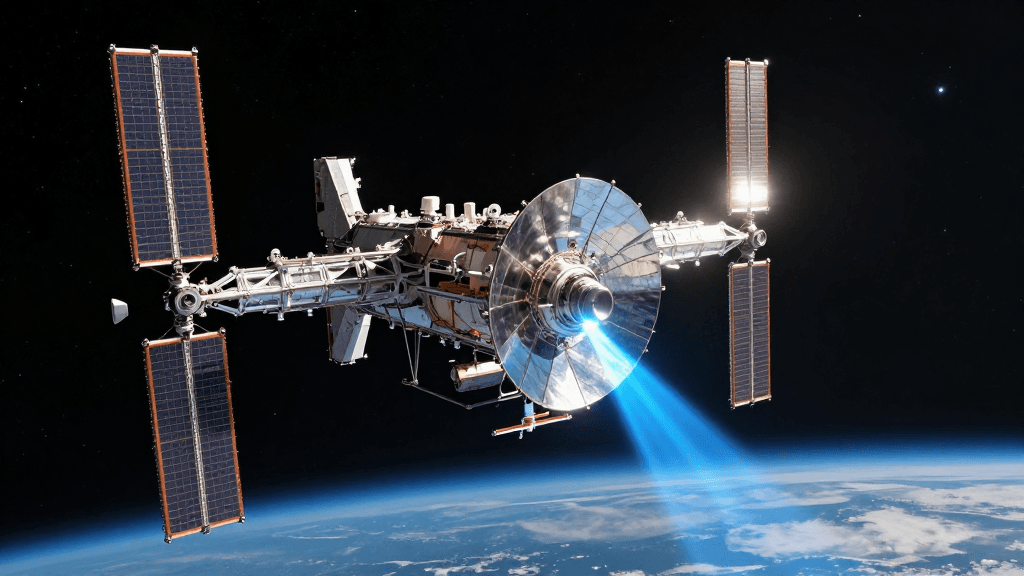
Hey everyone, these days, when we want to generate electricity, we just install power plants up in the sky and use solar energy! And it’s not just about installing them—we can even transmit the power back wirelessly! Doesn’t that sound a bit like something out of a sci-fi movie? Well, here in China, we’ve actually made it happen! Recently, our wireless power transmission system passed testing successfully. Drones can now charge while flying, completely eliminating the need to plug in or land—they stay powered by the microwaves being transmitted to them. Of course, this is just the beginning; there’s still a long way to go for space-based solar power stations. The project is called the “Sun-Chasing Project”—doesn’t that sound a bit romantic?
So, why are we on Earth still pursuing this “Sun-Chasing Project”? Because the biggest problem with ground-based solar power is its intermittency—it can’t generate electricity at night or on cloudy or rainy days. What? You’re asking why we’re still doing it? Because energy storage technology can only solve the problem of grid integration; it can’t improve the utilization rate of solar panels. So, clever scientists came up with a solution: capturing solar energy directly from space. The benefits are obvious. First, without interference from the atmosphere, the energy density is much higher. While the Earth’s surface receives about 136 watts per square meter of solar energy, in space that figure rises to 1,360 watts—or even higher. Second, the power station is deployed in geosynchronous orbit 36,000 kilometers above Earth. At that distance, Earth’s shadow barely blocks the sunlight, so it can generate electricity more than 99% of the time. Therefore, from a physical standpoint, this is definitely a worthwhile endeavor.
However, this is easier said than done. The Solar Power in Space project involves four core technological components: collection, conversion, transmission, and reception. Each component requires overcoming significant technical challenges. First, how to “collect” the energy? Space is a dusty environment, so power plants cannot be built with reinforced concrete; the concentrating facilities must be lightweight. Consequently, Chinese scientists proposed the Omega architecture—short for “Orb-shaped membrane energy gathering array.” Simply put, it consists of a massive, ultra-light spherical concentrator that focuses sunlight onto a single line near the center of the sphere. This design is simpler and more practical than the U.S.’s Alpha architecture.
The U.S. began exploring space-based power generation as early as 1968, but after evaluation, the project was shelved due to its perceived difficulty and high cost. It wasn’t until 2011 that NASA updated its proposal, calling it “Alpha.” This is a massive yet sophisticated system consisting of tens of thousands of mirrors constantly fine-tuning their angles toward the sun, designed for extreme lightweight construction and modularity. However, the complexity of the algorithmic coordination required is self-evident. The U.S. government also did not allocate substantial funding to NASA, so the project has struggled to move forward, remaining stuck at the stages of computer modeling and chip unit testing—not even as far along as Caltech’s SSPP project.
China, on the other hand, got a late start—research didn’t begin until the 21st century—but has now reached the stage of a fully operational, closed-loop ground-based system. Aside from the government’s strategic commitment to developing new energy sources and its financial support, the most important factor has been an innovative approach that charted a new course. Rather than dealing with the complexity of rotating mirrors—which is extremely difficult to control dynamically via software—we opted for a fixed spherical concentrator that requires no directional adjustment. Regardless of the angle at which sunlight enters the sphere, it naturally converges along a single line near the center of the sphere; all that’s needed is to install a mechanically moving energy-harvesting track inside. We simplified the headache-inducing software algorithm problems into hardware and mechatronics engineering challenges—areas where we excel. It is precisely this pragmatic engineering mindset that enabled us to be the first to complete Phase 1.0—known as “fixed-point full-link”—and Phase 2.0—“dynamic multi-objective”—ground validation. In terms of physical construction and technology, we are a full step ahead of the competition.
So, once sunlight is collected, the second step is “conversion.” From space to the ground, there are several stages of conversion: light to electricity, electricity to radio waves, and radio waves back to electricity. The main challenge lies in the end-to-end efficiency of wireless power transmission—specifically, how to minimize losses. The “Chasing the Sun” project uses third-generation semiconductors—gallium nitride (GaN)—to build solid-state power amplifiers for the space transmitter. With low resistance, these amplifiers generate less waste heat. At the ground receiver, the rectifier diodes switch rapidly, enabling precise capture of microwave oscillations and converting a greater proportion of microwaves back into electrical energy. One of the major breakthroughs I mentioned at the beginning was the successful wireless microwave power transfer at the kilowatt level to multiple moving targets simultaneously over a distance of hundreds of meters. The end-to-end transmission efficiency from DC to DC was significantly improved to 20.8%, meaning that one-fifth of the original electrical energy can be successfully transmitted and converted back into usable electricity—a figure that ranks among the highest in the world.
The fourth step is “transmission”—beaming microwaves down from 36,000 kilometers away. How do we ensure the signal hits the ground-based receiving station? The solution involves a two-way process: first, the ground station transmits a guidance signal into space, and the satellite calculates the receiving station’s position in real time. The transmitter uses an active phased array antenna, where countless miniature transmitter units adjust their transmission timing based on feedback from the ground. This synchronizes the waves from countless microwaves to converge in a specific direction, generating maximum energy and precisely targeting the ground receiving station. The latest beam collection efficiency reaches as high as 88%.
The final step is “capture.” In the future, massive complexes consisting of antenna arrays may be deployed on the ground to capture the microwaves and convert them back into electrical energy, which is then rectified, inverted, and fed into the grid. Although this is still a distant vision for the future, it suddenly occurred to me that many netizens joke that our Dean Zhang’s field of expertise is “future history”—and they’re actually right. He often discusses the relationship between political order and energy utilization—for example, how the United Kingdom and the United States rose to prominence on the back of coal and oil, while China is now undergoing an unprecedented leap in new energy. In fact, both anthropologist Leslie White and astronomer Kardashev have expressed similar ideas: the evolution or level of advancement of a civilization does not depend on cultural, political, or moral standards, but rather on the amount of energy available per capita.
From a technological perspective, human civilization is an evolutionary game in which we continuously increase energy density to support larger-scale, more complex social organizations. Scientist Carl Sagan once calculated that human civilization scores around 0.7, classifying it as a Type 0 civilization bound to its home planet, capable only of passively waiting for sunlight to pass through the atmosphere, attenuate, and reach the surface before being harnessed. The essence of the Solar Power Project is an attempt to break through planetary boundaries, actively intercept stellar energy in space, and make the leap to a planetary-scale Type I civilization. I hope that it will be Chinese scientists and engineers who lead humanity in taking this step.