The Grand Canal 2.0: The Latest “Masterpiece” from the Infrastructure Giant
9/13/2026#平陆运河#大运河时代#基建狂魔#广西#内河航运
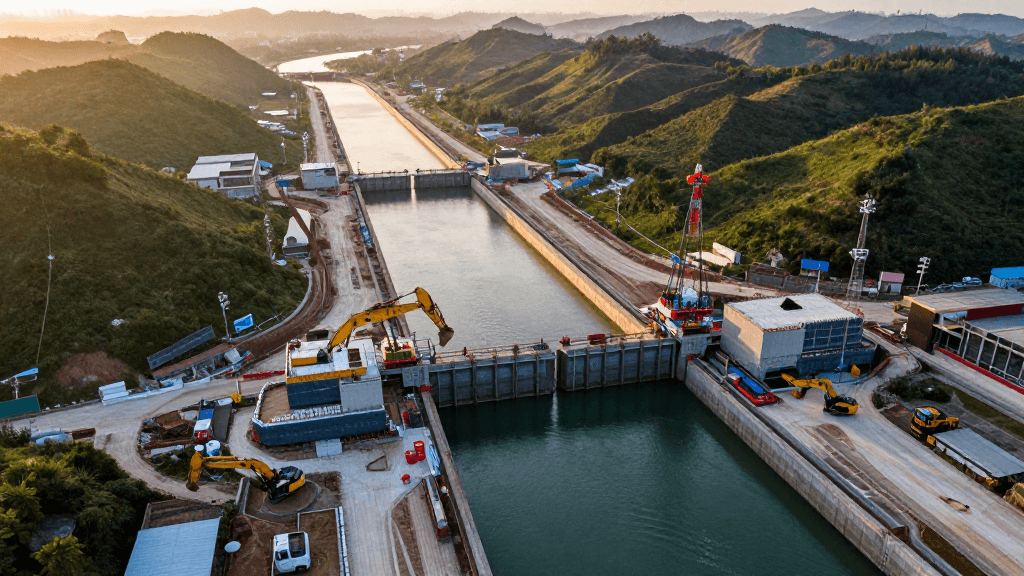
Listen up, everyone—China’s infrastructure has reached a new milestone. The last time we built a canal was the Grand Canal connecting Beijing and Hangzhou a thousand years ago, which helped open up our political and economic lifelines and solidified the unified national structure. Today, we’ve entered the “Grand Canal 2.0” era, with countless canals currently in the planning and construction phases—such as the Pinglu Canal.
The Pinglu Canal is 134 kilometers long and costs 72.7 billion RMB. Construction began in August 2022 and is scheduled for completion by the end of 2027. This project has been so low-key that many people haven’t even heard of it, let alone know what it’s for. When it comes to Guangxi, the first thing that comes to mind for most people is probably its “unparalleled natural beauty” and dense network of waterways. So why build another canal? In fact, Guangxi’s geographical situation is somewhat constrained. Although the Beibu Gulf is a natural deep-water harbor, it hasn’t garnered much attention. It wasn’t until recent years that its cargo throughput finally cracked the national top ten. As the only province in China with both land and sea borders with ASEAN, Guangxi’s ports—Beihai, Qinzhou, and Fangchenggang—are generally perceived as laid-back tourist destinations, lacking the massive economic and trade hubs found along the southeastern coast. All of this stems from the fact that Guangxi’s economic arteries have not been fully opened up.
Guangxi’s terrain slopes from west to east. Rivers such as the Yu, Qian, Liu, and Gui flow eastward to Wuzhou, where they converge to form the Xi River before emptying into the sea via the Pearl River Estuary in Guangdong—leaving the Beibu Gulf, which is just a stone’s throw away, by the wayside. As a result, goods from Guangxi—and indeed the entire southwestern inland region—are forced to take the longer route to the Pearl River Estuary, adding 560 kilometers to the journey and extending transit time by ten days. With the increasing volume of goods from the west, the Wuzhou Water Conservancy Project—the vital gateway connecting Guangxi to Guangdong—is operating far beyond its capacity. Its shipping throughput is the highest among China’s natural rivers, surpassing even the Three Gorges on the Yangtze River, and congestion is severe. If goods were forcibly transported by land, the cost of reaching the Beibu Gulf via rail would be three times that of water transport, and by road, six times as much—making it even less cost-effective. Consequently, the failure to connect Guangxi’s rivers to the sea has become a major shortcoming in the water transport system of the entire Southwest—a shortcoming that the “infrastructure powerhouse” cannot tolerate.
To connect the rivers to the sea, mountains had to be cut through and rivers dredged, giving rise to the Pinglu Canal. It wasn’t entirely a new excavation; rather, it primarily utilized existing waterways by straightening bends and widening the river channels. Starting from the mouth of the Pingtang River in Hengzhou, Nanning, the canal cuts through the Luwu Ridge—the watershed between the Shaping River and the Qin River—and follows the Qin River into Qinzhou Port in the Beibu Gulf. The 17-kilometer section of mountain tunneling involved over 300 million cubic meters of earthwork—three times the volume excavated for the Three Gorges Ship Lock. The difference in water levels between the upper and lower reaches of the canal is 65 meters—equivalent to the height of a 20-story building—and three cascading navigation hubs were constructed, each requiring massive amounts of concrete pouring, with a peak daily volume of 10,000 cubic meters. This massive project has opened up the southernmost sea outlet in Guangxi Province. Not only does it allow the province to connect to the seaport via its waterway network, but more importantly, it attracts and consolidates cargo flows from more inland provinces in the west, making Guangxi their top choice for access to the sea. The entire Pinglu Canal was built to Class I inland waterway standards and can accommodate 5,000-metric-ton vessels, representing the highest specification for inland waterways.
It is projected that by 2035, freight volume will reach 95.5 million metric tons, with transportation services contributing 45 billion yuan to GDP and industrial development driving an additional 32 billion yuan in GDP. This additional growth is expected to expand steadily, potentially reaching 173 billion yuan by 2050. While the canal’s primary function is transportation, its impact extends far beyond that. Increased trade attracts investment, and with investment comes the development of a supporting industrial ecosystem. Consequently, economic growth and industrial development along the canal’s route will flourish. The industrial rise in Southwest China creates a particularly high demand for low-cost water transport. With the Pinglu Canal, river-sea direct vessels can operate, further strengthening ties with Southeast Asia—this is the historical significance of the Pinglu Canal in the 21st century.
ASEAN is not only our largest trading partner; its stance in the strategic competition between China and the United States is also crucial. Last year, the total value of imports and exports between China and ASEAN exceeded one trillion dollars, representing a year-over-year increase of 7.4 percent, while trade between the United States and ASEAN totaled 559.7 billion dollars, a decline of 18.7 percent. Last year, the United States went on a tariff spree; we said, “It’s your business—do as you please. Business is tough, and if it comes down to it, we’ll just stop doing it.” This confidence stems in part from ASEAN; many goods that couldn’t be sold to the U.S. market were instead sold to ASEAN, resulting in a 13.4% increase in exports, which partially offset the decline in exports to the U.S. Therefore, the Pinglu Canal may redefine our relationship with ASEAN’s high-growth sectors and, in turn, shape the international landscape for decades to come.
In fact, the concept of the Pinglu Canal was proposed a century ago, but due to limited technological capabilities, the small scale of industry in the west, and the fact that the Beibu Gulf ports had not yet taken shape, it could not support a viable return on investment. It wasn’t until 2019 that planning and construction suddenly accelerated; construction began in 2022, and the project is set to be completed in just 52 months through a concentrated push. Last Sunday, the Guangxi Daily reported that 90 percent of the planned investment had been completed, meaning preparations for the canal’s opening to navigation will begin this May.
The Pinglu Canal is merely a microcosm of this new era of grand canals. In Jiangxi, the Zhejiang-Jiangxi-Guangdong Canal aims to connect the Yangtze River with the Pearl River and, through the Beijing-Hangzhou Grand Canal, link up with the Beijing-Tianjin-Hebei region, thereby breaking through the so-called “economic ring around Jiangxi” in one fell swoop. In Hunan, the Hunan-Guangxi Canal—known as the “New Ling Canal”—will likewise connect the Yangtze and Pearl Rivers, enabling Hunan, along with the Beibu Gulf and the Guangdong-Hong Kong-Macao region, to embrace unprecedented prosperity. In Hubei, the Beijing-Hankou Canal will straighten the river course to improve shipping efficiency and resolve bottlenecks in the middle reaches of the Yangtze River. In Anhui, the Jianghuai Canal connects the Yangtze River and the Huai River. In Henan, investments in inland waterway transportation are also being made to tightly link the Central Plains region with the Yangtze River Delta. By transforming isolated water systems into a true water network, these projects not only reduce logistics costs but also facilitate the relocation and upgrading of industries to the interior, unlocking key nodes in the domestic economic cycle and fostering more balanced development across China.
As such century-defining projects become increasingly common, it becomes less and less necessary for us to ask whose century this truly is.