Streaking Archimedes and Frozen Leningrad
11/4/2026#欧亚主义#俄罗斯#古米廖夫#地缘政治
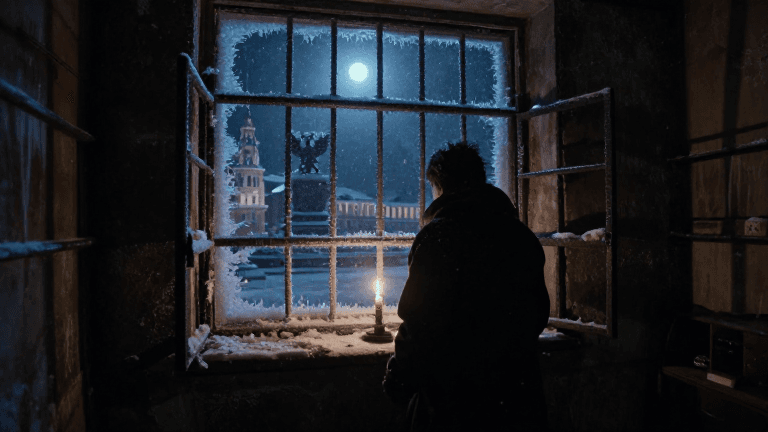
"Yurik, I've had an epiphany!" a man shouted, jumping up. But he couldn't strip naked and run through the streets in excitement like Archimedes—this wasn't a steaming Greek bathhouse, but a cold, oppressive Russian iron prison. Leningrad, that is, St. Petersburg's "Crosses" Prison, had held many political prisoners, including the famous Trotsky, and also this man's father. What had originally been single-occupancy cells had been converted into multi-person rooms because of the Great Purge of "Dear Father" Stalin; faint light filtered through the skylight, unable to illuminate the numb faces of the eight cellmates. Great, another one gone mad. But they would never know that in that moment, this prisoner had unraveled a confusion that had long haunted him: where does the driving force of history come from?
Thinking about such abstract questions inevitably requires an even more abstract environment. Before being escorted back to St. Petersburg, this man had served in a Gulag labor camp in the north, carving a canal from the White Sea to the Baltic—a Russian version of the Grand Canal connecting the Arctic Ocean to St. Petersburg. Gulag was the abbreviation for "Main Administration of Camps," representing the Soviet method of remolding class enemies through re-education. The laborers building the canal were half ordinary criminals, half political prisoners, but what they had done in the past no longer mattered here. The propaganda posters at the worksite enthusiastically called them "Canal Army soldiers," urging everyone to melt their prison terms with the heat of labor. Yet on the hard permafrost, carving a canal by hand with crude tools was truly as difficult as ascending to heaven. Exceeding the quota earned an extra piece of bread and 75 grams of cabbage or a potato pancake, which came nowhere near compensating for the enormous caloric expenditure. Many never lived to see the day of reduced sentences, instead becoming fertilizer for the forests along the canal. Watching his fellow workers die carelessly so that the canal could be completed on schedule, the man discovered that none of the various grandeurs in human history could be explained by rational behavior. Take Alexander's eastern campaign: any thoughtful strategist should have understood that with Macedonia's tiny population, let alone controlling vast territories, there was no way even to send the plundered booty back home—so why launch a war of aggression? It made no sense. That day, in the prison cell in St. Petersburg, he had his epiphany—yes, precisely that it made no sense. Some people are born with an irresistible impulse, a driving force that will stop at nothing to achieve a lofty goal. How to describe this vitality that defies normal biological logic? He couldn't come up with lines like "Only sacrifice can express great ambition, daring to make the sun and moon shine in a new sky"; he could only think of the selfless, self-denying Jesus Christ of Western culture, and so he invented the word passionarity (пассионарность), which Chinese often inappropriately translates as "passion." In fact, the word comes from the Latin passio, meaning suffering. Passion fruit is called Passion fruit not because it is sweetly passionate, but because its stamens correspond to Jesus's wounds and nails. This man, deep in prison, could foresee that his "Longchang enlightenment" would, many years later, become a footnote to another great cause.
Putin, who returned to the pinnacle of power in 2012, delivered his first state-of-the-nation address of the new era in the resplendent St. George's Hall of the Kremlin. Abandoning the polite official tone of his early days as president at the turn of the century, he described in an almost prophetic voice the great geopolitical rupture of the coming years. He said that growing global inequality in development might trigger new conflicts; who would lead the world, and who would be marginalized or even lose independence, would depend not only on economic potential but, more importantly, on each country's will, its inner energy, and the capacity for advancement and change that Lev Gumilyov called passionarity. It sounded like harmless enterprise. Shortly after taking office again, he announced the formation of a new Eurasian Union to reassemble the old lands of the Soviet Union—although he did not explicitly say "the time has come to sacrifice for Mother Russia," this obscure term was already a clear signal to the elite: a difficult and arduous struggle was about to begin. One year and three months later, Russia occupied Crimea, calling it an inseparable part of its national history and culture, and this series of conflicts ultimately evolved into a Slavic civil war that would exhaust a generation of Ukrainians. As an object of suppression by the mighty Soviet state machine, Lev Gumilyov could never have imagined that his theory would, in the post-communist era, be canonized as the spiritual adhesive of the Russian nation, used to piece together the fragments that fell away after the Soviet collapse.
He had been utterly desperate at the time: being transferred back to the big city was certainly not because of outstanding performance earning him a reduced sentence; on the contrary, it most likely meant he was to be sent to be shot. The reason was simple: he was the son of Nikolai Gumilyov. In that era of "heroes beget heroes, reactionaries beget bastards," the black identity of a counter-revolutionary descendant could at any moment become a death warrant. As a famous Acmeist poet of the late Tsarist era and founder of the Poets' Guild, in an age when his compatriots had only seen large animals in the form of bears near their villages, Nikolai Gumilyov wrote about the giraffes he had seen on African expeditions. He looked like a dissolute, unrestrained playboy, but compared with many patriotic poets who wielded their pens like knives, he didn't just write—when the country was in trouble, he truly stepped up. During World War I he joined the elite cavalry and earned two St. George Crosses for bravery. During the revolution he was a staunch monarchist, opposed the Bolsheviks, and considered them all illiterates; even after the tsar fell, he still refused to emigrate and publicly made anti-communist statements. The Soviets were well aware at the time that the old intelligentsia were not of one mind with them, so they devised many methods, such as setting up fake monarchist dens for entrapment. In 1921, the secret police Cheka fabricated charges, falsely accused monarchists of conspiracy, arrested more than eight hundred scientists and artists, and executed ninety-eight of them, the most famous being Nikolai Gumilyov. His old friend Gorky hurried to Lenin to plead for mercy, but before the pardon order came down, the man was already gone. Because Gumilyov admitted that although he had taken no action, in his heart he truly wanted to rebel. So what was there to discuss? Time to eat a bullet.
This suppression campaign made relations between the Russian intelligentsia and the Soviet regime even more tense. Starting in 1922, large numbers of intellectuals were systematically expelled—the "Philosophy Steamer" incident. Let me add some background here: many Russian intellectuals who fled to the West pondered, in the crevices of civilization, the question that had long troubled Russia—national identity. Since Peter the Great, the Russian double-headed eagle had been in a state of chronic spiritual schizophrenia: the Westernizers advocated comprehensively learning from Europe, while the Slavophiles narrowly advocated Slav exceptionalism and one-sidedly emphasized the superiority of the Russian nation. This split in identity led both Asia and Europe to regard Russia as the other; the Chinese called them "laomaozi," and they pleased neither side. Napoleon said that if you scratch a Russian, you will find a Tatar. The White émigrés, unwelcome everywhere, considered themselves eternal strangers; Russia was neither Europe nor Asia, but another separate continent—this was Eurasianism. Eurasianism was less an academic theory than a geopolitical worldview. Its core tenet was to regard the Eurasian landmass—note, not equal to Europe plus Asia in the geographical sense, at least excluding Western Europe and East Asia—as the northern forest-steppe belt connecting the two continents of Europe and Asia, which in fact was roughly equivalent to the Soviet Union; but it did not regard this vast land as an unbreakable pluralistic union, but rather as a unified entity of geography, ethnicity, culture, and politics. Most early Eurasianists came from intellectual families, but unlike their fathers who tended to use liberalism to change the country's backwardness, they grew up in the era of the Tsarist collapse and realized that merely aligning with the West was not Russia's way out; it would only bring Russia moral nihilism and materialism, causing it to lose its national vision and thus lose Russia. Their escape routes often led from the capital through Crimea, the Caucasus, and other places to Central Europe, where they witnessed the complex linguistic diversity of the borderlands, far more complicated than the red-white opposition described, and so they began to conceive new cultural and political utopias; they longed to recreate Russia.
The most dazzling star of early Eurasianism was the linguist Nikolai Trubetzkoy, of noble descent. To overcome the centrifugal ethnic forces created by the history of imperial conquest and colonization, he sought to redefine Russia. Generally speaking, Russian orthodoxy traced history back to Kievan Rus, but Trubetzkoy believed that Russia's national roots lay not in Kievan Rus but in the Golden Horde, in Genghis Khan's Mongol Empire and even in nomadic empires such as the Scythians and Xiongnu, because Russia had inherited their steppes, rivers, geographical systems, and the diverse ethnic groups of Slavs, Finns, Turks, and Mongols; therefore Russia's "Asian" character was higher than its "European" character, and Peter the Great's attempt to Westernize was distorting the natural national character. The so-called "Tatar yoke" from the East had been painted as very dark, but it was far less harmful to the Russian nation than the Western Romano-Germanic civilization: it caused the Russian top elite to accept Western spiritual enslavement, while ordinary people, unable to escape their relationship with the land, could not be fully Westernized; the vertical split in society was a weakness Tsarist Russia could never overcome. He wrote that the Eurasian landmass was a complete system geographically, ethnically, and economically, and that its political unification was an inevitable result of history. In his view, it was inevitable that a single state entity would dominate the Eurasian order, and such unification required enormous spiritual power, especially the kind that, like the Mongol tribes, did not cling to comfortable secular life. He wrote a book called The Legacy of Genghis Khan, attempting to awaken his Soviet compatriots, break free from the shackles of official atheism, and inaugurate a new religious and spiritual order. By the 1930s, Eurasianism split internally because of contradictory attitudes toward the Russian Revolution: one left wing believed that the revolution had prevented Russia's full Westernization and that the Soviet Union represented the non-European path they were seeking, so their position gradually tilted; the other right wing insisted that communism was also a European import, a Western attempt to use internationalism and atheism to destroy Russia's national identity centered on Orthodox Christianity, and therefore had to be resolutely resisted. After the two sides parted ways, the first wave of Eurasianism gradually disappeared in that chaotic and extreme era.
Let us return to our counter-revolutionary descendant Lev Gumilyov. He was only nine when he lost his father. Since his parents had divorced two years earlier, he had lived in the countryside with his grandmother, and his mother only came to see him in the summer—she simply couldn't take care of a child, and didn't want to; she had her own life, and the core of that life was poetry. That's right, his mother was a greater poet than his father, Anna Akhmatova, known as "the moon of Russian poetry" (the "sun" being Pushkin). Say the name "Akhmatova"—doesn't it faintly give off the smell of lamb skewers? That's right, it is a variant of the Muslim name Akhmed, a pen name she gave herself to commemorate her ancestor—Akhmat Khan, the last Mongol khan who tried to revive the Golden Horde. In 1480, it was Akhmat Khan who faced Grand Prince Ivan III of Moscow at the Ugra River and ultimately withdrew, leading Russia to completely throw off the control of the Tatar khanate and move toward national rise. More than four hundred years later, Akhmatova, a descendant of Akhmat Khan, had become fully integrated into the Russian nation. Even in the face of revolutionary upheaval, when many friends in cultural circles went abroad, she still chose to remain in the Soviet Union, because she was loyal to this sacred land, regarded herself as the heir of the Russian poetic tradition, and wanted to stay and write about this era. However, the freedom to write was running out: the Soviet Union required new literary and artistic workers to express revolutionary fervor, not to cater to bourgeois aesthetic sentiments with affected, self-pitying moaning. Starting in 1925, she could no longer find anyone willing to publish her poetry collections, entering a decade-long creative hiatus.
In 1930, the seventeen-year-old Lev Gumilyov moved to Leningrad to attend university and live with his mother and her new husband. The cold family atmosphere was one thing, but the key was that, as the son of an enemy of the state, he found all doors closed to him. The only thing he could do was to get ahead of the government and voluntarily subject himself to "labor reform": he joined geological survey teams, going deep into the Sayan Mountains and the Pamirs, always working hard without complaint and possessing rich historical and geographical knowledge, and finally after four years was recognized as a comrade who could be won over and entered the history department of Leningrad University. Actually, during this period Gumilyov was arrested once, when Stalin used the Kirov assassination to launch the Great Purge, but after all he had done nothing wrong and was released after only nine days. After enrolling, Gumilyov continued to face suspicion and exclusion. Fortunately, studying was still far simpler than handling complex human relationships. He became increasingly withdrawn and taciturn, letting history, geography, and ethnography occupy all his thoughts, trying to endure these years quietly. But sometimes, no matter how reclusive and forbearing a person is, he cannot stop fate from knocking at the door.
The Acmeist school founded by his parents often held "roommate gatherings" at Akhmatova's home. To avoid trouble, they basically kept their heads down, reduced publications, and only read poems to friends: hands, matches, ashtray, a beautiful and bitter ritual. Finally one day, the arrogant genius Osip Mandelstam brought disaster upon himself: at a gathering he read a satirical short poem, "We Live, Not Feeling the Country Beneath Our Feet." The "highlander of the Kremlin" in the poem was none other than Stalin, from the Caucasus; the poet recklessly mocked his fat fingers, greasy as maggots, his cockroach-like big eyes containing a smile, his tall boots always shining. No one knew who among the friends was a traitor, but in any case the secret police received a report and knew the entire content of the poem accurately. After Mandelstam was arrested, he confessed fully; thanks to the old editor-in-chief of Pravda, Bukharin, pleading with Stalin, he miraculously escaped for the time being, only being exiled. During exile, in hopes of a reduced sentence, he wrote "Ode to Stalin." But as Bukharin was executed as an enemy of the people, spy, and fascist running dog, in 1938 Mandelstam was again liquidated as a counter-revolutionary, and ultimately froze to death in a labor camp in Vladivostok because he never received winter clothes.
After the satirical poem case broke out in 1935, Lev Gumilyov, because he was familiar with Mandelstam's poetry, was arrested by the NKVD on suspicion of terrorist tendencies. Fortunately, his mother Akhmatova constantly pulled strings and secured her son's release. But this incident still caused him to be temporarily expelled from Leningrad University, interrupting his studies, which were only restored in 1937. But when Gumilyov was about to graduate in 1938, he was arrested yet again. He had merely publicly corrected a professor's false accusation against his father, but was charged with participating in a terrorist student organization intending to assassinate the Leningrad party secretary Zhdanov. Although the authorities had no evidence other than confessions obtained through torture of students, evidence was precisely the least important thing: at the time the secret police even had regional quotas for "unearthing enemies of the people," and using a suspect counter-revolutionary descendant to fill the quota was all too suitable. Gumilyov would originally have had difficulty escaping death, but fortunately there were too many cases to handle at the time; keeping a person in prison wasted labor, so it was better to send him to labor reform, and thus he became a member of the Canal Army. In 1939, Gumilyov was brought back to Leningrad for reinvestigation. At this point he had brought back from the labor camp a faint detachment and began to view everything with an aloof eye: besides pondering the motives of Alexander's eastern campaign, he also began to examine the social relations among the prisoners—although exposed to a primitive environment, there was no outbreak of the so-called "war of all against all"; Hobbes's theory of the state of nature still had some flaws.