From Being Assisted to Assisting the World: China's 50 Years of Desertification Control
11/3/2026#治沙#荒漠化治理#生态工程#中国故事
Everyone, today let's talk about a video that has gone viral recently: Yin Yuzhen, a model worker in desert control, was looking for an American friend, Sokolsky, and with the help of netizens, he was finally found. In 1999, Ronald Sokolsky, who was a diplomat in Luoyang, saw Yin Yuzhen's story on CCTV-4 and directly took out 5,000 US dollars to fund her tree planting. The fixed exchange rate at that time was 8.28, so 5,000 dollars was equivalent to more than 40,000 RMB. Not to mention ordinary people, even a high-income diplomat would have to save for a year without eating or drinking. This huge sum of money was given to a farmer she had never met, in order to prevent the desert from swallowing up China on the other side of the earth. This wave of internationalist spirit is truly moving!
However, I saw someone asking: This kind of internationalist spirit, who else has it? We ourselves do. Because now China is also doing what Sokolsky did back then, only more concretely—we not only provide money, but also technology and overall solutions. When technology reaches a certain point, many things will be integrated, and we will bring out our best skills.
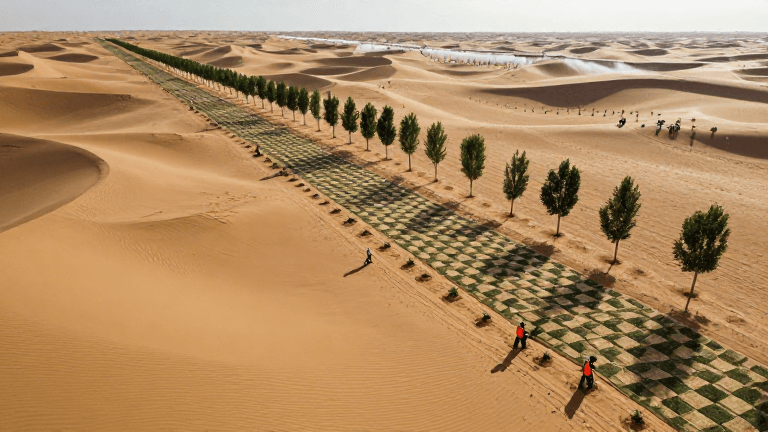
We must be clear on one point: China is now the country with the most research, the widest practice, and the highest technology in the field of sand prevention and control in the world. No need to say 'one of'; it is the most. Only China can say to a death sea like the desert: Surrender, you are surrounded by us. This is not an exaggeration. You can look up the Taklamakan edge-locking project. In 2024, the 3,000-kilometer green belt around the edge was fully closed, locking down the spread of shifting sand. It is part of the Three-North Shelterbelt. The Three-North Shelterbelt is the world's largest man-made forest belt, covering 45% of our land, that is, nearly half of China. Construction started in 1978 and will not be completed until 2050. It is truly a century-long tree-planting project. During the construction process, our scientific research input and output, the scale of ecological engineering, and the combination of technology application and industry have all reached the forefront of the world. Desert control experience has completely changed the traditional understanding of the international academic community.
In the past, everyone thought that greening was a passive response of the earth, mainly triggered by carbon dioxide concentration. But China has proven that humans can take the initiative to reshape the earth's ecology. Now we are already providing systematic solutions to Central Asia, West Asia, and Africa. For example, in 2007 the African Union proposed building an 8,000-kilometer-long, 15-kilometer-wide Great Green Wall in the Sahel region, learning from our Three-North Shelterbelt to prevent the southward expansion of the Sahara Desert. But it had been stalled for years due to various reasons, until China packaged and shared its knowledge, technology, and industrial solutions.
Among them, the Xinjiang Institute of Ecology and Geography of the Chinese Academy of Sciences played a key role. They not only plant trees to fix sand, but also conduct joint research, combining the experience of controlling the Taklamakan Desert with local actual conditions. For example, controlling shifting sand in Mauritania in West Africa, wind prevention in central Nigeria, and restoration of degraded grasslands in Ethiopia in East Africa. A number of demonstration projects have been implemented, such as the Green Technology Park in Mauritania. The spirit of ecological internationalism behind this is the result of China's long-term accumulation.
China has contributed a quarter of the world's newly added green area, the largest contribution rate. In 2024, more than 100 million mu of land was greened, 60% of which was forest. This is fundamentally different from India, the second-largest greening country, where farmland contributes more than 80%. Many people may have forgotten that these achievements were not made suddenly; we took many detours along the way. Because China has eight major deserts and four major sandy areas, and is one of the countries most affected by desertification. So at the beginning of the founding of the People's Republic, we began to 'save ourselves.' In 1950, the State Council established a leading group, and in 1978 we began building the Three-North Shelterbelt system. In the 1980s, many poplars were planted. This water-hungry tree has deep roots and quickly drains groundwater, causing desertification to rebound, and a single tree species is prone to pests and diseases. Later, we learned from our mistakes, stopped blind tree planting, took water resources as a constraint, and formed a model combining trees, shrubs, and grasses, mainly shrubs and grasses, with mixed species, gradually forming today's very scientific system.
Now many new technologies are being applied to desert control. For example, Science and Technology Daily recently reported that the Xinjiang Institute of Ecology and Geography of the Chinese Academy of Sciences has deployed in the Taklamakan the same black technology as on the far side of the moon—six environmentally friendly sand control materials. One of them is basalt fiber, made into mechanical sand barriers to replace traditional straw checkerboards. Straw checkerboards are made of natural plant stalks such as wheat straw. They fix sand well but have a short lifespan and are labor-intensive, making it difficult to lay over large areas. Basalt is rock formed from cooled lava erupted from volcanoes. It is resistant to high temperatures, corrosion, and does not degrade. It is melted at an extreme high temperature of 1,500 degrees, turned back into lava, and then drawn into fibers through platinum-rhodium alloy bushings. After cooling, it forms high-performance fibers thinner than a hair, wear-resistant, tensile, resistant to wind and sun, and will not age even under extreme ultraviolet light. It can be mixed and woven with other materials into fabrics, made into standard rolls, and laid by unmanned sand control vehicles, greatly improving efficiency and reducing costs. The last time basalt fiber attracted attention was during the Chang'e-6 moon landing; the national flag was made of basalt fiber and did not fade under extreme temperature and ultraviolet radiation. Moreover, basalt is abundant on the moon, especially in the lunar maria. In the future, when China builds a lunar base, it will use a large amount of basalt fiber.
According to Pei Liang, the chief scientist at the Xinjiang Institute of Ecology and Geography specifically responsible for new materials and new equipment, in addition to basalt fiber, there are also new materials such as fly ash solid waste utilization and microbial seed coating. They are also developing integrated modular intelligent laying equipment. Once the entire systematic solution is launched, sand prevention construction efficiency will increase by 50%, and sand prevention costs will be reduced by 30%. In the past, our desert control relied on countless heroes like Yin Yuzhen who made selfless contributions for decades. Now, equipped with black technology, we have more confidence in the desert battle. Not only must we fix sand, but we must also open up oasis agriculture. The institute has specialized transformation and irrigation technologies to combat wind erosion and salinized land. Salinized land at the edge of the desert can use underground brackish water to raise seafood. This is simply outrageous, but it is already a reality. This may also be the hope for Central Asian countries to resolve the ecological crisis of the drying Aral Sea and achieve desert greening.