Quietly, China has cornered two-thirds of the world's caviar
11/3/2026#鱼子酱#鲟鱼养殖#中国制造#产业观察
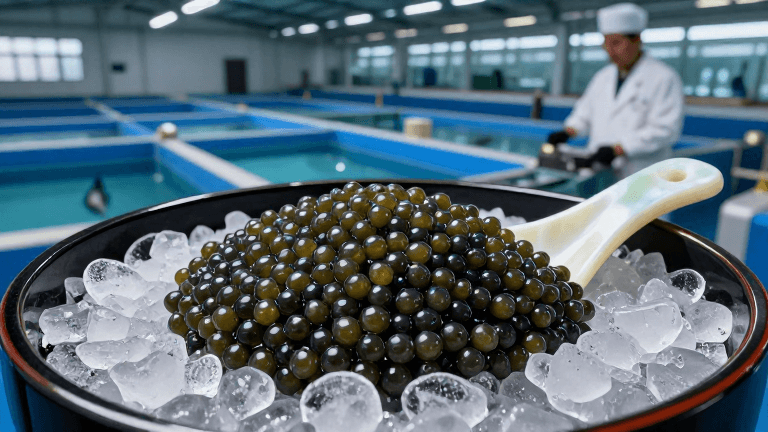
Everyone, did you know? Caviar has always been regarded as a representative of Russian culinary culture, but China has quietly produced two-thirds of the world's caviar, which is somewhat embarrassing for them. Most ordinary people have no idea about this and think we're just an NPC in this regard, but chefs in the industry all know about Chinese caviar. We've also been quite low-key: the packaging of top-tier caviar contains no Chinese elements at all, like a powerful king who is too humble to use his own name. Of course, being low-key has its benefits—it avoids negative impressions among Western consumers about Chinese food safety and quality, and keeps the stick of trade protectionism from falling on our heads as much as possible.
But a recent Financial Times article called out domestic caviar: China's trade surplus has exceeded one trillion dollars, and Europe is anxious, fearing China is engaging in below-cost dumping. Yet even in high-end luxury goods like caviar, China is actually dominating the market—and not just caviar: wagyu, salmon, black truffles—whatever you foreigners like to eat, we can sell it. The industrial logic is the same: with China's technology and scale, we can do anything in large quantities and at affordable prices. Moreover, in high-end food we're not undercutting prices, so you can't call it dumping—this is called filling a market gap. Foreign consumers are quite happy anyway, thanking China in the comments.
Caviar is equivalent to bird's nest and abalone in Western cuisine, a must-have at high-end banquets. Back in Persia, this stuff was food for the poor—sturgeon roe rubbed with salt and eaten as meat. After spreading to Tsarist Russia, it became a court dish; after the October Revolution, a group of exiled White Russian nobles brought it to Paris. Although French cuisine uses it a lot now, the raw materials are still most prized from Russia and Iran. TASS recently dished out some gossip: during US-Russia negotiations, US special envoy Witkoff bought 24 boxes of red salmon caviar from the Far East and hand-delivered them to the Trumpster—the Russians were delighted and are preparing to launch a Trump-branded version. That's of course not on the same level as the black gold caviar we served Obama at the G20, but it's still quite prestigious.
Domestically produced large-grain black gold caviar, a high-end ingredient, doesn't even need cooking—simple preparation brings out an upper-class flavor. I think the taste is okay, but foreigners really love it, and they're very particular: you have to use a mother-of-pearl spoon, place it on the web between thumb and forefinger to warm it with body heat for a few seconds, then savor it drop by drop—that's the authentic way.
But demand is simply too great. The most authentic Caspian wild sturgeon was fished into endangered status, so starting 20 years ago, most countries around the world banned the import and export of wild sturgeon caviar. With wild fishing banned, farming is the only option. Farming is much harder than fishing: the cycle is too long—sturgeon can live to 100, mature sexually very late, and you have to feed a fish weighing hundreds of jin for over a decade before it produces quality roe, making costs too high; water quality requirements and environmental control thresholds are also very high; the technique of extracting roe from live fish is complex and has to be learned. These reasons deterred most countries, and only the national team of the great foodie empire kept tirelessly tackling the challenges—with the global wild caviar supply collapsing, how could China's fisheries strategy easily let such a huge market opportunity slip away?
So the Chinese Academy of Fishery Sciences under the Ministry of Agriculture used Heilongjiang's Kaluga sturgeon and Amur sturgeon for crossbreeding: Kaluga has large eggs and good quality, Amur sturgeon matures early and carries large quantities of eggs—combining the two overcame the problems of late maturity and low yield in sturgeon, and the breed suitable for farming was named 'Sturgeon Dragon No. 1.' Its roe is amber and brown-gray, with a creamy, nutty flavor and a delicate texture; because our water quality is better than the polluted environments of wild fish, the conclusion from blind tastings by gourmets is that the taste is actually purer than wild Caspian caviar. It supplies various three-star Michelin restaurants, Oscar banquets, and Singapore Airlines and Lufthansa first class—the best caviar is no longer Russian.
Then a large amount of private capital entered sturgeon farming. Benefiting from the national team's technical support, resource guarantees, and industrial chain extension, they completed large-scale production from laboratory to production line, turning an industry that didn't exist in China at all in 2000 into today's world leader. Part of China's caviar is labeled Made in China and goes to the affordable market for volume; part goes to France and Italy for OEM labeling—once labeled, it sells for more, adapting to global consumption trends—downgrading where needed, upgrading where needed. And China's domestic market has also started eating caviar, with total demand growing 10% per year.
Although China's food culture is profound, it has long lingered outside the modern high-end food market, just like the relationship between Made in China and the luxury goods industry. When Chinese companies march into this field, every country will protect its own high-value-added foods: Japan restricts the outflow of wagyu genes, and caviar producers in Europe and America are also seeking government protection. Will Europe follow the US next year in raising import tariffs on Chinese food? Who knows. But domestic demand will certainly become increasingly crucial—let everyone have a taste and turn it into a traditional Chinese delicacy, and then there'll be nothing to worry about in the long run.