Plasma Wall Breaker: A Domestic Wonder That Surpasses the US?
11/3/2026#等离子球磨机#工业技术#材料科学#产业观察
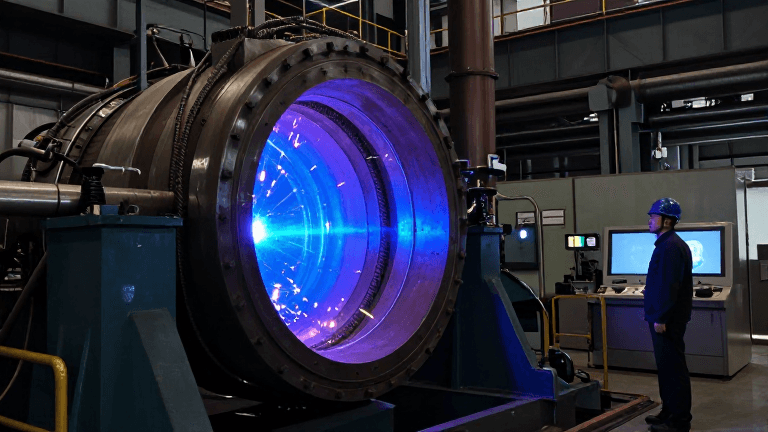
Today is another day of dancing in my knowledge blind spot. The news says that China has released the world's first 100-liter continuous production plasma ball mill, and the hype is high, saying it can help China surpass the United States technologically—from super powder to super power. Isn't this just a high-speed blender for grinding powder? What's so impressive about that?
After looking into it, I realized I was just speculating. It turns out that the main event in high-tech competition is the intense competition in materials, and the more intense it gets, the more tedious it becomes: how to grind materials finer, purer, and more active? You could also call it a blender, but it's not breaking down soybean cell walls; it's breaking down the atomic lattice of matter, efficiently producing high-performance, highly active nano powders. This grinding technology developed in tandem with industrialization and urbanization. Initially, like building construction and furnace repair requiring ground cement, and thermal power generation requiring pulverized coal, heavy-duty ball mills were used, with large drums carrying balls to crush materials. Later, it gradually became more refined, such as ceramic coatings needing to be ground more evenly and finely, using planetary ball mills that rely on centrifugal force and high-speed impact to break things down. In this race, Germany has already pushed mechanical force to its limit. If you want to grind finer, you can only increase speed or extend time, but below the micron level, the conversion rate of mechanical energy is already very low, and the excess energy becomes heat, causing the material to agglomerate, deteriorate, or be contaminated by the grinding media. So, just as it is difficult to improve the thermal efficiency of internal combustion engines, traditional ball milling has also hit a ceiling. Moreover, the West has accumulated too many patents in structural design, wear-resistant liners, bearing life, and precision transmission. If China continues to stubbornly pursue this path, there may not be much hope.
At this point, Professor Zhu Min from South China University of Technology came with over twenty years of research results and made a curve overtaking, proposing the concept of plasma-assisted ball milling for the first time in the world. What's so impressive about him? Just as electric motors overtook internal combustion engines, it essentially introduces a new energy dimension, bypassing the inefficiency of traditional mechanical energy. Plasma is the fourth state of matter besides solid, liquid, and gas. Essentially, it is a highly charged gas, where gas is ionized under high energy, and electrons detach from atomic nuclei. For example, lightning in nature. So while others grind by hitting walnuts with a hammer, we apply high voltage. On the basis of traditional ball mill mechanical impact, it uses a high-voltage electric field to generate plasma, instantly bombarding the material surface with high energy, stripping electrons from the material surface without raising the temperature, inducing lattice distortion, making the material surface very "hungry" and prone to chemical reactions. Many powders in traditional methods require high-temperature melting at thousands of degrees, and some super alloys are difficult to melt and mix even when heated. Now we can directly force them out at room temperature using plasma.
What's another benefit? This technology can effectively prevent materials from clumping together at the nanoscale. Of course, for industrial production, the biggest advantage is definitely high efficiency, ten times that of traditional ball milling. What used to take a hundred hours to grind can now be done in less than ten hours. This machine was released by Huaxin Materials Innovation, incubated by South China University of Technology. Previously, it went from 500 milliliters, 1.5 liters, 3 liters, 20 liters, step by step. The most common customer feedback was that it wasn't enough, so increase the capacity. So this time, the 100-liter configuration can operate continuously 24 hours a day, meaning it's not just a few hundred milliliters of output in a lab, but can support large-scale production.
What needs this? Their press release was low-key, mentioning batteries, electronics, mineral processing, but the applications are actually very broad. The core application should be energy storage materials, such as magnesium-based hydrogen storage materials, silicon-carbon anode materials for lithium batteries and sodium batteries. There are even more high-performance powders used in the military: nano aluminum powder needed for rocket propellants, titanium alloy powder needed for hypersonic fighters, nickel-based superalloy powder for engine turbine blades, special ceramic powder for stealth aircraft radar-absorbing coatings—all rely on plasma ball milling. As for the United States, in the production of high-end weapons such as next-generation radars, heavy stealth aircraft, and hypersonic weapons, it has already fallen behind China. One reason is powder processing, which is a key bottleneck. Although the United States is strong in materials science, it does not have plasma-assisted ball milling technology. China not only has this technology but has also rapidly iterated into industrial mass production.
If China can completely crush the United States in cost, scale, and production efficiency of high-performance powders, that would be continuously optimizing the manufacturing gene from upstream raw materials. Then, chain reactions in strategic industries such as semiconductors, aerospace, and new energy could reshape national strength. This is what American think tanks fear most: falling behind in competition in industries that are key to national strength.