Why Does Chinese Scientific Research Inspire Both Hatred and Fear in the West?
9/15/2026#科技创新#研发投入#产业升级#中美竞争
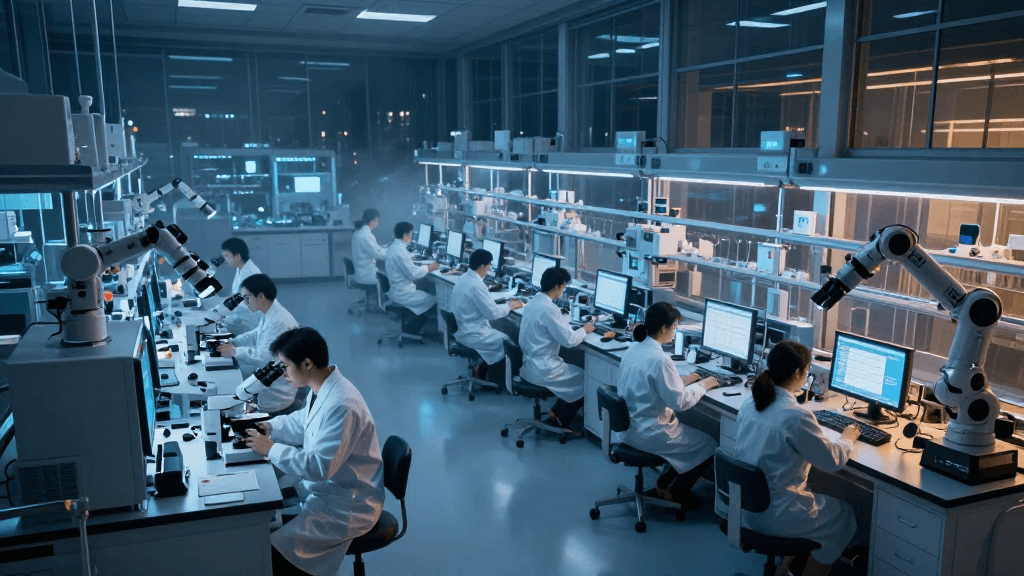
Ladies and gentlemen, ladies and gentlemen, ladies and gentlemen! A new phenomenon has emerged in the world. Tell me, why does China always seem to have the upper hand in the global race for innovation? Western elites simply cannot fathom it. The Financial Times has provided the answer: China has transformed from the “world’s factory” into the “world’s laboratory.” The data speaks for itself: in 2007, China’s R&D spending was only one-third of that of the United States. By 2023, China had poured $781 billion into R&D, nearly matching the U.S.’s $823 billion. When cost advantages are factored in, the actual intensity of investment has already surpassed that of the United States. R&D relies on the government, businesses, and universities. If we look solely at government spending, China’s investment had already surpassed that of the U.S. a decade ago. Now that Trump is cutting research funding, the gap is widening even further.
Businesses and universities are also narrowing the gap. When it comes to technology, it ultimately boils down to human capital. China produces 50,000 doctoral graduates in science and engineering each year, compared to 34,000 in the United States. China can devote nearly 50% more top-tier talent to scientific research than the United States. Therefore, as long as you do not believe that the Chinese people are inherently unintelligent, this quantitative change will inevitably lead to a qualitative change. Building on this foundation is the guidance of national strategy. China’s scientific research rarely involves the kind of free-wheeling, purely theoretical work; instead, it focuses on two areas: first, serving industrial transformation; and second, reducing external dependence and pursuing self-reliance and control. Applications in the real economy that lie at the intersection of these two areas are given the highest priority. Examples include advanced materials, alternative fuels, and power equipment, among others.
A few days ago, I mentioned that the U.S. wants to adopt a “nationwide system” for scientific research—but in fact, China has been doing this for a long time. Geopolitical pressures have forced China to sharpen its strategic focus. To put it simply, the will of the state has determined that China must defeat the U.S. Therefore, even if it means cutting welfare benefits for one or two generations, the country is committed to funding scientific research in strategic fields. Government, business, and academia are working together to achieve technological autonomy and control, thereby reducing vulnerability. They are collaborating to address the challenges faced by the real economy and to pursue a dominant position in global supply chains.
The next phase will be completely different from the decentralized model of the past. Capital investment will be more concentrated and tilted toward key industries, reducing spending on local industrial expansion and minimizing opportunities for industrial waste and corruption. The first tranche of 51.4 billion yuan from the Special Fund for the Development of Strategic Emerging Industries in Central State-Owned Enterprises, launched in late October, clearly illustrates this trend. The 15th Five-Year Plan states very clearly that the technological revolution and great-power rivalry are intertwined, and competition in new technologies and emerging sectors is becoming increasingly fierce. Therefore, we must fully leverage the advantages of the national mobilization system for emerging industries to gain strategic initiative in intense international competition. These are the exact words.
Thus, we have long-term policy guidance, stable funding, a comprehensive industrial ecosystem, an extremely rapid pace of commercialization, and a steady pipeline of talent. To Western political elites, this is a terrifying Eastern scientific behemoth. But for Western business elites, it’s a different story. In the past, foreign companies flocked to set up factories in China because our labor was cheap and environmental damage went unchecked. Now they are scrambling to establish R&D centers here because China is not only a hub for manufacturing products in emerging fields but also a center for knowledge production. There are 150,000 corporate research institutions, 5 million researchers, and an explosive growth in patent strength.
Of course, many criticize the quality of China’s scientific research, claiming that patents are inflated and designed solely to raise capital. I recall an expert in the electronics and information technology sector once saying that 90% of domestic patents are junk. But you have to “follow the money,” right? Capital is willing to put real money on the line to build R&D centers. The number of foreign-funded R&D centers in Shanghai has risen from 440 in 2018 to 631 this year, while Beijing has 279. Many foreign companies also believe they must collaborate with China on R&D to survive. Take automakers, for example: to transition to new energy vehicles and integrate autonomous driving technology, they have to come to China. Even a company like France’s Renault—even if it doesn’t sell cars here and is solely focused on R&D—still has to come. Capital understands very clearly that without the responsiveness of China’s supply chain, their technology is essentially just a lab specimen—it cannot be mass-produced.
Take Volkswagen, for example: it developed driver-assistance technology in Hefei in just a year and a half—a project that would take at least four years in Germany. Another example is Sweden’s Scania, which is developing autonomous driving technology for trucks. Previously, they spent a long time trying to get it right in Sweden and the U.S. without success, but now, with R&D in China, it’s been implemented within a year. So even though the West is divided into several camps—debating whether to compete with, cooperate with, or coexist with China—and even though most of them still have reservations, wondering whether this state-led development model is truly effective, it does seem to be working. Conversely, they’re also worried about whether the traditional American approach—where innovation is led by research institutions and safeguarded by a democratic system—still works. If it doesn’t, can it be replaced by China’s “whole-of-nation” model? But that would mean defeating China on its own turf—is that really feasible?