The U.S.'s Governance Capabilities: From Road Construction to Record-Keeping—How Good Can It Really Be?
9/14/2026#美国国家能力#卡内基#五年规划#治理效能#深层国家
Everyone, I recently came across a report from the Carnegie Endowment for International Peace that questions the United States’ state capacity—arguing that governing a country is just like building roads: both are forms of infrastructure development. If the tangible aspects are in such a state of disrepair, how well can the abstract aspects possibly be? The report offers a very simple definition of state capacity: whether the government can do what its citizens ask it to do. In our country, scholars such as Hu Angang and Wang Shaoguang define it more as “the capacity to realize the will of the state.” They began emphasizing the importance of state capacity back in the 1990s, at a time when many were idolizing the Western model of the separation of powers. At that time, the intellectual sphere was flooded with narratives advocating for the “complete Westernization of politics.” While liberals believed the state was too powerful, these two argued that the state was too weak—particularly that its fiscal revenue-raising capacity needed to be strengthened, as this is the foundation of all state capacity.
About a decade ago, we had a collaborative project with the Berggruen Institute, and I helped Professor Hu translate his article into English for publication in the U.S. edition of *The Huffington Post*. I recall that he particularly emphasized how the Five-Year Plan embodies state capacity over a temporal span. Time really does fly—it hasn’t even taken the proverbial “30 years for the tide to turn”; in just a few short years, the United States has already begun to reflect on state capacity and governance effectiveness. I suspect that in a few years, the debate will shift from “democracy versus authoritarianism” to “good governance versus bad governance.” Returning to the Carnegie report, it states that in governments with strong state capacity, citizens don’t need to prod the government—it will formulate plans and make preparations on its own. Officials are more at ease, policy options are plentiful, and laws and regulations are enforced smoothly. I wonder who they had in mind when they wrote that.
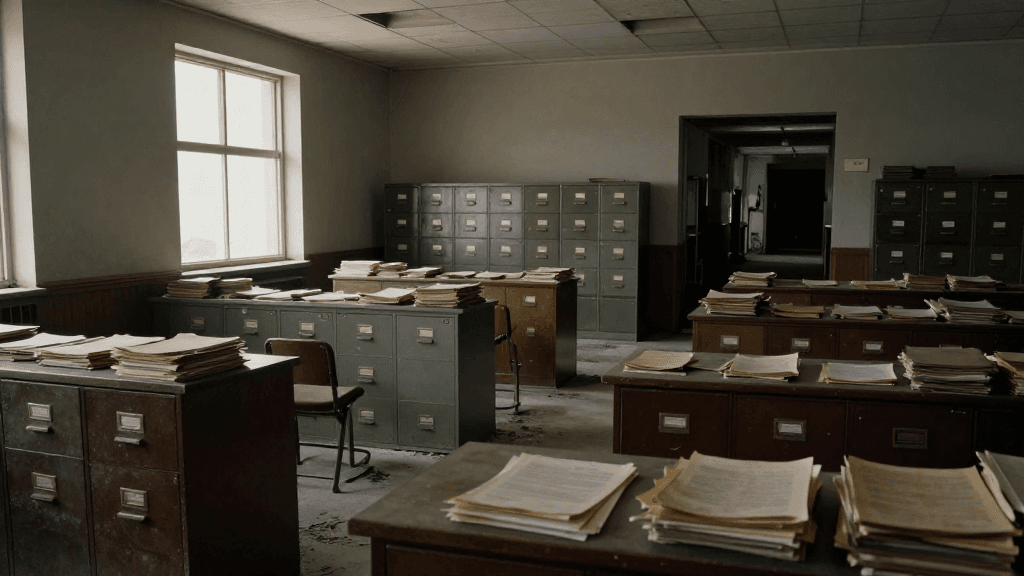
Then the report launches into self-criticism, lambasting everything from disaster relief to health insurance—all the usual complaints. However, there’s one story that’s quite interesting—did you know? The approval process for U.S. federal employees applying for retirement benefits takes a month. You submit a paper form to your agency’s HR department, and then all agencies across the country mail them to a disused limestone mine in Pennsylvania—a mine that was converted into an archives center 60 years ago, containing 26,000 filing cabinets and 400 million sheets of paper. With so many documents, everything is processed manually by a dedicated team of 600 people. How long an application form spends in circulation there may even depend on the speed of the mine’s elevator.
This antiquated system is merely a microcosm—not an exception. Take, for example, the dreaded Internal Revenue Service (IRS), which began upgrading its IT systems in the 1990s. Thirty-five years later, it is still using architecture from the 1960s. Or consider the Biden administration’s push for electric vehicles and its promise to build charging stations—in four years, they’ve built a total of seven, which is less than what’s available in our own neighborhood. If you were to ask our Dean Zhang, he’d say that the U.S. presidential administration’s governance capabilities don’t even measure up to those of the elderly residents on our neighborhood committee.
When Trump took office, he made a key promise to voters: to dismantle the “deep state.” The “Dark Enlightenment” faction refers to this as “demolishing the cathedral”—a goal conservatives had actually set long ago. In Musk’s hands, this means wielding a sledgehammer and scrawling “Demolish” everywhere, cutting agencies, streamlining processes, and centralizing power in the name of modernization and lean governance. However, in Carnegie’s view, this approach has not only failed to improve government efficiency but has actually exacerbated the original problems—thereby further hollowing out the body of the nation and leaving the U.S. even less capable, so that many things remain mere talk and cannot be accomplished. Many people think the U.S. is being underhanded by saying one thing and doing another, but in reality, sometimes it’s purely a matter of capability—it simply doesn’t have the capacity, you see? The report identifies this as the true problem facing the U.S.: it’s not that its military might is insufficient, nor that it lacks financial resources, but rather that the government is unable to carry out the actions it decides to take.
The report divides the decline of U.S. national capacity into three parts: “invisibility,” “neglect,” and “deconstruction.”
“Invisibility” refers to the government acting as a hands-off administrator, avoiding direct responsibility for public projects and relying on contractors for everything—essentially “outsourcing governance.” Why has it come to this? The report provides a chart showing that from the 1960s to the present, U.S. federal real spending (represented by the dark blue line) has increased by 500%, and the workload has grown fivefold; however, the number of federal civilian employees has risen by only 26%. Logically, the workforce should have numbered in the tens of millions, but it rose only from 2.3 million to 2.9 million last year; after a year of turmoil under Trump, this year’s figure has fallen to its lowest level in 60 years. The government has a great many public duties but does not employ civil servants—which means the federal government delegates the work to contractors. Consequently, the scope of government officials’ responsibilities has shifted: they are no longer accountable for the execution of specific tasks, but only for verifying whether contractors are in compliance. An obsessive focus on “compliance” is a terrifying phenomenon; it can lead to the creation of countless redundant metrics—all hard indicators that are easy to quantify and evaluate—which is far simpler than actually assessing whether a project is effective. So government agencies focus on this, and the compliance system grows ever larger—it’s not just compliance, but compliance for compliance’s sake. The people Musk and others want to lay off are, in fact, this very group. Speaking of which, I’m reminded of another scholar, Paul Light, who has long studied this outsourcing system. He says there are nine times as many government contract workers as there are civil servants, forming a massive “shadow workforce”—which may be viewed as the “deep state,” leading to their jobs being cut.
The second aspect is called “neglect,” which essentially means that bureaucrats have become disconnected from the people. The government does not deal directly with the public but relies on contractors, resulting in highly fragmented public services—forget about “one-stop online services”; it’s a victory just to get anything done at all. That’s why everyone blames the government for being inefficient. In such an opaque environment, if the government seeks to allocate budget funds to strengthen capacity-building, and the public has no idea where the money will go, they naturally won’t support it. However, support isn’t necessarily guaranteed even within the government itself, especially when the two parties are evenly matched and constantly undermining each other—if the ruling party wants to strengthen its capacity, the opposition will look down on it. What if the government becomes more capable and its approval ratings rise? Do I still want to rise to power? Furthermore, some areas are actually in dire need of capacity building, but the public isn’t aware of it—take diplomacy, for example: The U.S. State Department has long been in a state where it lacks both funding and personnel, and Trump even slashed its budget by 20%. Diplomats need to work on long-term efforts to do their jobs well, so the public tends to feel that no matter how much money is poured in, there are no visible results—might as well just scrap the whole thing. If the problems can’t be solved, at least get rid of some of the people who can’t solve them.
Finally, there’s the “deconstruction” coming from within the political elite itself. As an establishment think tank, Carnegie has been relatively polite in criticizing populists for rolling back progress and causing disruption: people like Bannon have been plotting to dismantle government institutions for a long time, and with Trump’s second term, they were finally able to carry out their plans. From foreign aid to financial regulation, from diplomacy to education, these sectors are all undergoing drastic staff cuts. It would be one thing if the U.S. were simply playing by itself behind closed doors, but the key issue is that its diplomatic sector is being treated the same way—among the 25 major government agencies facing cuts, five are directly related to foreign affairs. For example, USAID was completely dismantled: 95% of its staff was laid off, its office buildings were shut down, its servers were removed, and its office systems were locked down.
The result of this approach is, first, a weakening of the U.S.’s own analytical and planning capabilities, and second, a disruption of its relations with other countries. The U.S. is now playing by itself behind closed doors; at the diplomatic level, many international cooperation projects have seen participants drop off mid-conversation, and processes have ground to a halt—international issues are inherently complex, and staff cuts only slow them down further, causing constant delays.
The report concludes: We must still prioritize the civil service. We need to safeguard the rights of public employees through laws and regulations, ensuring their job security so they can focus on professional duties—rather than living in constant fear for their livelihoods and constantly thinking about changing careers. Reduce the burden: Civil servants must focus on practical, substantive work—not waste resources and energy on internal red tape just to prove they’re being productive. The current compliance burden is simply too heavy. Data is essential: Government agencies must regularly publish clear and reliable data so that the public can understand the connection between the state’s capabilities and the results it delivers. Transparency is key: Outsourcing, after all, lacks transparency. Single-bid contracts are very common, and with little competition among contractors, the results may not necessarily be better than if the government had handled them itself—and it also makes the public feel that the government is absent.
These are sound recommendations, but they’re phrased in a neutral and measured tone. Might the private owners of so many contractors with vested interests take offense? How serious could the consequences be? I simply don’t know.