Let's talk about the war and food at the Shangyi Long Restaurant.
9/17/2026#龙餐馆#好好吃饭#中东#粮食安全
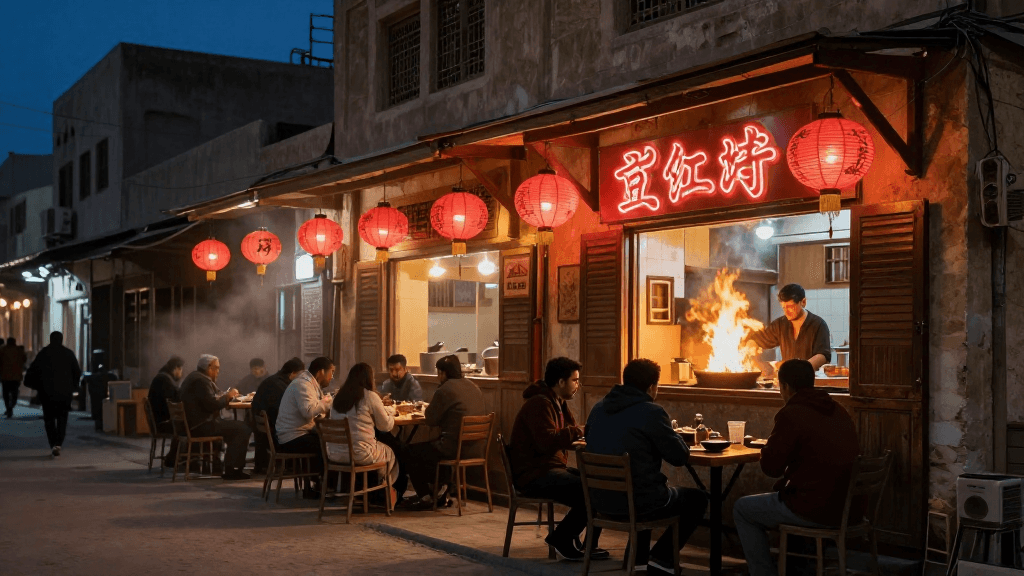
As soon as I stepped out of the Dragon Restaurant, I took a quick look around. What is the “Dragon Restaurant”? For viewers of *The Great Food Empire*, that’s crystal clear. Behind all the diverse cuisines lies a simple message: “Eat well”—this embodies the Chinese way of life and the worldview that underpins it. There’s no preaching, nor any condescending judgment. However, some netizens took issue with this, saying that this anti-war film didn’t deliver a harsh blow to imperialism or harshly criticize the aggressors—instead, it seemed to gloss over the issues. But I think that’s actually a good thing. The chef isn’t “Wolf Warrior”; he’s just a speck of dust in the flow of time. Caught in the conflict zone between Western and Middle Eastern civilizations, he does his best to navigate the waters with tact and flexibility. Although he finds himself on the brink of death, he maintains a distinctly Chinese approach—bringing small moments of joy to those around him by treating them to good food. This warmth for the stomach may only cast a faint glow upon those around him, yet it wards off the most brutal alienation that war inflicts upon the human heart and preserves the very essence of what it means to be human. And that is enough.
As for the bigger question—how we defend peace—that’s something we should ponder beyond the confines of the film. Overall, I think it’s fantastic and highly recommend it—especially to those with some understanding of contemporary Middle Eastern history, Western intervention, and the rise of extremist organizations. Much of what’s depicted in the film is based on real events; it tells the story of the Iraq War and the American occupation following Saddam’s downfall. At that time, there were more than a few Chinese-run restaurants and farms operating in Baghdad. Some did business with American soldiers, while others provided shelter to innocent local civilians. This story is largely based on real-life events. On the Iraqi side, Old Zha was a Ba’ath Party cadre under Saddam’s father. At the time, the entire state apparatus was dismantled by the U.S., and a large number of military-trained individuals, still armed, took up the path of resistance. U.S. prisons carried out indiscriminate arrests, resulting in numerous miscarriages of justice. It was precisely in these dark dungeons that religious zeal and democratic resistance converged. The future leader of ISIS, al-Baghdadi, was released from Abu Ghraib Prison in Baghdad. This prison was indeed the scene of a prison break, just like in the movies, with at least 500 inmates escaping. ISIS also did train children to become so-called “indoctrinators” for the caliphate, participating in terrorist attacks. It can be said that, aside from the bright spot of Chinese cuisine, the entire film is very somber.
But what I’d like to focus on is the simple value China has exported: “Eat Well.” Our ancestors taught that agriculture is the foundation of the nation and that food is the cornerstone of governance; only by safeguarding the food supply can a regime remain stable. As the saying goes, “A ruler regards the people as heaven, and the people regard food as heaven.” Only those who truly understand this principle can succeed. Any political order must prioritize and adapt to the fundamental issue of food. The Saddam Hussein regime, having been subject to long-term sanctions, relied heavily on a food rationing system. While this system severely harmed agriculture, it was nonetheless an efficient distribution mechanism. However, after U.S. forces entered the country, they implemented market-oriented reforms on this planned-economy-style rationing system, which quickly led to chaotic looting and systemic collapse. Consequently, large-scale imports of cheap relief grain were introduced, further devastating local agriculture. Furthermore, during the decade from 2003 to 2013, the U.S. implemented seed patent laws in Iraq, allowing international seed companies to apply for seed patents locally while prohibiting farmers from saving and reproducing seeds. This created business opportunities for agribusinesses like Monsanto and Cargill. Iraqi farmers had no choice but to purchase seeds from these companies. These patented seeds, however, were bred to yield decreasing harvests year after year; once the patent term expired, farmers were forced to purchase new seeds, or else face legal action for growing unpatented crops. This dealt a significant blow to Iraqi agriculture.
Iraqi agriculture has undergone a series of transformations—from the land distribution to landlords during the British colonial era, to the establishment of intensive farms under Saddam Hussein, to the impact of shock therapy during the U.S. occupation—compounded by neighboring countries’ construction of large dams upstream in the Mesopotamian River basin. These factors have continuously led to rural decline and land degradation. Not only has Iraq transformed from a self-sufficient nation into a food-importing country, but urban population concentration has also trapped it in a vicious cycle of resource scarcity. Who, exactly, is stepping up to help Iraq? It is this farm-to-table restaurant that ensures you have a proper meal. A couple of days ago, I read an article by an Iraqi scholar arguing that we must learn from China’s rural revitalization model and not neglect agriculture, rural areas, and farmers. This is because many parts of the Middle East face issues of uneven development, with major cities effectively becoming quasi-states that absorb a disproportionate share of public resources, placing immense pressure on people’s livelihoods. So what should be done? We must learn from China’s green rural revitalization model. Indeed, in recent years, Iraqi officials, scientists, and engineers have been coming to China to study agriculture—especially in the northwest—to learn from China’s experience in land management, saline-alkali land remediation, desertification control, water conservation and irrigation, rural poverty alleviation, and other aspects of sustainable development. Moreover, China’s approach—which combines smallholder farming cooperatives with modern technology—is better suited to Iraq’s national conditions than the Western model of mechanized large-scale farms. Two years ago, Iraq temporarily banned rice cultivation due to water shortages, but now they have begun growing a hybrid rice variety called “Giri,” which is a cross between the local “Hupo” rice and Asian “Jasmine” rice. The development of this drought-resistant new variety draws heavily on the scientific approach pioneered by Yuan Longping’s team, which harnesses hybrid vigor. Furthermore, while Iraq previously relied on flood irrigation for rice cultivation, it has now not only adopted the principles of water-saving irrigation but also introduced drought-resistant, high-yield crops, thereby stabilizing the supply of staple grains and vegetables. Furthermore, through seawater nitrogenation projects and the use of kelp to remove nitrogen from industrial wastewater, China has helped Iraq conserve its precious freshwater resources for public welfare and agriculture.
In China’s international cooperation efforts, Iraq is by no means a unique case. In fact, many developing countries threatened by climate change have established in-depth agricultural partnerships with us, spanning Southeast Asia, Central Asia, Latin America, the Middle East, and Africa. For example, our “Green Super Rice” is an agricultural project specifically designed for promotion in resource-poor regions. which was previously focused mainly on Asia but has now expanded into African countries, helping populous nations like Nigeria safeguard food security. We introduced the “2-1” rice variety—a high-yielding, disease-resistant strain that thrives in any soil—which has tripled yields per mu under the same growing conditions and has been warmly welcomed by local farmers. Our agricultural experts not only conduct research and development on the ground but also carry out extension work. They have crossed the thresholds of government offices and the boundaries of village fields countless times to achieve the results we see today. China’s growing international influence in the agricultural sector has made the United States increasingly uneasy. Consequently, the U.S. is also ramping up its efforts in Southern countries, though it places greater emphasis on free-market competition in agriculture, improving agricultural technology and financing channels, and ensuring the smooth flow of trade in cash crops. In short, they treat agriculture as a business. But once business becomes market fundamentalism, it pays no heed to the basic needs of ordinary people—whether you can put food on the table is none of its concern.
Haven’t the U.S. been in an uproar recently, claiming that college students can barely afford to eat, with a single “Barriso” taco selling for $20? Instead of addressing rising prices or asking why the cost of living is so high, America’s so-called “honorable officials” ask why you don’t just eat instant noodles. If you complain about prices, they claim you’re pushing for “precise planning,” "Drag the communists out!" Meanwhile, China’s cooperation with them is less about controlling the market and more about increasing production and boosting food self-sufficiency—this is almost a contest of civilizations. Whether rich or poor, no matter where in the world you go, there is one simple notion: whether you’re American or Iraqi, as long as you’re a human being, you should strive for a modest life and eat well.