Democracy and the Republic in Garbage Time
9/17/2026#美国大选#特朗普#MAGA#民粹主义
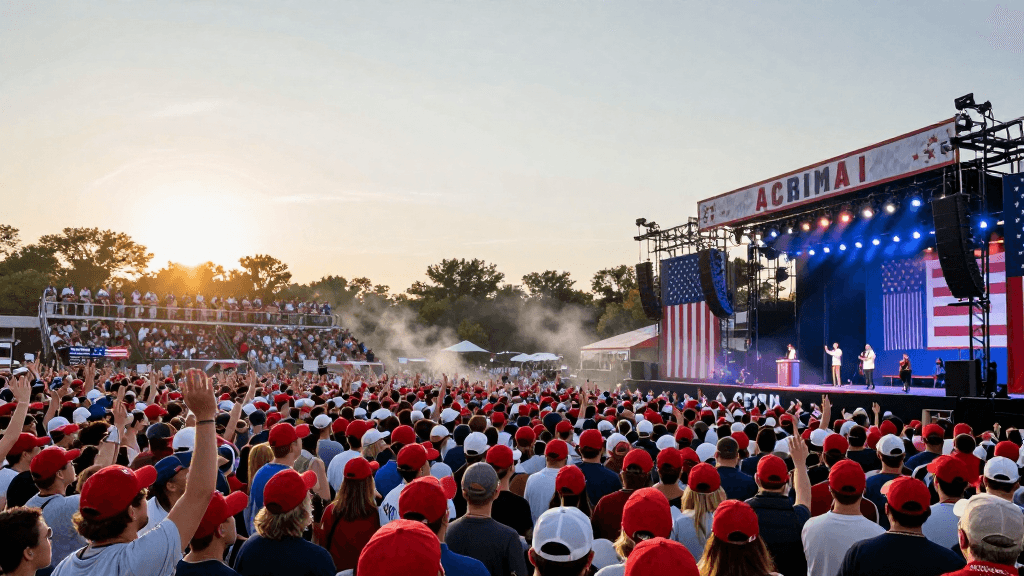
Folks, the U.S. presidential election has long since entered garbage time—there’s nothing left to say. Think about it: I’ve done so many episodes—have I ever mentioned Harris? Not once. She’s not worth mentioning; it’s as if she doesn’t even exist. Maybe her luck really is just that bad. The Democratic Party’s problem isn’t just a national issue—it’s a global one. It’s like the U.S. election: there used to be some suspense—you didn’t know whether Dong Wang or Sleep King had the better game—but after just one debate, the suspense vanished, leaving only a kindergarten-style competition.
“You did great; you know all the answers.” ” That kind of praise really sounds like the verbal encouragement a kindergarten teacher gives a student. In this contest, it seems there are only “reverse winners” and no losers. But the contest has now entered garbage time. No matter how fierce Dong Wang is, don’t count on him beating a zombie. Now, the pressure has shifted to within the party.
There are deep divisions within the Democratic Party; big donors and the media are exerting pressure behind the scenes to push Harris onto the stage. They used to say, “The nation has a prison, and San Francisco has a treasure.” Now, however, they’re saying that the best way for Biden to serve the country is to retire—some have even publicly suggested making arrangements for his final affairs. If he’s elected but can’t actually serve, why not just switch leaders? In my opinion, it doesn’t matter who they choose—they won’t win anyway. Given the Democratic Party’s current state, if Biden weren’t senile, he’d already be their best candidate. With just this handful of people—including that “Ha-ha-Harris”—being pushed into the spotlight, do you really think he can win? He can’t. He doesn’t have what it takes.
The Republicans are breaking through on the right with populism—it’s a bit ugly, but it works. At least they still speak like normal people. The Democrats, on the other hand, are terminally ill, obsessed with a bizarre, hypocritical ideology that ordinary Americans can’t even understand. They’re completely out of touch with the people; the only way they can stay in the game is by cheating. Either they erase the sidelines and let immigrants take the field, or they rig the referees to give the opponent a stroke. How is this game even played?
Trump’s choice of Vance was a blunder—Vance is even more qualified than Trump himself and can only serve to solidify the base. But I actually think this is an adaptation to the times. Look at Harris: even though she clearly had the chance to attract voters with a centrist approach, she still chose a running mate who’s even further to the left than she is. It’s become difficult to win over new voters, so she must mobilize her existing base and unite her own camp. But you can’t unite people with rational policies—it all comes down to who’s better at incitement.
When it comes to “Agetprop,” the U.S. and indeed the entire Western world—where capitalism reigns supreme—are blind spots for the left. I simply can’t wrap my head around it. That’s why left-wing populists like Sanders face a glass ceiling; until they shatter it, they’ll always remain little more than mascots. Consequently, in all Western nations, only the right wing is truly capable of uniting various factions and consolidating overall strength through populism. The right-wing worldview is simple: the strong prey on the weak, and there are no hidden agendas in the open. Those who adhere to this terrifying logic are bound to clash. Vance’s strategy aligns more closely with America’s inevitable choice: pulling back from Ukraine and the Middle East, setting sights on China, and striking hard.
The results of the U.S. presidential election will be revealed in two months. Where America heads afterward will fundamentally reshape the global landscape of the 21st century. The answer for this era isn’t important; what matters is how we seek that answer. The first clue is that photograph of Trump, blood trickling from the corner of his mouth, shouting defiantly after the assassination attempt. What I see is the death throes of the old system. Imagine an unsustainable system: under militarism, the elite constantly engage in “outward spiral”—plundering resources, bringing in immigrants, and driving down labor costs—which leads to “inward spiral” among the common people. A traitor from the ranks of the privileged elite, who became the voice of the common people, was assassinated by the elite.
I’m not referring to the fortunate Dong Wang, but to the ill-fated Caesar. History does not repeat itself, but it does follow a similar trajectory. At this very moment, the situation mirrors that of Bishbik two thousand years ago. The strategy articulated by Vance is the inevitable choice for the United States: to withdraw its forces from Ukraine and the Middle East, aim at China, and strike hard.
Faced with figures like Dong Wang, Vance, Bannon, Yaven, Rand, and Thiel, the establishment within the “cathedral of globalization” would label them all as fascists. Just as, in the eyes of the Zhao Song dynasty, figures like Zhao Gai, Song Jiang, Gongsun Sheng, and Cai Jin were all deemed rebels. The rebels argue: “Your emperor bears the surname Song, and so does my brother. But while you can be emperor, my brother cannot—we rebel only against the royal family, not against the imperial system itself.” Therefore, the order we seek to establish is one of external conquest and internal oppression, with a rigid hierarchical structure.
What exactly is the future of human civilization? Does breaking the old order mean establishing a new one, or returning to an even older one? At least in the eyes of some, it means absolutizing and organically integrating political units. Externally, they envision a community where the lines between factions in the game are blurred; internally, they maintain a rigid hierarchy with a clear division of labor, ready at any moment to purge what they find undesirable. For here, they are the Brahmins who possess the highest wisdom, guiding the power-holding aristocracy and ruling over the ignorant masses.