China’s Perspective on the Political Landscape in Latin America: The Rise of the Right and the U.S.-China Rivalry
9/18/2026#中美博弈#拉美#地缘政治#右翼浪潮
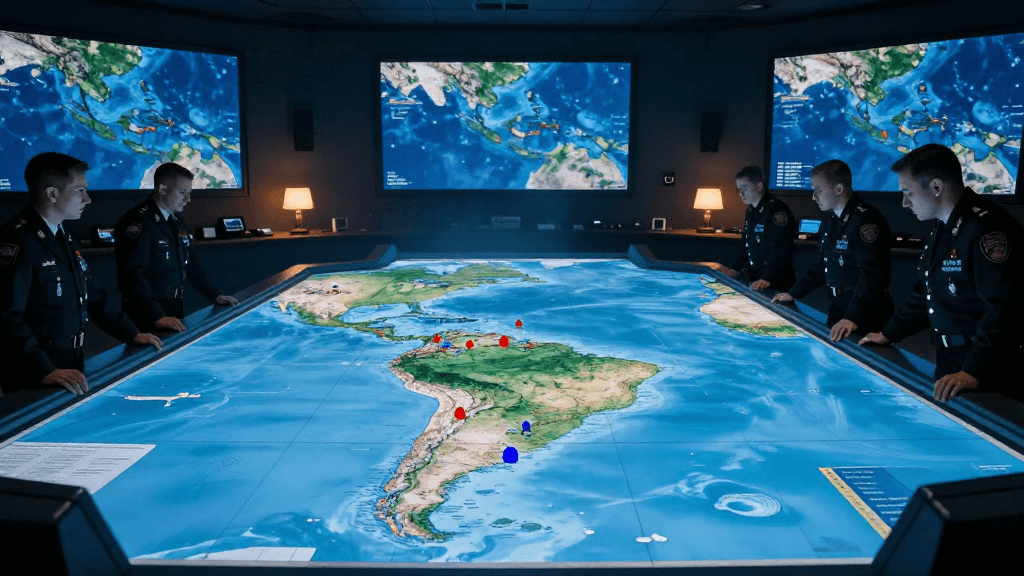
Everyone, let’s talk about the latest developments in Latin America today. To be honest, this is quite a spectacle. Traditionally, Latin America has been divided between the left, which is pro-China, and the right, which is pro-U.S. Recently, the U.S. has been meddling in Latin America as if it were its own backyard, and Trump has once again become the leader of the global right wing. What does this mean for us in China?
We responded swiftly to the strategy put forward by the U.S. by releasing the “Policy Document on Latin America and the Caribbean.” The document states that major shifts are accelerating, the international balance of power is undergoing profound adjustments, and unilateral bullying undermines international peace and security. Just a few days later, a seemingly routine report on CCTV mentioned a pilot observation and exchange activity on the deployment of military equipment across the entire armed forces. A map depicting the military exercises caught the attention of international media because it was focused on the Gulf of Mexico and the Caribbean Sea. Isn’t this exactly like “Hearing Thunder in the Silence”? What does this indicate? We’ve made thorough preparations in the military sphere—we’re not to be taken lightly.
The political landscape in Latin America has recently undergone a major shift, with right-wing forces clearly on the rise. The proportion of the population supporting the right has reached an all-time high. Chávez had just ushered in the first “pink wave,” but now Maduro’s regime faces U.S. attempts at subversion. Many right-wing governments, on the other hand, are unconcerned by U.S. hegemonic actions and are even offering support. Left-wing opponents may find themselves struggling to survive this year, which means that Latin America’s second “pink wave” is receding, and a right-wing conservative “blue wave” is making a comeback.
Last October, Argentina held midterm elections—seen as a referendum on Milei’s radical reforms—and the result was a landslide victory for Milei. This year, he aims to establish himself as a leader of the right-wing alliance by organizing a Latin American right-wing summit. Chile’s new president, Castells—an admirer of Pinochet—immediately traveled to Argentina to align with Milei following his election victory. In Bolivia, Paz defeated the socialist left, which had been in power for 20 years; in Ecuador, Novoa is pursuing a pro-U.S. policy; and in Honduras, the new president, Asfora, a right-wing politician, may fulfill his campaign promise to sever diplomatic ties with us and reestablish relations with Taiwan; and El Salvador’s President Bukele, whose domestic approval rating ranks among the highest in the world, remains firmly in power. The remaining Latin American countries will all hold general elections this year—Costa Rica, Colombia, Peru, Haiti, and Brazil—and the outcomes of these elections may ultimately drive the region further to the right.
With the collective decline of the Latin American left and the rise of pro-U.S. right-wing governments on one hand, and the U.S. tightening its grip on the Western Hemisphere on the other—does this signal a mutual convergence leading to the demise of the CP? No—convergence is possible, but its demise is not inevitable. In reality, Latin America faces many intractable political and governance issues. Voters, driven by disappointment, swing back and forth between left and right, believing that it makes no difference who takes office. On the U.S. side, the Trump administration has explicitly stated its intent to restore American dominance in the Western Hemisphere and block competitors from outside the region—a blatantly aggressive stance that essentially amounts to a “cut each other down to size” strategy. Many interpret this as a strategy of “advancing to retreat,” but since the U.S. has shown no intention of withdrawing from Asia, we cannot afford to be blindly optimistic. Consequently, the policy document on Latin America and the Caribbean released by China has been viewed by many regional policy analysts as an effort to extend the struggle to the U.S.’s doorstep, and the contest for regional influence between China and the U.S. is likely to escalate further.
On the economic and trade front, we have been continuously deepening our ties with Latin America. We are now the top trading partner for most Latin American countries, with more than 20 countries participating in the Belt and Road Initiative, and our economies are highly complementary. Latin America provides natural resources—such as donkey meat and beef from Argentina, and iron ore and soybeans from Brazil—while China supplies industrial manufactured goods, such as electric vehicles, and invests in infrastructure projects, such as the subway system in Mexico and hydroelectric power plants in Ecuador. China-Latin America economic and trade relations have shifted from basic commodity trade to technical cooperation in areas such as power, telecommunications, and aerospace—something the United States views with great apprehension.
Our deep-space station in Argentina has been repeatedly obstructed by Milei, as the U.S. considers it a quasi-military facility. Similarly, regarding the Qiankai Deep-Water Port in Peru—where COSCO Shipping holds a 60% stake and exclusive operating rights—the U.S. fears it could become a supply station for the Chinese Navy. On the issue of Venezuela, even when China offers only diplomatic support, there are significant differences of opinion within U.S. strategic circles. One view holds that China’s support is merely lip service, which will cause Latin American countries to weigh the potential security risks of drawing closer to China; another view holds that U.S. bullying will backfire, pushing Latin America toward China. In reality, the U.S. fears losing control of Panama even more, which is why it is currently engaged in a power struggle with us over terminal operating rights—because this is not only a trade corridor but also a vital passage for the U.S. Navy connecting the two oceans. U.S. scholars have even listed numerous scenarios in which China could blockade Panama—ranging from orchestrating various accidents or sabotaging ships to block the passage, to even having anti-U.S. forces lay mines.
Overall, the U.S. is extremely sensitive to the security situation in the Caribbean region of Latin America. Any assertive move on our part can make them restless. CCTV’s report on the wargame simulations is, in fact, sending a strong signal. On December 19, 20 units from military forces and academies across the armed forces conducted wargame demonstrations on various subjects in Xuchang. The focus was actually on the independently developed intelligent wargame system, but some of the footage set people’s nerves on edge. The demonstrations featured the waters near Taiwan, Russia, and Japan, but what unnerved the U.S. most were the computer screens of experts from the University of Chinese Academy of Sciences. One screen displayed a map of the Americas dotted with blue and red markers: the Red Force was locked in a standoff with the Blue Force in the Caribbean, while the Blue Force was establishing a second line of defense in Texas. Many international media outlets picked up on this image, interpreting it as a sign that the Chinese military’s strategic outlook is shifting.
Although China’s relations with Latin America are primarily economic and trade-based—with virtually no military involvement—why would China’s wargame maps target the U.S. “backyard” and simulate a conflict there? Does this indicate that China harbors ambitions for global hegemony? There are various speculations internationally, but this actually appears more like a step forward in strategic understanding. After all, the U.S. has conducted countless war games simulating a conflict across the Taiwan Strait—it hasn’t explicitly stated that war is inevitable, but in reality, it is piling geopolitical pressure around China’s periphery. Including the regions surrounding the United States in our war games indicates that these areas have entered our long-term strategic perspective as objects of strategic study. This essentially reflects China’s ongoing development of a strategic understanding commensurate with its status as a major power. The U.S. will have to get used to this, just as we have gotten used to the Pentagon’s war games. So I think Australia’s ABC News summed it up well; although its stance differs from ours, it noted that China is not actively seeking war, but is demonstrating to the world that it is fully prepared.