Ten Days of Field Research in Europe: Berlin's Anxiety and the Undercurrents of St. Petersburg
10/30/2026#欧洲调研#圣彼得堡论坛#地缘观察#国际观察
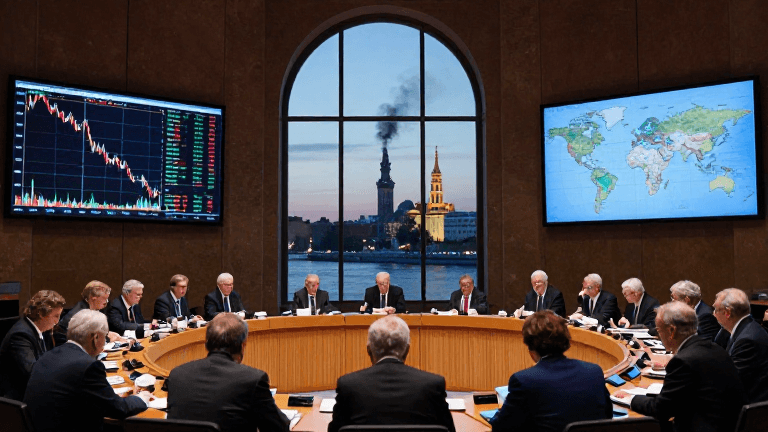
Everyone, first let me share something from our institute. My colleague Liu Dian just got back from Germany and Russia. I didn't go this time; he went with our Dean Zhang Weiwei. I've been too busy this month, and next I'm going to Eastern Europe—Romania and Serbia. I don't know if I can get the Romanian visa, so I specifically went to ask him about what he saw and heard during this ten-day research trip. Their itinerary was: the first few days in Berlin, Germany, and the last few days in St. Petersburg, Russia.
In Berlin, they attended a seminar at the Schiller Institute. The Schiller Institute holds an international conference every year. This conference is actually a gathering of many of the institute's founder Ms. LaRouche's old friends from the European and American left, getting together to chat. The feeling was that these old comrades have a very, very deep worry about war: for example, our current era is very, very similar to 100 years ago, especially the period between World War I and World War II in the 1920s and 1930s—many atmospheres, basic conditions, the international situation, and economic cycles are all very, very similar. They said Germany's military spending is now expanding rapidly, which brings them deep concern, because they are relatively old and have lived through the entire long history of World War II and the Cold War last century, so they are very worried about the current international situation. But there was also a very interesting aspect of this meeting: there were relatively few young people attending. They now feel that many young people in Germany are completely depoliticized, and they are indifferent to such a moment of turbulent change. What could be felt in the venue was the concern of some left-wing elites on the European continent about the future, and a forward-looking prediction of a new round of crisis in global capitalism. In particular, one participant this time was a former UN Under-Secretary-General, an Italian sociologist. At this meeting he clearly warned that we may soon see a new round of financial crisis—unprecedented and the largest in scale. The impact of this financial crisis on human society and humanity's future may far exceed the 2008 financial crisis, and even far exceed the Great Depression in the first half of the last century. Then on the spot he even solicited votes, saying that this year he would also run for UN Secretary-General and hoping everyone present would vote for him. Worried at first, then starting to canvass for votes—full of comic effect, so it felt very interesting.
After landing in St. Petersburg, there was nothing much on the first day. On the morning of the second day, everyone probably saw the news too: on the morning of the opening of the St. Petersburg Economic Forum, Ukraine sent drones to attack an oil infrastructure facility near the docks in St. Petersburg. That day they were actually not far from there, and on the road in the distance they saw a patch of firelight and black smoke. At first they thought it was a fire, and only later heard local people explain that it was drones. And perhaps unlike the feeling of watching news in China, the local friends were accustomed to it. This kind of drone attack, internet outages, and occasionally some disasters in individual places basically do not have much impact on normal local life order and urban traffic order. The biggest impression was the constant internet outages.
At this forum Liu Dian probably watched quite a few sessions. The three that impressed him most: one was because he does research related to artificial intelligence, so he was very interested—the situation of artificial intelligence in Russia. Heads of Yandex and several local large-model companies came out. Yandex and several others are actually all Russian; you can understand them as Russia's state-owned version of Baidu. After this conflict, a large number of Western digital services withdrew from the Russian market. This time when they went, they used Yandex for maps and even for ride-hailing. There is also a local model called Alisa, based on Russian-language corpora. But the overall level of their speeches, including their understanding of artificial intelligence, showed an obvious rupture: some speakers seemed unable to distinguish clearly between intelligence and digitalization, but in China this is actually basic common sense in the industry. Of course, some of the discussions on technology were clearly still at the frontline level, but the overall feeling was somewhat like what he heard from friends in China's internet and AI circles about artificial intelligence six or seven years ago—that is, a generational gap of several years has already appeared. This was a very obvious feeling.
The second feeling was this: Russia now attaches great importance—more accurately, it is not that it attaches importance to everything about artificial intelligence, but that it attaches importance to building internet scenarios related to e-commerce. In particular, one sub-forum talked about how Russia's e-commerce is now developing very fast. The figure he remembered being mentioned was that one platform's transaction volume exceeded 2 billion US dollars. Chinese viewers may find this ordinary when they hear it—which of our platforms doesn't have transactions of one or two trillion RMB? Converted into US dollars, that's also hundreds of billions. But the Russian market is clearly still in a stage of gradual cultivation and development. Talking with many local friends, they said that Russia now attaches great importance to supporting the e-commerce economy. What has emerged? Especially in St. Petersburg, delivery riders earn more than academicians. Now if you run relatively diligently, as a delivery rider you can earn about 400,000 rubles a month, equivalent to 40,000 RMB, which is actually quite considerable; and they seem to earn about 20 RMB per order, sometimes more, sometimes less. Although this market is still in the process of cultivation, there may still be special opportunities in certain professions, though it is also very hard work. At the time he thought, if China's entire ecosystem of delivery riders were brought into competition in Russia, would this market develop faster? Of course, he hasn't done much research in this field; he was just throwing out a brick to attract jade.
What our institute mainly participated in was a session on finance, which he also found very interesting. Because he didn't bring cash to Russia this time, he went to bank branches—he visited seven bank branches—and because he is a Chinese citizen without the relevant procedures, it was very difficult to handle financial services. Russia actually has quite a lot of bank card payments and digital payments, but now due to SWIFT sanctions, if you don't open a local bank account, many services cannot be used with mainland Chinese bank cards and accounts. One intuitive feeling is that Russia's financial services still need improvement. And many of the problems Russia is encountering now may also be encountered by many countries around the world in the future—for example, disruptions in global capital markets, changes in the situation caused by sanctions among major countries triggered by sanctions involving major countries, and the complex institutional responses involved. Then our Dean Zhang Weiwei also talked about three structural changes in finance. The first structural change is a structural change in energy finance: non-dollar-settled energy transactions are now expanding rapidly in the global financial system. The second structural change is that Hong Kong has surpassed Switzerland to become the world's largest wealth management center by scale. This is easy to understand: once the Middle East is at war, many of the Middle East's old money and new money may originally have been placed in Switzerland or Singapore, but as everyone can see, whether Switzerland or Singapore, they still cannot escape the American factor behind them; precisely because mainland China, the Chinese government, and China's independent sovereignty are supporting them behind the scenes, after this Middle East crisis a large amount of money poured into Hong Kong. In previous years the main trend seemed to be moving money out of Hong Kong; the money moved out in previous years has now moved back this year—very interesting. The third change is a change in regulatory finance. In particular, Russia is highly focused this time on China's financial blocking order and anti-sanctions blocking order. Because we can see that to some extent this is like a close-quarters encounter in financial warfare: after the blocking order, it is as if this round of US financial sanctions against specific companies only took effect within the US legal system and foreign systems, while correspondingly for all domestic financial institutions, this time China stood firm—services continued as they should, because the state provided the legal effect of sovereign blocking. Russia is very, very focused on this and thinks China has done something of breakthrough significance this time. Of course, this matter can be discussed in more depth later when there is a chance.
Finally, there was Putin's speech, which they listened to on site. Everyone may have seen all kinds of information online. The most interesting part was that at the beginning, Putin talked about responding to Zelensky's so-called peace talks. He actually made some very vivid metaphors on site. In popular Chinese terms, this was a staged-collision-style peace talk. You see, when talking about peace talks, on one side Russia was holding a big conference, while on the other side Ukrainian drones were giving off black smoke—black smoke before the conference, which in Chinese terms is an unlucky sign, a way of putting eye drops. He directly characterized it: Zelensky, first, has not shown any real sincerity in talks; second, he is actually engaging in empty talk. And indeed, from an objective perspective, at this stage between Ukraine and Russia, globally, including the two countries involved, there have been many signs of easing recently, but indeed the real conditions for reaching peace talks are not yet in place in many preliminary foundational conditions. The second feeling was also very interesting: if you do a word-frequency analysis—because the St. Petersburg Economic Forum mainly discusses economic development—when talking about economic development, the word he heard most frequently in Putin's entire text was sovereignty—the sovereignty and economic security of Russia as a whole. In particular, this time he spoke very highly of technological sovereignty: how to build all the things we mentioned earlier—artificial intelligence, e-commerce, the digital economy, and so on—within a framework of complete sovereignty. And very interestingly, he also talked about how the Russian version should accelerate the construction of a domestic grand circulation. Finally, there was one detail not much reported in the news: this was the first time in nearly ten years that the United States sent a high-level delegation to the St. Petersburg Economic Forum. Throughout the conference, Putin was clearly mocking and needling, constantly talking about the current situation in Russia, including Russia-Ukraine and the global situation. And the most memorable point was what he said when responding to a reporter's question: he said that in the past, when we talked about international rules, the WTO, globalization, and the so-called rules-based international order, there was a precondition—that Western developed countries dominated economically and in market competitiveness. But we can see that the share of these former so-called Western developed countries in the global economy is rapidly declining. Rapid decline has led to a situation: in the past, when they were strong, they talked to you about rules and standards; now that they have become weaker and their market competitiveness is insufficient, they have started talking to you about protectionism, sanctions, and barriers. The series of sovereign and protective policies they once criticized developing countries for, they are now picking back up one by one, including the United States now beginning to learn China's entire industrial policy system. Including recently in this circle—those of us working on artificial intelligence—what we are most focused on is that the United States is now discussing how to take state equity stakes in several AI companies: last year it took a stake in Intel; originally it was said that money under the Chips and Science Act was subsidies, and in the end it was said that this was not subsidy money but money for state equity, and with a swoosh it was converted into US shares. Now there is discussion that the United States wants to take equity stakes in these artificial intelligence companies. So the world pattern is undergoing a change—thirty years east of the river, thirty years west of the river—a huge role reversal has taken place. I think these are quite interesting observations.