Aluminum Corporation of China: The Green Long March and the Battle in the Coal Sea
10/30/2026#中国铝业#绿色转型#电解铝#产业观察
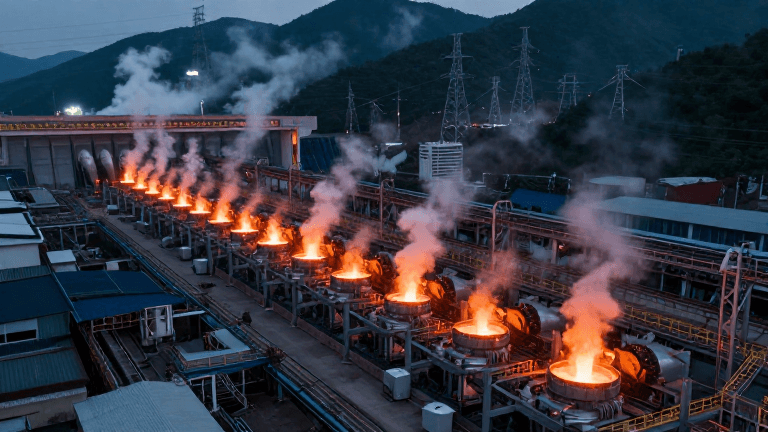
Everyone, today I'd like to talk with you about China's aluminum industry. Our aluminum industry is the world's leader, accounting for 60% of global aluminum output—more than anyone else. But being the leader doesn't mean we're invulnerable; we have two Achilles' heels: carbon footprint anxiety and ore dependence. Right now, we happen to be at a qualitative turning point of a technological revolution. The Financial Times used "green long march" to describe this revolution, but it only tells part of the story: as industry migrates from north to south, our northern revolutionary base areas have not only not been lost, but have actually grown stronger. This story is too big, so let's start with aluminum production and give a brief account.
Our aluminum industry is divided into two parts: first, refining bauxite into alumina through the Bayer process; second, electrolyzing alumina into metallic aluminum through the Hall-Héroult process. Although we have very little bauxite, only 2% of global reserves, and it is low grade, relying on imports from Guinea and Australia, we have still grasped the dominant position in midstream alumina refining and downstream electrolytic aluminum smelting, producing 60% of the world's alumina and electrolytic aluminum. This is not something ordinary players can match.
Aluminum is a high-carbon, high-pollution, high-energy-consumption industry. Our two major weaknesses are coal power and red mud. Coal power is mainly used in the electrolytic aluminum stage, which consumes a shocking amount of electricity. 45 million tons of electrolytic aluminum consumes more than 60 billion kWh of electricity each year, accounting for 6% of national electricity consumption. In the past, the energy structure relied on coal power, so the aluminum industry naturally clustered near coal and bauxite resources, pursuing integrated coal-power-aluminum operations. Around 2010, the aluminum belt of Shandong, Henan, Shanxi, Inner Mongolia, and Xinjiang accounted for more than 70% of national capacity. But coal power is not cheap, uses a lot of water, and has high carbon emissions. This year the EU carbon border tariff has officially taken effect, further increasing the cost of coal-powered aluminum. So the transition to green power and achieving carbon peaking by 2030 and carbon neutrality by 2060 are extremely urgent.
The obvious solution is to move smelting capacity to places richer in clean energy. In 2017 the government capped electrolytic aluminum output at 45.5 million tons. In 2018 it also stipulated that no new smelting capacity could be built in northern regions with severe air pollution, effectively encouraging the transfer of northern smelting capacity to the south. Output is fixed: however much is built in the south, that much is shut down in the north. As a result, Yunnan became the core recipient, mainly using hydropower—and of course some wind and solar power—to build a green aluminum valley. For example, the private aluminum giant Hongqiao Group moved its electrolytic aluminum capacity from Shandong to Yunnan, investing 45.6 billion yuan to build two smelters. The second was completed this year, equivalent to placing 60% of its capacity in Yunnan, with annual output reaching 4 million tons—equivalent to the entire capacity of North America. After the relocation, carbon emissions can be reduced by two-thirds, meeting strict environmental standards and strengthening the export competitiveness of low-carbon products.
But here's the problem: if all capacity goes south, won't the north become hollowed out? How can that work? So the midstream alumina stage still has to stay in the north, because this step requires heat, and combined heat and power in the north is cheaper; industrial waste heat and cheap steam from coal play a key role. This leads to the red mud problem. Bauxite is a heavy and dirty raw material. Producing one ton of electrolytic aluminum requires two tons of alumina and roughly four to five tons of bauxite. The slag left after alumina refining settles into strongly alkaline industrial waste called red mud. Southern bauxite is higher grade, so the red mud problem is less serious; northern ore has higher silica content, produces more red mud, and poses severe environmental challenges.
Last year there was a piece of news many people missed: the French-Swiss joint venture IB2 cooperated with local Senze Energy in Liulin County, a coal-producing area in Shanxi, on a comprehensive utilization project for bauxite residue. It took only ten months from groundbreaking to production—what speed! It also tried to build plants in Europe and America, but after six years it is still stuck at the research stage. Shanxi needs economic transformation, so it hit it off with IB2. What is IB2's strength? China's high-silica bauxite is unsuitable for the traditional Bayer process, excessively consumes reagents, loses aluminum, and produces large amounts of red mud, so northern diaspore has not been fully utilized. IB2 pre-treats bauxite through pre-desilication, allowing many depleted zombie mines to be reused and reducing import dependence. It has also achieved an important breakthrough in red mud treatment: first, through pre-desilication, red mud volume can be reduced by 60%; the remainder can efficiently extract metals such as gallium, scandium, and vanadium, and the ore structure is improved for hydrometallurgical processing; rare earth elements have also been extracted from red mud. Most of the remaining solid material is neutral and can be recycled as building material, no longer an environmental burden. For Shanxi, this is a bridge to industrial upgrading: from simply mining coal and smelting aluminum, while retaining or even expanding the midstream alumina industry, it adds extraction of critical metals.
Against the backdrop of coal power, turning waste mines into high-value resources, China will in the future form an industrial pattern of "alumina refining in the north, electrolytic aluminum smelting in the south"—a situation that should be said to be far more optimistic than the one the Red Army faced during the Long March.