What kind of Chinese company can make the US want to ban it but not dare to kill it?
10/30/2026#药明康德#生物医药#中美博弈#产业观察
Biopharmaceuticals are an important battleground in America's struggle with us, and the United States is desperately trying to maintain its technological dominance. At the end of last year, it introduced the BIOSECURE Act, prohibiting U.S. companies from cooperating with so-called companies of concern. But after much wrangling, in the end it did not name names or specify exactly who was to be isolated, because America's biopharmaceutical industry depends on China: if there were a true decoupling, American cancer patients would have no way to survive, causing a massive public health disaster. The United States has already realized that its dependence on Chinese pharmaceutical companies constitutes the pharmaceutical world's Strait of Hormuz.
I read an article in China Talk titled "The WuXi Empire," which uses the WuXi group as an example to explain why the United States cannot simply take the approach it used to ban Huawei and apply it directly to Chinese pharmaceutical companies. In fact, WuXi AppTec, as the elephant in the room, was indeed explicitly targeted when the BIOSECURE Act was being drafted. This is quite strange: the WuXi group does contract research, and WuXi AppTec and WuXi Biologics are respectively the third- and fifth-largest institutions in this market, while all the others from first to tenth come from Western countries. The United States clearly has so many alternative choices, so why is it so afraid of the WuXi group?
Because it is embedded in every aspect of the biopharmaceutical industrial chain, with business covering a quarter of all U.S. drug research and development; cutting off its cooperation with American pharmaceutical companies outright would be equivalent to choking its own people. The article argues that it is difficult for the United States to find a winning approach, and the difficulty lies in the fact that companies like the WuXi group rely on overall strength rather than monopolizing any single link in the supply chain. When the so-called chokepoint simply does not exist, the United States has no way to grasp the pharmaceutical world's TSMC, and suppressing Chinese pharmaceutical companies becomes out of the question. Even more frightening is that China's pharmaceutical R&D investment is far lower than that of Europe and the United States; this advantage was not built by throwing money at it, so restricting Chinese companies' funding will not undermine their advantage either. Thus the article reaches a conclusion: since the United States cannot stop China or dominate the entire industrial chain, the question it should consider should become which areas can be conceded to China, and which capabilities the United States can lose without dying.
So how does this article derive these conclusions from WuXi AppTec? First, we must return to the historical background of WuXi AppTec's rise. Around 2000, the cost of developing new drugs for Western pharmaceutical companies exploded, and they had to outsource R&D; it just so happened that China had a large number of chemistry and engineering talents who could take on this work, and China's WTO accession greatly improved intellectual property protection. The right timing, right place, and right people produced WuXi AppTec: from the very beginning it was an enterprise that adopted international standards, served Western clients, and oriented itself toward the global market. Over the years, its expansion timing has been very accurate, and it rode the east wind of domestic reform of the drug review and approval system; encouragement of innovative drugs and R&D allowed it to establish a firm foothold in the market. Then large-scale R&D outsourcing led to deep integration of the Chinese and American biopharmaceutical systems, making them difficult to sever. To this day, WuXi AppTec, already in the crosshairs of the U.S. government, still derives two-thirds of its revenue from American clients.
This cooperation model is very special. WuXi AppTec is different from Western pharmaceutical companies: it does not directly develop drugs, but provides an integrated contract research, development, and manufacturing (CRDMO) platform. Traditionally, a drug at different stages cooperates with different contractors, but WuXi AppTec directly does everything for you across the entire process, from molecular discovery to commercial mass production. You only need to provide it with an idea, and it is responsible for realizing it, equivalent to providing a full set of infrastructure for drug development. This model is extremely attractive to Western pharmaceutical companies: long-term stability, low cost, and high efficiency.
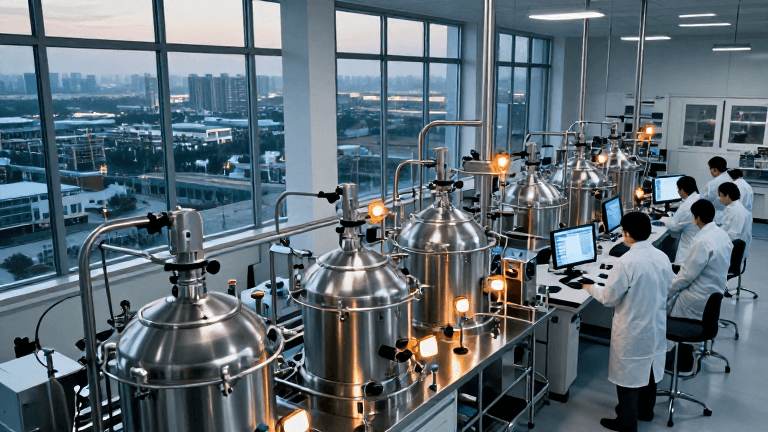
In this kind of cooperation, WuXi AppTec has found its own advantage—not some secret recipe, but the highly integrated optimization of all technologies, processes, tools, and solutions across the entire field of drug R&D, which you can plug into and use at any time. Its platform resources and technologies are something most biopharmaceutical companies simply do not possess themselves. For example, in scale production, when general biopharmaceutical companies speak of scale production, they mean making bioreactors bigger, with a single tank of 20,000 liters; WuXi AppTec does not do that. It uses a bunch of small single-use reactors, in the same batch, so that if any engineering problem occurs anywhere, there will be no cross-contamination. Such cutting-edge technology and scale production facilities are actually very costly; for example, WuXi Biologics' factory in Singapore cost enormous sums, but China's domestic industrial policies are favorable to it, offsetting part of the financial pressure. More importantly, China has an extremely dense pool of science and engineering talent, which means the cost of high-tech teams is only half that in the West or even lower, so it can maintain larger team sizes, shorten project cycles, and overcome technical difficulties. In addition, China's biologics supply chain is rapidly localizing, making raw material procurement more convenient, the supply chain more resilient, faster, and lower in cost.
Have you noticed? WuXi AppTec's success does not come from any secret history of technology, but from its structure and positioning, as well as the high-efficiency, low-cost industrial ecosystem that China has built over decades. Precisely because companies like WuXi AppTec are so comprehensive, the United States cannot ask pharmaceutical companies to outsource R&D to allied countries in order to squeeze out Chinese companies: cooperating with India offers low wages and no shortage of talent, but India mainly does small-molecule generic drugs and is not very good at biologics; cooperating with South Korea, biologics are strong, but small molecules and chemistry services are not. In short, you cannot find anyone who can fully replace WuXi AppTec, and WuXi AppTec is only one company; China also has pharmaceutical service companies such as Asymchem and Porton. This case tells us that industrial offense and defense do not necessarily unfold around technological bottlenecks; breaking through a single point or desperately defending a certain barrier is not necessarily the only way to play. Sometimes a comprehensive and balanced business structure is instead a more resilient advantage. It is easy to shake a mountain, but hard to shake an industrial chain.