What kind of "environmental terrorist attack" could force Berlin into a state of disaster?
10/30/2026#柏林纵火#生态恐怖主义#能源转型#国际观察
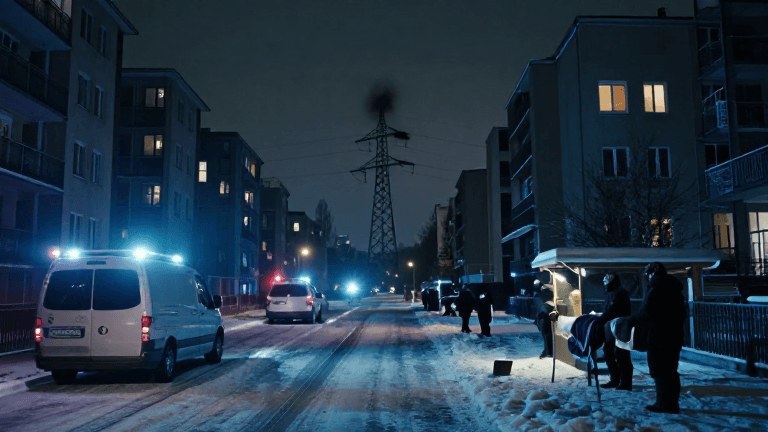
Everyone, there's been another arson attack in Berlin. On January 3rd, a high-voltage transmission line next to a power plant was burned down, cutting off electricity to 50,000 households and 2,200 shops or businesses. Although power was later partially restored, 35,000 households still had to wait until January 8th for their electricity to come back—nearly a week without power. A household blackout doesn't just mean lights out; your shower, cooking, internet, and phone calls are all affected. Worst of all, there's no heating, because the district water-heating system in this area is driven by electric pumps. I checked—over the past couple of days Berlin's high temperature has been around zero degrees, and it's still snowing. The Berlin city government declared a state of disaster that same day, mobilized the Bundeswehr for emergency response and disaster relief, distributed supplies, set up warming centers, and used military generators to keep critical public facilities like nursing homes and hospitals running.
How did it catch fire? Someone came forward and admitted: we did it. The group is called Vulkan Gruppe (Volcano Group), and they released a long open letter titled "Cutting Off the Ruling Class." They said this arson was an act of self-defense, an act for the public good, an act of international solidarity. They oppose fossil fuels, oppose tech companies, oppose AI's energy demands, oppose the imperialist lifestyle. They particularly emphasized that the current economic system is driven by fossil fuels, has an insatiable greed for energy—especially with AI's electricity demand growing exponentially—so this greed must be destroyed at its source, and we must reclaim our right to affluent tech companies—this is all typical leftist rhetoric. They said they didn't intentionally harm ordinary people but were targeting the rich: this area, Lichtfeld West, is Berlin's most classic old-money villa district, where Prussian military aristocracy have lived since the 19th century, and many German diplomatic elites live there now; if less affluent residents were affected, they are very sorry.
The police classified it as an far-left, anarchist, anti-fascist organization. But because of its high degree of anonymity and sophisticated anti-tracking methods, all that's known is that it operates in Berlin and Brandenburg, and its structure remains unclear to this day. Vulkan Gruppe has been committing crimes since 2011: initially sabotaging rail transit, causing railway disruptions; in 2018 it destroyed power lines in another wealthy district, cutting power to 6,500 households and 400 companies; in 2020 it began committing arson, burning a cable shaft at an IT research institution to oppose digital discipline and mass surveillance; in 2024, it set fire to the high-voltage lines of Tesla's Gigafactory in Brandenburg, saying it wanted to completely destroy this extremely exploitative factory, causing a full evacuation and a week-long shutdown. Musk was furious, calling Vulkan Gruppe the dumbest eco-terrorists on Earth.
Actually, this kind of eco-terrorism has existed in the West for decades. Long ago, an American mathematician sent bombs to experts across industry, academia, and research who promoted modern technology and industrial society, killing several and injuring dozens. He wrote a long open letter called "Industrial Society and Its Future," which remains hugely influential to this day with many admirers, including Luigi Mangione, who assassinated the UnitedHealthcare CEO, including Elon Musk, and many people in the MAGA circle greatly appreciate it. It's essentially about accelerating the collapse of the existing system. Vulkan Gruppe is the same—it wants to floor the accelerator, and wants Germany to go even faster, thinking this is what "no destruction, no construction" means.
So Germany's current situation is a bit awkward: the destruction has happened, but the construction hasn't fully taken hold. Europe's traditional fossil fuels have been declining, with carbon emissions from power generation halved compared to 20 years ago; Germany, as the EU's pioneer of energy transition, had nearly 60% renewable energy last year, so it really has taken big strides. And unlike those who shoot the arrow first and then draw the target, it's not sly at all: to achieve climate neutrality before 2045, it rigidly worked backward—by 2030, 80% of electricity must be green; by 2035, 100% green; coal must be completely phased out before 2038; then five years later natural gas must stop too, because LNG onshore terminal operating licenses are issued through December 31, 2043, leaving a two-year buffer period. That's how it's transitioning, setting one deadline after another, but the transition itself hasn't been smooth sailing—Great Germany has its own national conditions here.
Among green energies, wind power is the largest, concentrated in the North Sea and Denmark area, but its major electricity consumers and industrial centers are in the south in Bavaria, so north-to-south power transmission is a big scheduling problem. Residents along the high-voltage transmission lines all oppose them, endless lawsuits, and the lines simply can't be built, so when the north generates power, the grid can't handle it and has to say "pause for a bit," then go to the south and tell fossil fuel plants "hold on a little longer." All this scheduling ultimately becomes cost. And Germany isn't famous for good weather—what about windless cloudy days? Energy storage technology can't keep up with demand and can't support a massive industrial system. What about other sources? Nuclear power is gone now, natural gas is transitioning to hydrogen but commercialization is still far off; importing electricity—buying hydropower from Northern Europe, nuclear power from France—you can buy it, but that's robbing Peter to pay Paul; they need electricity at home too.
Germany's idea is good—it's aiming for a green future. If carbon taxes are inevitable, then I'll transition early, won't I have a first-mover advantage? It's just that the strides are a bit too big, and it's hurt itself, turning into a high-electricity-price country: before the transition, electricity was under 20 cents per kilowatt-hour; now it's risen to nearly 40 cents, and during the 2023 energy crisis it approached 50 cents. Expensive electricity drives away manufacturing, especially energy-intensive industries—not just traditional heavy industry, but high-tech too: AI data centers are moving to Northern Europe, semiconductors are barely retained through government subsidies, biopharmaceuticals keep only R&D while basic pharmaceuticals move abroad. Without cost advantages, deindustrialization naturally follows, hurting Germany's core competitiveness.
Actually, when I saw this news, I was thinking: if these leftist kids—it must be kids who did this—came to China and took a look at China's green transition, without those radical sharp turns, always establishing before destroying, coal as the backstop, green energy charging ahead—they might, ideologically speaking, be even less willing to accept it. But is there a possibility that it's precisely because of Germany's radical transition that the government needs to take more care of businesses—this year they still have electricity subsidies—so the cost becomes even higher, shifting more onto ordinary people, causing electricity bills to rise, creating so-called energy poverty: 6.3% of people dare not turn up the heating fully at home, dare not take hot baths, dare not turn on the oven to roast meat, just make do with dry bread, saving wherever they can, leading to an overall decline in living standards and widening the wealth gap—which is exactly what the left opposes most. But guess what—the right opposes it too, directly opposing the green transition itself. For example, AfD's core demand is to stop this expensive green experiment, dismantle garbage installations like wind and solar, and restart nuclear power for me—very spirited.
So whether it's green electricity or nuclear power, thinking with Chinese logic makes it hard to understand: why not have it all? Today I just read a report on national grid security, and one chapter discusses how to respond to various extreme situations, including severe weather. I need to digest it a bit more and then report back to everyone. Bye-bye.