I Took a Trip to Myanmar: From Rumors of 40-Degree Heat to Checkpoints Along the Way
9/27/2026#缅甸#东南亚#内战#国际观察
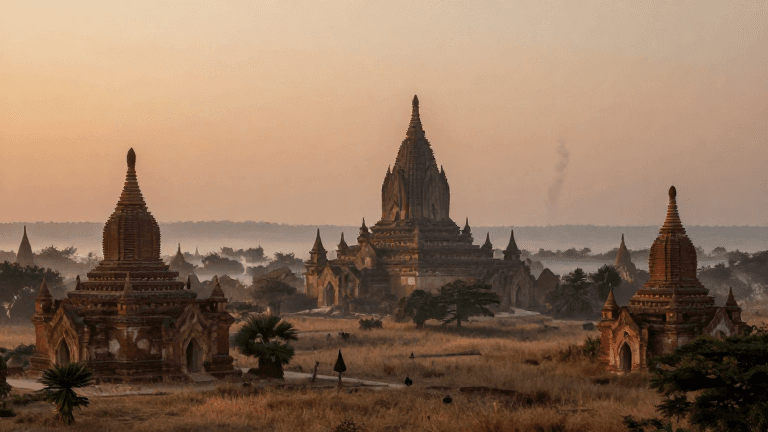
Everyone, I recently took a trip to Myanmar and just got back. The reason I haven’t posted in so long is this—there have been some changes at work, and it just so happened to coincide with this business trip.
What was I doing in Myanmar? Attending a conference. A government-affiliated think tank under the Myanmar government organized the event, hoping to learn from China how to tell their own story effectively. China has its own story, and Myanmar has its own. I went along with Professor Zhang, who was presenting on the “Chinese model,” and my role was simply to take notes during the conference—I was just tagging along. I was actually quite lucky. Myanmar is currently ruled by a military government; many countries around the world have cut off ties with it, so the country is fairly isolated—it’s not somewhere just anyone can visit. I was able to get a glimpse of it from a distance.
Before leaving, I was booking my flight and packing my bags; back in Shanghai, it was around 10 degrees. Then I checked the news from Myanmar—40 degrees! I panicked right away, thinking I might just die from the heat. Once I arrived, it actually didn’t feel that hot; my first thought was: “It’s not so bad.”
But what really made me nervous wasn’t the temperature. Myanmar is a very complex country, and the security situation is quite chaotic. The military government basically only controls the area from Yangon in the far south—along the coast—all the way up to Naypyidaw; the surrounding areas are all occupied by various ethnic armed groups. The phone scam operations you often see in the news used to be in northern Myanmar, along the China-Myanmar border. After a joint crackdown, they moved further away to Mawaddy—a bit southeast of the Thailand-Myanmar border—which is also beyond the government’s reach.
Every detail of our itinerary had been set in advance; there was no free time. I was just a tag-along—does a tag-along have any freedom? Not only that, but there was also a curfew there, so we couldn’t go out at night. I said I just wanted to go for a walk, but they told me it wasn’t safe. I asked, “How is it unsafe? Everyone’s gone home—is it actually less safe for me to be out?” Come to think of it, that made sense. In the end, I didn’t go out anyway, because they said I might get rounded up for conscription. I pointed out that I was a foreigner, but since I look like someone from Southeast Asia, I couldn’t really explain myself clearly—so I figured, never mind, I wouldn’t take that risk.
The accommodations weren’t bad, though. Coming out of Yangon Airport, it felt a lot like a British colony in Asia; the hotel we stayed at was brand-new, luxuriously decorated, and specifically designed to host VIPs—five-star standard. It was a stark contrast to the surroundings in the rest of Myanmar—but power outages still happened just the same.
It takes five or six hours to drive from Yangon to Nyei, and there were an awful lot of checkpoints along the way—barricades made of sandbags housing firing positions, each manned by about eight to ten people. There was one every few meters, with several firing positions providing cross-fire to control a single intersection. So we asked, “Is this road safe?” They replied, “To be honest with you, there was fighting just a few days ago—the rebels attacked this area just a few days ago.”
Of course, in a place like this, they have to conscript soldiers. Young people harbor resentment toward the military government; many would rather flee—even to work illegally in Thailand—than return. The exodus of young people who remain in the country is also severe; some have simply stopped attending school—not because they don’t want to, but because they feel there’s no future in education. Yangon University is Myanmar’s best university, with a particularly strong humanities program. Before the 2021 coup, 800,000 to 900,000 people registered for the college entrance exam each year; after the coup, that number plummeted to 100,000. It has slowly recovered over the past two years, reaching 200,000 this year. Where did everyone go? They simply stopped taking the exam. Because even after passing, there are no industries or job opportunities—much of production has come to a standstill.
There is a genuine shortage of supplies. Power outages occur daily, foreign exchange reserves are strained, there is a desperate need for U.S. dollars, and there are shortages of medicine, food, and grain. When natural disasters strike and relief is needed, or when farmers’ irrigation canals are flooded and require repair, these tasks simply cannot be carried out now—governance has essentially been crippled by the security situation. I feel that the people of Myanmar are living in a state of extreme hardship.
As for politics, the situation is even more complex. Myanmar’s military government is a domestic force that emphasizes sovereignty and autonomy. They previously held an election, but the military government claimed it was marred by fraud and irregularities—and under their constitution, as the protector of the nation, they have the authority to make such claims. At the time, the United States also claimed that the election was undemocratic and non-compliant. Yet after the military took over, the U.S. then argued that the takeover itself was non-compliant. Neither side is acting reasonably. Meanwhile, the previous government still exists in exile as an opposition government; even the ambassador to the United Nations remains the same person—not someone appointed by the military regime.
The gray economy, long-standing regional fiefdoms, and the shadow of external forces—these elements seem to be ever-present in Southeast Asia. On this trip to Myanmar, that is exactly the kind of country I witnessed.