Romania: Vampires and Casinos
9/27/2026#罗马尼亚#欧洲政治#示威#国际观察
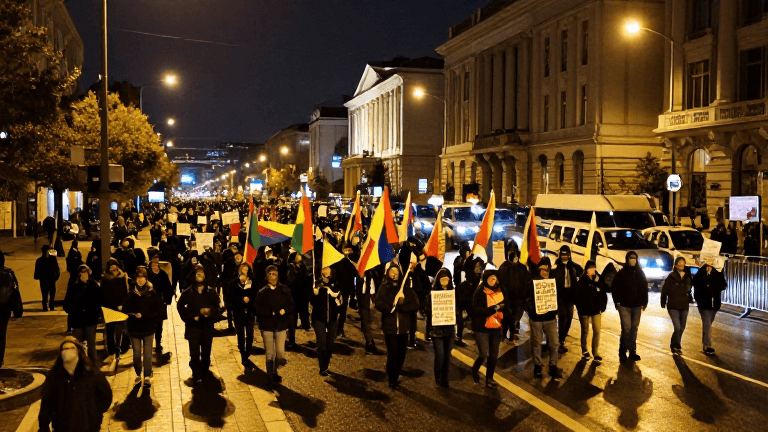
Ladies and gentlemen, it’s 9:00 p.m. right now, and I’m standing on a street in Romania—the sky is still unusually bright. This place is supposed to be all about vampires and castles, but right now, all I see is an abundance of positive energy. That Palace of Parliament—formerly known as the People’s Palace—was a massive engineering project that Ceaușescu brought back after his visit to North Korea. He demolished old neighborhoods to build it, and this main avenue right in front of the entrance was specifically leveled to make room for it. Construction lasted from 1984 to 1997, a period during which the entire country underwent a major political shift. It is recognized by Guinness World Records as the heaviest building in the world, weighing 4 million metric tons. It’s said to sink 6 millimeters every year and is the world’s second-largest government building, second only to the Pentagon. I didn’t go inside, but I’ve heard it has eight underground levels, with the deepest serving as a nuclear fallout shelter—a vast network of tunnels connecting all the city’s government departments.
The building has a high vacancy rate. In the 1990s, there was a proposal to convert it into the world’s largest casino, and it even attracted a $1 billion investment from George Soros, but none of these plans came to fruition. As I walked on, I saw a tree-lined boulevard on my left and the old town on my right, which retains its historic charm. On the afternoon of my first day, I heard the sound of gongs and drums and ran over to see a parade. There was a kaleidoscope of flags—Palestinian flags, animal costumes, anime characters, animal rights symbols, and more… This “Happy Pride 2026” event celebrated the 30th anniversary of Romania’s earliest LGBT organization. But it was actually a broad left-wing march protesting against conservatives and opposing fascism, homophobia, transphobia, and misogyny. Look at that logo—the hammer and sickle has been subverted into a symbol of gender equality. In reality, capitalism fears social organization and seeks to reduce people to nothing more than micro-struggles driven by mere biological impulses.
Later, I walked to the area across from the University of Bucharest, where an engineer was giving a street speech. He called for peace in Ukraine, Iran, Gaza, and the Middle East. He introduced himself to me as an engineer who had once lived in China. He spent his weekend giving speeches, covering a jumbled array of topics—from Orthodox Christianity and traditional family values to Gandhi, Martin Luther King Jr., and Charlie Cock, then on to Zelenskyy’s resignation, domestic political demands, and even the merger of Romania and Moldova, as well as opposition to mandatory vaccinations… He kept quoting Michael Jackson’s “They Don’t Care About Us.” He spoke quite highly of China, viewing it as a messenger of peace.
Next, I saw police greeting another group of protesters who had come to commemorate a historical incident in which miners brutally beat students. Judging by their black clothing, this was a group of right-leaning students. They and the protesters from earlier each carried out their respective missions, keeping to their own business without interfering with one another. Then I visited the Romanian Socialist Party, a small party office located right below a currency exchange shop. Their history is quite dramatic. Party Chairman Rotaru, a former member of the Romanian Communist Party and a Ph.D. in economics, later joined the Labor Socialist Party, where he opposed the divestiture of state-owned assets. However, when the Labor Socialist Party sought to merge with the Social Democratic Party, he broke away from it and founded the Socialist Alliance Party.
The following evening, I took a walk through the Old Town with a young party official. He was a solar panel expert in the new energy sector and told me that while Romania is rich in resources, most of its energy is controlled by foreign companies, which sell it to the local population at high prices. Worse still, the country is suffering from severe population and employment hollowing-out. Of the country’s 20 million people, 4 million live abroad—many of whom are intellectuals and highly skilled workers, such as doctors, nurses, engineers, and designers. With the European economy in decline in recent years, these emigrants may not necessarily be faring better, yet they still refuse to return. Consequently, the government has begun accepting immigrants from South Asia, India, Bangladesh, and even Nepal. The Nepalese man mentioned that many people from his country go to the Gulf states, especially Qatar. That’s when I realized there are quite a few Nepalese in Romania as well.
Most of the food delivery riders on the streets have South Asian features, and the red light boxes on the streets aren’t part of a red-light district—they belong to several SuperBet chain casinos. This gambling industry isn’t limited to SuperBet; it also includes currency exchange booths, loan sharks, and even machines for topping up gambling accounts. Bucharest is known as the “Las Vegas of Europe.” Since the government bans celebrities and influencers from endorsing gambling ads, they’ve resorted to using AI to generate images of sexy women. The real economy is in decline, with many shops remaining closed, and the overall standard of living is low. The average monthly income in Bucharest is 1,400 euros; while income levels in the capital are slightly higher, the wealth gap is significant. Low-income earners make 800 euros a month—already higher than the minimum wage of 600 euros—yet their cost of living remains high. Young people pay 700 euros in rent, plus 100 euros for electricity, water, and property management fees—living here costs 900 euros a month. This way of life truly gives one the feeling of being an ant in turbulent times, and public discontent runs deep. Taxi drivers are always talking about the EU, France, and bureaucratic corruption. Their demands are simple: they want Romania to have economic autonomy, to use its own resources, and to stop providing aid to other countries—especially for war-related weapons purchases. They hope to become a fully sovereign nation.