India: The Dream and Reality of Big Bang-Style Reforms
9/22/2026#印度经济#GDP#大国竞争#制造业
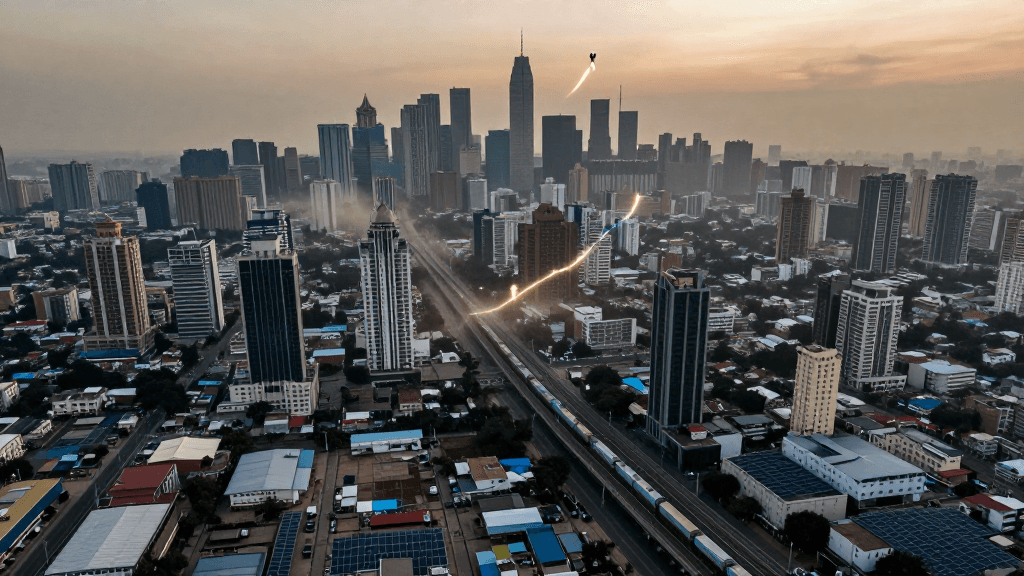
Everyone, let’s talk about India today. Did you know it’s actually hard to say exactly where India ranks in terms of GDP right now? That’s because it’s catching up to Japan—once it passes Japan, it’ll be fourth; and in a few more years, once it overtakes Germany, becoming the “third-largest” will be just around the corner. Well, since it’ll be the “third-largest,” it’ll have to learn from China and the U.S. How? Through comprehensive reform, of course!
A spokesperson for the Indian People’s Party made a bold declaration: “Big Bang-style growth”—meaning explosive growth! The goal is to turn India into a developed nation by 2047, the centennial of the nation’s founding. How will they achieve this? GDP must jump from $4 trillion to $30 trillion, with an average annual growth rate of 8%. However, while they achieved that in the second quarter of this year, the full-year figure was dragged down by one percentage point. Folks, let’s not dwell on the past—let’s focus on the future!
So what’s India going to do next? Domestically, it’s pushing for comprehensive reforms; internationally, it’s rolling out an “Indian version” of the Belt and Road Initiative. As for the reforms, they mainly involve simplifying the tax system and supporting small and micro enterprises; tariff exemptions on raw materials to support manufacturing; amending labor laws to benefit employers; and relaxing restrictions on foreign investment, allowing wholly foreign-owned enterprises in many sectors with automatic approval—but not for Chinese investors. The nuclear power market will be opened to private enterprises, with foreign investment also permitted—but not from China. As for Chinese investment, it remains subject to dual scrutiny and restrictions regarding trade and national security.
Sino-Indian relations have warmed somewhat this year, but whether they can normalize next year hinges entirely on the United States. The U.S. trade war with China is aimed at finding a new manufacturing hub to replace China. India was overjoyed at the prospect and quickly raised its hand, shouting, “Pick me! Pick me!” But after several years, both the U.S. and India have realized it won’t work! If China were completely excluded from the supply chain, India’s manufacturing sector simply wouldn’t be able to obtain critical raw materials and intermediate products. For example, sectors such as telecommunications, pharmaceuticals, chemicals, and photovoltaics are highly dependent on China. So they still have to import from China.
India aims to achieve its long-term goal of developing its manufacturing sector. But progress has been a bit slow so far. The plan was for manufacturing to account for 25% of GDP this year, but it currently stands at only 17%. The more manufacturing there is, the more indispensable China’s supply chains become. The U.S. pushed for “de-Chinaization”—and guess what? They still have to buy from China. It’s all been for nothing.
Of course, some industries in India have indeed seen an increase in domestic production rates, such as the toy industry, as reported by Bloomberg. But exports remain problematic because much of the technology and supply chain infrastructure lags behind Vietnam’s. Instead of relocating to India, Chinese companies are moving to Vietnam. As a result, last year India’s toy exports to the U.S. totaled only $100 million, while Vietnam’s were $3 billion and China’s were $11 billion.
During the Trump administration, tariffs were slashed across the board, with a 50% tariff rate directly imposed on India. Many foreign companies began diversifying their operations—no longer just “China Plus One,” but also “India Plus One.” India also faces challenges and urgently needs to deepen reforms, scale back the nationalist ideological maneuvers of recent years, and concentrate its resources on achieving explosive growth.
On the international front, India has a major initiative called IMEC, or the India-Middle East-Europe Economic Corridor. Starting from India’s west coast, it travels by sea and land to the United Arab Emirates, then continues overland to Israel, and finally crosses the Mediterranean to Europe. With strong U.S. backing—which spearheaded the Abraham Accords to improve relations between Israel and the Gulf states—the project is still moving forward, despite a slowdown caused by Israel’s military operations in Gaza. The U.S. needs this initiative; India is pursuing strategic autonomy; and the hub countries along the IMEC route each have their own agendas.
The Gulf states maintain close economic and trade ties with India, restoring relations to their historical norm. Europe is also enthusiastic, particularly the countries of Southern Europe. However, some major players in the Middle East have adopted a nuanced stance; for example, Turkey is unhappy and plans to collaborate with Iraq to build a corridor. Iran has been completely excluded, and Egypt’s status regarding the Suez Canal has similarly been undermined. The geo-economic dynamics are complex, making it difficult for the IMEC to form a closed loop in the short term.
To sum up, the Belt and Road Initiative can use this opportunity to deepen cooperation with the Middle East’s wealthy nations. Ladies and gentlemen, while India’s dreams are grand, the reality is fraught with challenges. Let’s keep a close eye on this!