The Glory and Embarrassment of India's AI: From the Second Tier to Third Place
9/22/2026#印度#人工智能#科技产业#国际时政
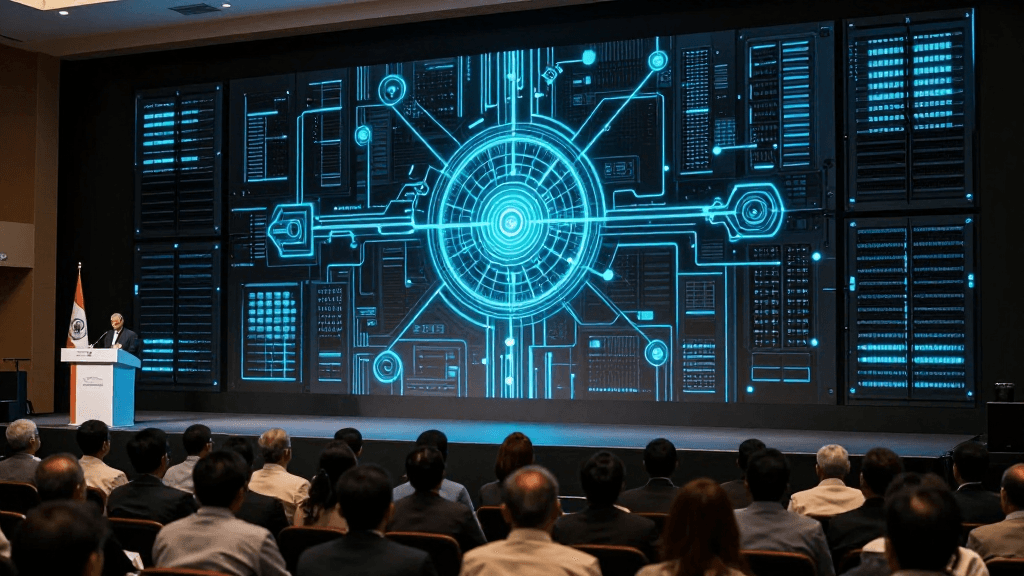
Everyone, a video has recently gone viral in our group showing a high-ranking Indian official fiercely confronting the IMF Managing Director. It shows India’s Minister of Electronics and Information Technology taking on the IMF Managing Director at the Davos Forum, claiming that India’s AI capabilities are on par with those of China and the U.S., placing it in the top tier. The minister spoke at length, breaking down AI into five layers: applications, models, chips, infrastructure, and energy. But here’s the question, Mr. Minister: How many of these layers does India actually have? Has the power supply issue been resolved? Ultimately, what India takes the most pride in is still the superficial application layer—that is, what AI is used for, such as in agriculture, healthcare, and education. In fact, many of India’s AI projects are merely about integrating digital and real-world sectors—using AI to support traditional industries.
Nevertheless, Indian officials like to emphasize that the country is the world’s largest provider of AI services. This claim sounds like they’re asking: “How many of these layers do we actually have? We haven’t even solved the power issue yet.” But the fact is, compared to the United States’ cutting-edge innovations in proprietary models and our industrial integration in the hardware sector, India is charting a unique course: serving small and medium-sized enterprises globally—especially in Europe and the United States—to boost efficiency. Software services are India’s forte, and using AI to replace manual labor is second nature here. In the first half of last year, it was revealed that the British unicorn BuilderAI was actually powered by 700 Indian software engineers writing code by hand. However, AI is sometimes misused in fraud schemes. Forty-seven percent of Indian adults—either personally or through someone they know—have fallen victim to scams, a figure twice the global average. This clearly illustrates the boom in the AI industry and the lag in regulation.
Next, let’s talk about India’s large language models. India doesn’t compete in the race for large language models with hundreds of billions or more parameters; instead, it specializes in smaller models in the range of billions. This is because they’ve found that smaller models are sufficient for handling most use cases—a strategy that both saves costs and improves return on investment, representing a uniquely Indian approach to the AI industry. However, this argument is actually somewhat flawed. According to Stanford University’s Global AI Vitality Index report, the U.S. AI industry scored 78.6 points, establishing a commanding lead over the second-place country, while China scored 36.95 points. Behind China is a group of countries—including South Korea, the United Kingdom, Singapore, Spain, the United Arab Emirates, Japan, and Canada—all of which scored only in the teens. India was the only country to break the 20-point barrier, ranking third with a score of 21.59—a significant improvement over the previous year.
So how were these scores calculated? The Stanford report breaks down the assessment into seven dimensions: R&D, AI responsibility, economy, talent, governance, public sentiment, and infrastructure. Each dimension is further subdivided into specific criteria. The United States ranked first in all dimensions except for talent and public opinion. China’s score came primarily from R&D, where it was on par with the U.S. and far surpassed all other countries. However, China’s talent score ranked relatively low among the top ten. In contrast, India scored highly in the talent category, ranking second among the top ten, second only to Singapore.
Some have argued that the AI race is a competition between “Chinese in China” and “Chinese in the U.S.”—so how can India’s AI talent outperform both China and the U.S.? The answer lies in the fact that the five sub-indicators within the talent category—such as the number of AI jobs and the prevalence of AI skills—are all derived from LinkedIn data. However, LinkedIn withdrew from the mainland Chinese market back in 2021, so there are very few active users here. Since the Stanford report relies solely on LinkedIn data, it actually significantly underestimates China. In contrast, India’s IT sector is deeply embedded in the Western tech ecosystem, where LinkedIn penetration is high and the proportion of AI professionals among all users is substantial. Moreover, due to India’s massive labor force, it has a statistical advantage—which effectively overestimates India’s standing.
Another scoring category in the Stanford report is public opinion, measured by the number of AI-related posts on social media and whether the overall sentiment is positive or negative. In this regard, India ranked second, with 72% of users expressing optimism toward AI; China ranked third, while South Korea took first place. U.S. internet users are generally skeptical of AI giants, and skepticism is quite prevalent. However, this skepticism has, to some extent, contributed to higher scores in another dimension: discussions and practices regarding AI responsibility and ethics in the United States. In this dimension, only China and the United States scored significantly, while other countries scored virtually nothing.
In summary, the Stanford report should neither be blindly trusted nor dismissed outright. The author notes that the data on China does not fully reflect the depth and robustness of China’s AI ecosystem; it is wise to consider all perspectives, and there is no need to turn it into evidence for “winning-oriented thinking.” Finally, I would like to thank the group member who provided the lead, and I welcome professionals from all industries to join us so that the value of our group continues to rise.