The Indian Navy's Dream: A Weapon Against China or Just a Pile of Junk?
9/22/2026#印度#海军装备#军费开支#印度洋
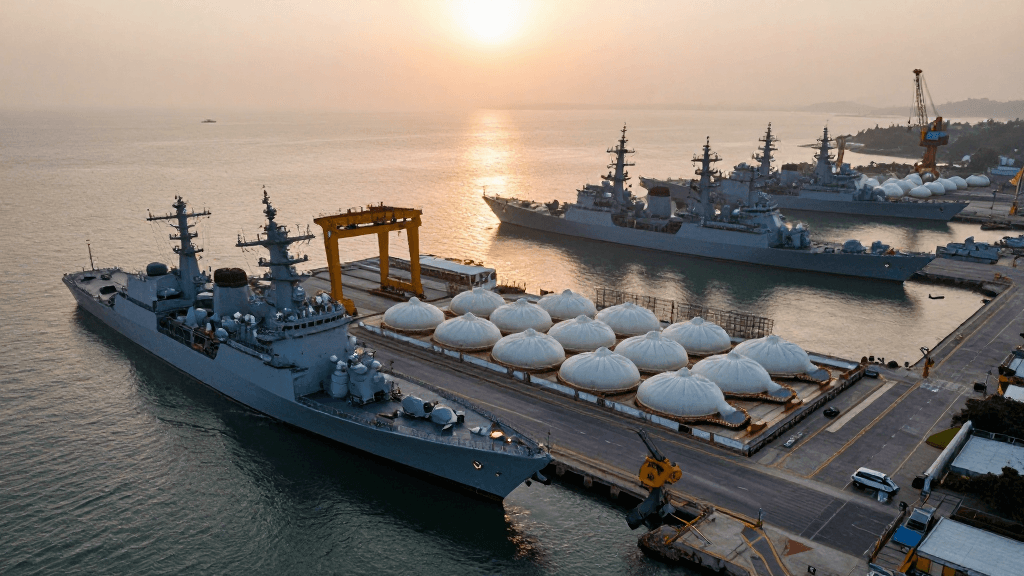
Listen up, everyone. Ten years ago, India poured $40 billion into its navy, and now we’re watching it flex its muscles. An in-depth report by the *Financial Times* tells us that India’s naval ship is setting sail at full speed, with the goal of rivaling China. We don’t deny that India is a formidable force, but it remains, after all, a sentinel of the Indian Ocean—as Modi himself said during his inspection of the “Vikrant.” This represents both an elevation of India’s self-perception and an adjustment to its strategic positioning. Since its founding, India’s wars have always been fought on land, but senior military officials believe that India is not only a continental power but also a maritime power—a “pioneer” of the Indian Ocean.
During the India-Pakistan clash this past May, India deployed an aircraft carrier to exert maritime pressure. Although hostilities were ultimately averted, India’s dominance in the Indian Ocean is now an inevitable trend. The importance of this region goes without saying: two-thirds of the world’s oil and half of all container shipments—including 95% of India’s own merchandise trade—pass through here. The Indian Ocean is not only vital to India but equally vital to us; 60 percent of our trade also passes through this region, and our trade volume is five times that of India’s. Therefore, maritime competition with China seems inevitable. Since land-based expansion is blocked, the only option left is the maritime route.
Consequently, India needs to build a blue-water navy to control the southern Indian Ocean, strengthen the defense of the Andaman and Nicobar Islands, and contain the Strait of Malacca. They claim this is a countermeasure against Chinese expansion, but in reality, it is intended to limit the Chinese Navy’s ability to enter the Indian Ocean. As for its own capabilities, India remains quite confident. Over the past decade, our navy’s tonnage has skyrocketed by 1.7 million metric tons—equivalent to adding four Royal Navies. Although India hasn’t expanded as rapidly as we have, it has still grown steadily by 300,000 metric tons, roughly equivalent to 0.8 times the size of the Royal Navy, which is already quite substantial.
On the other hand, India believes that China will not deploy more than 35 percent of its military power to the Indian Ocean, reasoning that since China hasn’t yet cleared up the mess on its own doorstep, it won’t venture out to challenge others on their turf. Even if it did, India believes it has the capability to disrupt China’s military presence overseas. For example, some Indian maritime strategists have argued that in the event of a direct conflict, even if China were merely using its naval base in Djibouti to refuel, India could reduce Djibouti to rubble. Given this, the Indian Navy sees no need to strictly match China’s capabilities. Their internal assessments suggest that for every three warships China builds, India needs only to build one. Unfortunately, due to gaps in industrial infrastructure—such as steel shortages and a supply chain reliant on various international sources—India has not fully realized its plans.
Initially, India proposed building 24 submarines over 30 years, but 25 years have passed, and only six have been delivered. This year, however, India has moved beyond “PPT shipbuilding” and significantly accelerated its pace, commissioning a new vessel on average every 40 days. Currently, 55 new ships are under construction, and another 64 have been approved. Furthermore, a domestically produced nuclear-powered aircraft carrier has been included in its strategic blueprint. According to the Indian Ministry of Defense’s plan, the country aims to have at least 200 vessels by 2035, which means that over the next 10 years, dedicated investment in military modernization will need to reach $40 to $50 billion. Currently, the largest portion of its military spending goes toward salaries and pensions—accounting for more than half of the budget—while less than 30% is allocated to equipment, though this is already significantly more than it was a decade ago.
Of course, to become a naval power, hardware investment is only one aspect; improving the quality of personnel is also crucial. India has indeed had its share of absurd incidents, such as a fire breaking out during the maintenance of a frigate, which capsized after excessive water was pumped in to extinguish the blaze, and a nuclear submarine where the rear hatch was left open, allowing seawater to flood the propulsion compartment. In any case, the West has high expectations for the rapid rise of India’s military capabilities and, in order to nurture India, is sharing intelligence and providing technical support. U.S. strategic experts say that the interests of the West and India are highly aligned, and they hope for strong cooperation in the Indian Ocean. U.S.-India cooperation has already been enshrined in the United States’ latest National Security Strategy, which calls for continuously improving U.S.-India relations to encourage India to contribute to Indo-Pacific security. But why has the U.S. heaped praise on India even before it has demonstrated such contributions? Because the U.S. aims to draw India into an anti-China alliance and have it shoulder the burden of countering China. Just how alarmed is India? It is, after all, a major power with strategic autonomy—why should it work itself to the bone for the United States?
Indian officials have privately told the *Financial Times* that should a conflict break out in the Taiwan Strait, whatever the West decides to do is none of India’s business—this is not a war India should be involved in. Senior Indian military officials have also stated that Sino-Indian relations are shifting from confrontation to competition, and ultimately toward coexistence. India isn’t falling for the U.S.’s ploy, yet the U.S. still courts it and continues to support its rise. This is because, in a zero-sum mindset, India’s very existence serves as a check on China, whereas a weakened India would lead to the Indian Ocean region falling under China’s control—something the U.S. is even less willing to accept. Therefore, while the U.S. is strategically retrenching, it is effectively granting India verbal control over the Indian Ocean, allowing it to hold the fort in its own backyard. For India’s development—especially its defense industry—this is undoubtedly a positive development.