Iran: A Puzzle Forged by War
9/22/2026#伊朗#中东局势#地缘政治#国际时政
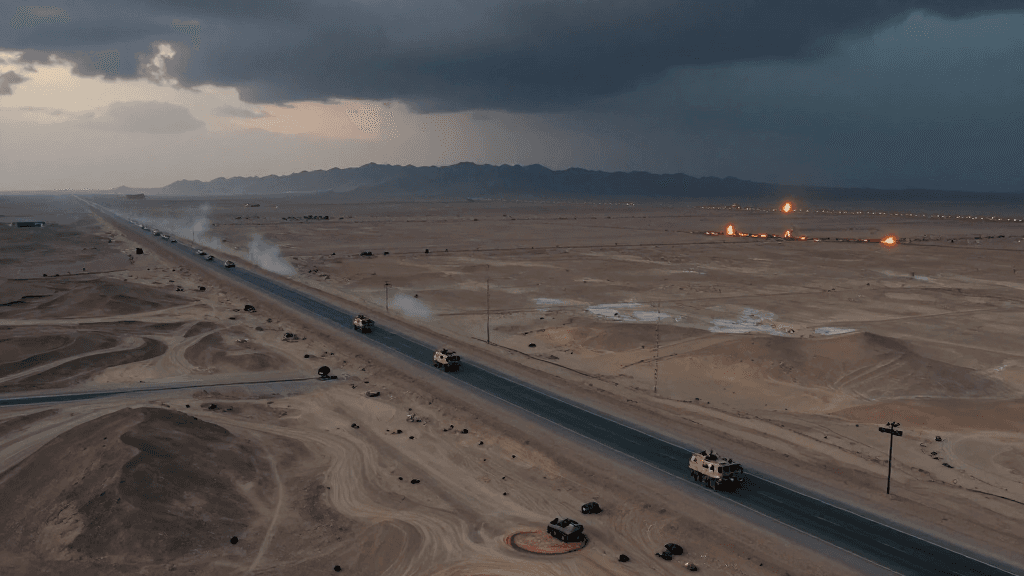
The war came too quickly, like a tornado—before we could even feel the heat, it had already hit the pause button. In just 12 days, Israel launched a surprise attack on Iran, and the U.S. stepped in. Iran launched a symbolic retaliation, while the U.S. and Israel issued threats calling for regime change in Iran. Just as everyone was worried that the conflict would escalate, the pause button was pressed. Will this violent tornado subside, or is it brewing an even bigger storm? Will the course of the Middle East change as a result? Perhaps the answer is inevitable.
When I last wrote “Iran and Israel,” the title was a question: “Will this trigger World War III?” That question was likely misguided. Back when the Soviet-German War was raging and the “Meat Grinder” DLC was about to launch, no one thought Western Europe’s “show war” was worthy of being called World War I. And although China’s War of Resistance was brutal, it wasn’t retroactively recognized as part of World War II until the Allies declared war on Japan following the attack on Pearl Harbor. When future historians look at us, will they see us as a group of peaceful frogs facing the Russia-Ukraine conflict, the Gaza crisis, the India-Pakistan conflict, and the Iran-Iraq war—and say, “The water’s just right”?
We must understand how the Middle East arrived at its current state in order to speculate on how the present will shape the future. We can take today as our starting point, exploring the world of news, tourism, and social media check-ins. But ultimately, we must step into the river of time to find the threads of history.
Late on the night of June 21, the United States struck a sleeping Iran with a “midnight hammer,” deploying 125 aircraft—including intelligence, reconnaissance, refueling, and escort flights—and even staging a decoy operation in the Pacific. Seven B-2 Spirit stealth bombers took off from Missouri, flew across the Atlantic, slipped into Iranian airspace, and dropped 14 GBU massive bunker-busting bombs on the Fordo and Natanz nuclear facilities, while another Navy nuclear submarine fired 30 Tomahawk cruise missiles at Natanz and Isfahan.
Natanz was exposed in 2002, and Iran acknowledged its existence and agreed to inspections in 2003. Fordow was secretly constructed in 2006 and its existence was acknowledged after it was discovered in 2009. The U.S. attempted to sabotage the centrifuges using the Stuxnet virus spread via USB drives, but Fordow remained resilient and deployed air defense missiles. It is widely speculated that Isfahan is likely the third uranium enrichment site announced by Iran on June 12, with defenses even more robust than those at Fordo. While Israeli airstrikes have primarily targeted Natanz, and given that Isfahan’s defenses are even stronger, Fordo received special attention this time.
The U.S. military claims that GBU munitions were not developed specifically for Fordow, but were designed with it as a hypothetical target; theoretically, they can penetrate 60 meters of soil. Fordow is constructed of carbon-fiber-reinforced concrete, steel plates, and solidified volcanic rock; it would require 2–4 bombs to penetrate from a single point in a "fish-head" formation to cause damage. However, satellite imagery shows that the U.S. military dropped 12 bombs, leaving three craters at each shaft—possibly due to electronic jamming causing GPS errors, which prevented precise, sequential strikes.
Judging by Iran’s backfilling and repair progress, the damage to Fordo was limited. Nevertheless, Trump has declared the operation a “complete success,” claiming the facility was “thoroughly destroyed” and that Iran’s nuclear program has been set back by decades. U.S. intelligence agencies assess that the strike has caused a few months’ delay to Iran’s nuclear program. However, the White House was quick to dismiss these reports as “fake news,” and the Pentagon’s review was dismissed as an attempt to undermine the narrative of success. The CIA stepped in to smooth things over, saying that regardless of whether it’s “decades” or not, a setback of several years is certainly inevitable.
On June 19, Iran had already transferred its nuclear materials; Iran explicitly admitted this, and satellite imagery confirmed it. Sixteen heavy-duty trucks were lined up at the entrance to Fordow, loading up. Even I know about this—the U.S. certainly knows, and Israel is very anxious. Look, they’re transferring the material. But Trump said he wouldn’t believe or spread rumors, claiming that transferring material isn’t that difficult and that they wouldn’t be able to move any of it. Israel is getting impatient; they’ve been itching to strike Iran for far too long.
Israeli Prime Minister Netanyahu has been speaking about Iran’s nuclear program for 30 years. After the U.S. withdrew from the Iran nuclear deal in 2018, it became a matter of survival for Iran. Iran does not wish to possess nuclear weapons, fearing it would provoke a full-scale strike from the U.S. and Israel; it only wants to maintain a credible breakthrough capability to avoid triggering military action.
Starting in 2017, with Trump’s support, Israel began to align itself with Sunni Arab nations, normalizing diplomatic relations with countries such as the United Arab Emirates, Sudan, Bahrain, and Morocco. Previously, Egypt and Jordan—which ignored the Palestinian issue and engaged with Israel—were viewed as “traitors to the Arab cause.” Now even Saudi Arabia, the “big brother” of the Gulf states, is on the verge of aligning with Israel. And that’s not all: in 2023, Saudi Arabia also restored diplomatic relations with Iran, effectively ending the “mini-Cold War” in the Middle East. Everyone’s getting along—so who’s in the worst position? Hamas. Hamas and Israel’s far-right are the only irreconcilable conflict in the region. These non-state actors are the backbone of resistance within the “Arc of Resistance,” while Iran is primarily responsible for funding, supplying equipment, and providing military advisors.
Watching Palestine be forgotten, Hamas has developed existential anxiety and launched attacks against Israel. Iran supports this in principle but advises against rushing into action, as it can no longer afford to drag this out. Many netizens, driven by hatred for the U.S. and sympathy for the Palestinian people, feel frustrated with Iran—the “big brother”—expecting more from it. However, many within Iran believe that as long as the other side is willing to lift security threats and economic sanctions, there’s nothing that can’t be reconciled. However, this does not mean that everyone is open to reconciliation; the constitutional government that came to power through the Islamic Revolution would find it particularly difficult to do so.
After the ceasefire, Khamenei stated in a speech that Iran had achieved three major victories: victory over Israel, victory over the U.S., and victory over itself, resulting in unprecedented unity. The U.S. and Israel are pinning their hopes on airstrikes and bombings to topple the regime in Tehran—isn’t that just a game of tit-for-tat? Iran has more missiles than Israel has anti-missile interceptors—who will be the first to crack? Only if a ground offensive is launched will Iran’s opposition forces have the chance to step forward and welcome the “imperial army.” Israel lacks this capability and can only rely on U.S. forces to conduct amphibious operations in Iran and overrun Tehran. Such a move would be political suicide, dooming the nation’s future; yet some, blinded by greed, will surely try to pull the trigger.
The U.S. has made its position very clear, mentioning regime change. Since World War II, the U.S. has orchestrated regime change in other countries more than 90 times; in most cases, this has led to the collapse of the state, economic turmoil, and social division. Yet the U.S.’s self-reflection on this matter stops at acknowledging that “we can’t find any examples of countries flourishing after intervention—it’s been a failure.” But for imperialism, this isn’t a failure—it’s a massive success. The true goal of regime change has never been to deliver democracy; rather, it is to increase entropy and create chaos within small systems that contradict the grand order.
The collapse of the Iranian regime will not be replaced by liberal democracy, nor is a restoration of the Pahlavi dynasty likely to result in an authoritarian military monarchy. The most probable outcome is a warlord-led civil war, with armed factions carving out their own territories, while Western corporations plunder the country’s resources. Iran, having lost its sovereignty, will descend into chaotic rule or become yet another fragmented nation on the periphery of the empire. Being forced to integrate into and submit to the empire’s division of labor and value chain aligns with the strategic interests of global hegemony.
Trump is not a spokesperson for the global empire; regime change does not align with the goals and methodology he has publicly declared. After dropping a massive bomb, he endured Iran’s symbolic retaliation against U.S. military bases, actively sought a ceasefire, and promptly withdrew from a full-scale war with Iran. I believe he intended to make a grand show of force to curry favor with Israel; as for whether he actually achieved anything—if so, if so—he’s just toeing the official line.
But such a calculating approach is dangerous. First, Trump has no genuine affection for Israel; he supports it because he needs the backing of American Jewish financial interests, and now that he’s fallen out with Ma, the richest man in China, he needs that support even more. But his rise to power wasn’t entirely about money; many Americans genuinely support him. During his campaign, he ran on an anti-war platform—not exactly as a peace lover, but at least on the premise that whoever wages war in the Middle East is a fool. Ending endless foreign wars is one of the core tenets of “Make America Great Again” (MAGA).
Now that Trump is taking on Iran, a faction within the MAGA movement has defected to the establishment neoconservative camp on key issues, sparking concerns about internal division. But why continue to support the neoconservatives, who seek global hegemony? Because there is also a “China-first” faction within MAGA that believes the prerequisite for—and the outcome of—American greatness is the weakening of China.
By using Israel to take down Iran, they aim to disrupt China’s partnerships in the Middle East and further squeeze China’s energy security as an industrial powerhouse. It’s very difficult to strike a balance here; if they can’t, they won’t be able to maintain the Republican Party’s facade and will be unable to hold off the Democrats to secure the U.S. presidency. Musk and the tech faction have already split, and as this division continues—whether through further polarization or compromise—the MAGA camp will undergo massive changes. The Next Generation Leadership Program may be launched ahead of schedule.
Iran will become a watershed moment. Why do the U.S. and Israel seek to overthrow the Iranian regime? Why is the Iranian regime so difficult to topple? Is there truly a risk that it could be overthrown? We must answer the most fundamental question: What is Iran?