Xinjiang Cotton: From Top Producer to Sanctioned Industry
9/25/2026#新疆棉#棉花产业#农业观察#产业链
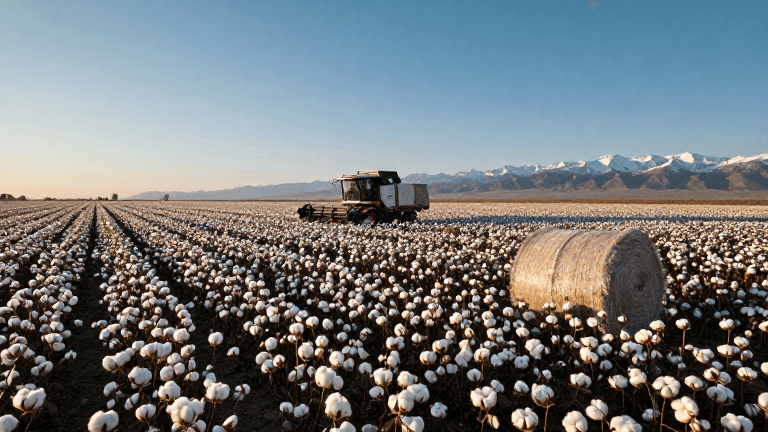
Everyone, I recently traveled to Xinjiang to conduct research on cotton and, while I was there, to get an update on the latest developments regarding Xinjiang cotton. This story goes back to March of this year, when I wrote an article on my WeChat official account about China’s cotton industry. It mainly discussed how China’s cotton output is projected to exceed 6 million metric tons by 2025, with Xinjiang’s production reaching as high as 6.61 million metric tons. These figures certainly draw envy from around the world. At the time, I also specifically emphasized that China’s cotton output is three times that of the United States, and that the quality has improved by leaps and bounds in recent years. For example, while India claims a production of 5 million metric tons, its actual industrial chain and quality are far inferior to ours. As it turned out, that single article really drew a lot of attention.
One reader commented that while increased cotton production is a good thing, cotton farmers aren’t making money. Purchase prices aren’t rising, nor are international cotton prices. These words gave me a lot to think about. It turns out that while China’s cotton industry appears strong on the surface, it hides numerous underlying issues. No one has mentioned this in the past two years, yet consumers have continued to “buy, buy, buy”—unaware that the West has been consistently using sanctions to suppress Xinjiang cotton.
I recall that from late 2020 to early 2021, brands like Adidas and Uniqlo banned the use of Xinjiang cotton. The U.S. and the West employed various propaganda tactics, such as alleging “forced labor.” In fact, 30 years ago, the cotton industry did indeed require a large labor force, but now, with advances in technology—particularly automated harvesting—output has increased significantly. The key problem, however, is that cotton prices just won’t rise. This directly affects the motivation of cotton farmers.
Xinjiang’s cotton output exceeds 6 million metric tons, but national subsidies cover only about 5 million metric tons. Then there are the expensive harvesters—costing 3 to 4 million per unit—which are beyond the means of individual farming households. Growing cotton also requires laying plastic mulch, topping the plants, and watering, resulting in high costs and low profits. Although mechanization has improved, overall costs remain high, leading to declining enthusiasm for cultivation. Coupled with a shrinking market—now at about 40 percent of its peak—factory revenues have also plummeted.
Furthermore, Xinjiang cotton faces several major challenges. The costs of laying plastic mulch, topping, and irrigation are high. Additionally, the international futures market is heavily influenced by the New York market. Western sanctions rely on financial measures—such as manipulating the futures market—to drive prices down. This not only affects domestic purchase prices but also makes it difficult to sell the cotton. Domestic absorption capacity is limited; brands like Adidas and Zara are actually controlled by international capital and generate significant demand. However, domestic demand in China is insufficient, so our ability to absorb this supply is constrained.
Although Xinjiang cotton is of excellent quality, it is constrained by financial sanctions in the international market, preventing prices from rising and making it difficult to sell. This not only impacts our domestic industrial development but also leaves us vulnerable to control by other countries. For example, the U.S. uses capital to control the global consumer market; if our massive production capacity cannot be released to the world, cotton from Australia, Argentina, and Brazil will dominate the market.
Technologically, we are already quite advanced—for example, using lasers for topping, drones for pesticide spraying, and Beidou positioning and visual recognition for harvesting machines. The problem, however, is that we are being held back by capital and international market constraints. So, how can we solve this problem? It requires the collective effort of the entire industry, including support from national policies, as well as integration and innovation across the industrial chain. I hope we can find a way to make Xinjiang cotton the global leader once again.