Carbon Fiber Battle: From a Brutal Elimination Round to the T1200 Grade
11/1/2026#碳纤维#新材料#高端制造#产业观察
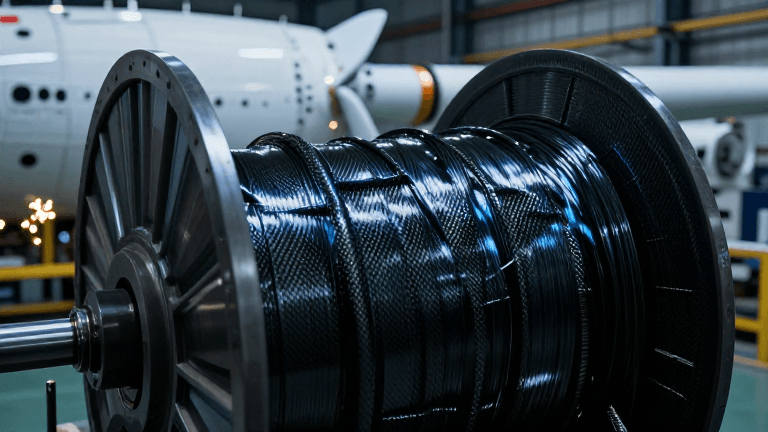
Everyone, recently there's been more good news from our country in the field of carbon fiber. Our T1200-grade ultra-high-strength carbon fiber material has made its global debut, and this came even faster than the mass production of T1100-grade by a month. There's a lot behind this story, so let's sort it out.
I remember that day I was watching CGTN news, which reported on the mass production of T1100-grade, and I thought about writing an article then. I never expected that just one month later, T1200-grade would burst onto the scene. This thing comes from Zhongfu Shenying, called SYT80; laboratory development was at the end of last year, and production capacity has already reached hundreds of tons. We have become the first country in the world to achieve hundred-ton-level mass production. This is not something just for show in a lab, but something that can truly be used in industrial production. From a 1-kilogram sample to hundred-ton-level products, this hurdle has stumped many countries, especially Germany and Russia, which have never gotten past it. We actually crossed it so quickly—that really makes people cheer.
The performance of T1200-grade carbon fiber is truly astonishing. A single fiber has a diameter of less than 7 microns, one-tenth of a human hair. The tensile strength of ordinary steel is generally 0.5 GPa, while T1200-grade can reach 8 GPa, more than ten times that of steel, while its density is only one-quarter that of steel. This means it is both light and strong—simply an indispensable key material in fields such as aerospace, national defense and military industry, new energy, and high-end equipment. Therefore, it is called the "king of new materials."
Speaking of more than ten years ago, Chinese carbon fiber enterprises went through a brutal elimination round, and only a few remained. For example, Zhongfu Shenying, through independent research and development of equipment and technology, step by step plucked the crown of new materials. T1200-grade carbon fiber, through nanoscale structural control, greatly reduces internal micropores during the carbonization process, increasing strength by 10%-15% over T1100-grade. Actually, our carbon fiber research can be traced back to the 1960s, led by units such as the Shanxi Institute of Coal Chemistry of the Chinese Academy of Sciences. But the industrial foundation lagged the international level by twenty to thirty years. At the beginning of this century, our country's external dependence on carbon fiber was as high as 80%-90%, and because of its key role in missiles, fighter jets, and other fields, it was listed by the United States and Japan as a strategic material. The global market was basically monopolized by Japan's Toray, Toho, and Mitsubishi and the United States' Hexcel, and exports were extremely strict—not only expensive, but also strictly prohibited from military use.
In 2001, the Ministry of Science and Technology realized that the shortage of high-performance carbon fiber seriously threatened national defense security, so it established a special carbon fiber project. Not long after, the United States and Japan simply began an embargo and chokehold, further tightening export restrictions, which instead stimulated us to list it as a key strategic material. In 2015, targets were proposed for the self-sufficiency rate to reach 40% by 2020 and 70% by 2025, and these have already been exceeded ahead of schedule. One has to say, thanks are due to the launch of the large aircraft project, which provided it with a huge downstream market and forced through the connection from laboratory to factory. Japan's Toray is indeed an industry giant; the entire performance grading system was established by it. Its customers range from Boeing and Airbus to hydrogen cylinders, golf clubs, and high-end fishing rods, occupying the top of the industry pyramid. In 2023, Toray released a T1200-grade product, but the specific tonnage and uses were not disclosed. Industry estimates put it at only the hundred-ton level, with an extremely high premium and review of end uses.
Toray originally hoped to use new products to dominate the next two super tracks, namely humanoid robots and the low-altitude economy. And the localized supply of our Zhongfu Shenying's SYT80 can precisely prevent Toray from locking down the profit chain. Moreover, rising costs and product price increases at Toray provide us with an excellent opportunity to expand market share. So, from today onward, offense and defense have changed positions.
Also, do you remember the Hamilton Index of the U.S. ITIF that I mentioned? One of the few clusters of advanced industries in the United States is Washington State's aerospace within other transportation equipment. American think tanks have already recognized China's sci-tech innovation complex—for example, the coupling between research institutions and industrial entities such as the China National Building Material Group Research Institute and Zhongfu Shenying, and between Shenzhen University and Changsheng Technology. This has not only rapidly consolidated the core pillar of the development of domestic new quality productive forces, but is also launching an impact on the remaining high ground of American cutting-edge science and technology industries.