Why has Japanese diplomacy "taken leave of its senses"? We must start with domestic politics.
11/1/2026#高市早苗#日本政局#中日关系#地缘观察
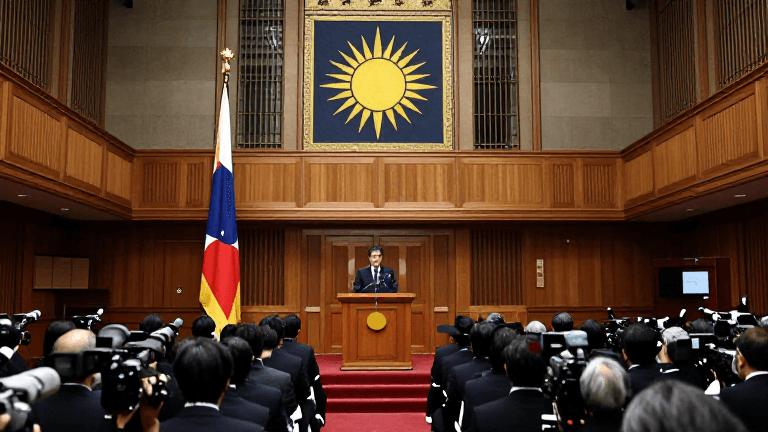
Everyone, there's something worth paying attention to. When conflicts arise between China and Japan, the external public opinion environment is actually quite unfavorable to us. Japanese Prime Minister Sanae Takaichi is making trouble on the Taiwan Strait issue, and Consul General in Osaka Xue Jian directly said on foreign social media that for a dirty head that barges in without permission, one can only chop it off without hesitation. This is just a metaphor—defending national sovereignty and chopping off the dirty head raised by militarism is no problem. But Japanese public opinion immediately exploded, saying how can you incite the beheading of a national leader? Western media immediately chimed in, saying the 'wolf warrior' who 'punishes even those far away' is back.
The West taking sides—everyone is used to it. Do they really not understand China's red lines? Definitely not; whenever they get a chance, they want to disgust us. So-called 'either stupid or bad'—they are definitely not stupid; there are actually quite a lot of clear-headed people. For example, the YouTube current affairs channel VisualPolitik, which I often watch, analyzed Sanae Takaichi very well. The core point is: Sanae Takaichi's domestic political position is unstable, and there are many moves she cannot make. After comparing options, she finds that talking tough on China and taking a hardline stance is actually the easiest and safest. So you have to understand Japan's diplomacy from the perspective of its domestic politics.
Why do I say that? Because the Japanese government is almost the Liberal Democratic Party. Since the LDP was founded 70 years ago, it has basically been out of power for only a few years. But after Abe stepped down, the LDP has become increasingly unable to hold things together; it no longer has a majority in both chambers of the Diet and must govern in coalition with other parties. For the past 20-plus years, the LDP's old partner has been Komeito, which is relatively left-leaning, supports welfare, immigration, and friendship with China. But it recently announced a 'divorce' from the LDP and withdrew from the coalition. The surface reason is that it thinks Takaichi, as Abe's disciple, is too hawkish, and especially that visiting Yasukuni Shrine is bad for handling Japan's relations with China and South Korea. But Abe also visited before, and they didn't say anything then, so that's not the real reason.
The real reason is that LDP bigwigs used political donations to fill slush funds, which is a huge scandal in Japan. Including the earlier assassination of Abe by Tetsuya Yamagami—what was behind it? It was the LDP's deep collusion with the Unification Church faction of Sun Myung Moon. By the way, Trump is also in their circle. This made it too ugly for Komeito, as a Buddhist group, not to cut ties. And within the LDP, the ones caught up in the scandal happened to be Abe and Takaichi's faction, called the Seiwa-kai, which advocates abandoning the pacifist constitution and rearming Japan—the party's right wing—and it was forced to disband because of the scandal.
On one hand, this weakened their political strength; on the other hand, in recent years Japan's economy has also run into major problems. The surface phenomena are jarring: wage income has fallen for many consecutive months, pay raises cannot keep up with inflation, and at the same time rice prices keep rising—at the peak, the average price of ten jin of rice exceeded 5,000 yen, equivalent to more than 200 RMB. These problems are now very hard to solve, because the old method was to raise interest rates to suppress inflation, but now the Japanese economy is in the awkward position of having inflation without growth. Raising rates rashly at this time could trigger a recession; the government also dares not do large-scale fiscal stimulus as in the past, to avoid further pushing up inflation and expanding the fiscal deficit.
Takaichi herself wants to redo Abenomics. The three arrows of Abenomics—printing money, spending money, and structural reform—in plain terms mean monetary easing, increased public spending, and structural reform. But now Japan can do none of these three things. Compared with more than a decade ago, the yen has depreciated by over 50%. Printing money was possible before because the currency was overvalued; now people don't want yen, and printing more will only make it weaker and inflation higher. In the past, the Japanese government borrowed heavily, with debt at 240% of GDP—for reference, the US is 125% and China is 88%. Japanese government bonds used to be backed by the central bank: print money, print, print; buy bonds, buy, buy. But now it cannot absorb so many bonds, to the point that the ten-year government bond yield has reached its highest level in 17 years, showing the market cannot digest them. If you can't borrow, you can't expand spending to stimulate the economy. As for the third arrow, structural reform, Abe himself never explained it clearly, and now it is even harder for Takaichi.
What Abe faced back then was a very serious structural problem in the Japanese economy. For a long time Japan focused on building the nation through manufacturing, such as robots, automobiles, and especially consumer electronics. In hardware, Japan is hard to beat anywhere in the world—their smart toilets could measure blood pressure and such long ago. But the problem is that it completely missed the rise of the mobile internet, digital transformation, and cloud technology. Now the entire technology ecosystem is connected by software, and because Japan was too successful in hardware, it developed path dependence: the government responded slowly to new trends, lacked appropriate industrial policy, and blindly protected past hardware manufacturers; inside companies, seniority-based promotion prevailed, and young software engineers were not valued. As a result, there are neither successful software companies nor a formed IT internet and software ecosystem.
At the same time, hardware manufacturing also suffered setbacks. After the Fukushima nuclear accident, nuclear power plants shut down one after another, reducing electricity supply by 30%, and this part could only shift to fossil fuel imports, causing electricity prices to rise sharply. For a country that exports industrial goods, this means manufacturing competitiveness has been severely hit. Only Germany, after Nord Stream 2 was blown up, can understand this pain, and Japan has carried the burden of high-priced energy for more than a decade—much worse than Germany. If the information technology revolution is compared to a ball game, Japan scored a lot in the first half through hardware such as semiconductors, integrated circuits, and electronic products; in the second half, which compares the internet and software ecosystem, it was absent, so productivity growth has been slower than in other developed countries.
So although Sanae Takaichi has the intention to imitate Abenomics, the broader environment has changed, and these arrows really cannot be shot in her hands; she can only make an issue of political topics. Now the party tied to the LDP is an extreme right-wing party called Nippon Ishin no Kai, which you can understand as Japan's MAGA. It is the opposite of Komeito, advocating small government, less spending, anti-immigration, anti-China, constitutional revision, and military building. The LDP, having lost Komeito, has already lost a layer of checks and is turning right; adding Ishin no Kai will inevitably let both aspects run wild together.
The first aspect is immigration. Abe called himself a conservative nationalist, but in practice introduced a large number of immigrants, and the LDP now has a lot of room to maneuver here. The other aspect is diplomacy. Simply put, Japan wants to toughen up and create enemies, using the so-called 'rally around the flag' effect to achieve the goal of treating internal illness externally. So who can Japan be tough on? It can't be the United States, right? Nor South Korea, because the US does not want it to be tough on South Korea either. Looking around, there is only one choice: us.
Therefore, Sanae Takaichi's diplomacy must be understood within the framework of US diplomatic strategy. It not only includes current trash-talking behavior like 'a Taiwan contingency is a Japan contingency,' but will also push Japanese companies in the future to decouple from China in strategic areas and work with the US to build supply chains that bypass China and compete directly with us. Many people now worry that Japan wants to overturn the postwar international order, that is, abolish the pacifist constitution. But in fact, the threshold for constitutional revision in Japan is very high, and only a minority in the country support it. Compared with that, how Japan will assist the US in geopolitical industrial competition is the longer-term and more practical impact. I will continue to follow this point in the future and report to everyone whenever there are developments.
But now I have to go to an AI meeting first. An expert from Sciences Po in France is speaking about global AI governance, and I'm going to see whether what they say is interesting. Okay, see you next time, bye-bye.