If the United States takes Greenland, would that have a big impact on us?
10/31/2026#格陵兰#稀土#北极博弈#地缘观察
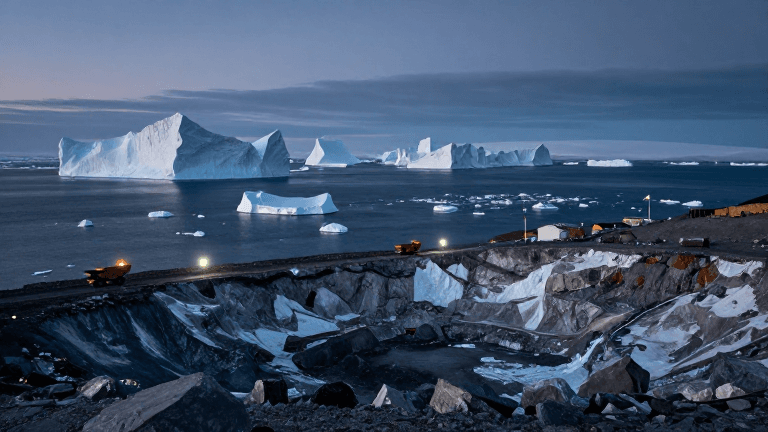
Everyone, if the United States takes Greenland and monopolizes its oil, gas, and rare earths, what impact will that have on us? This question needs to be broken down: Will it take it? Is opposition effective? Only then comes how it will impact our overseas interests.
Whether it will take it must be divided into subjective and objective aspects. Subjectively, the United States has actually already let itself go. Previously it spoke of law and rules; now it is demonstrating its determination to act as a robber. On January 6, White House Deputy Chief of Staff Stephen Miller said that the rule of strength, force, and power is the iron law of how the world operates; Trump said that the only thing that can constrain him is his own sense of morality, and added: I do not need international law. In 2019 he proposed buying Greenland through a real estate transaction, and at the time there was strong internal opposition in the U.S. government—the diplomatic establishment believed that since the United States already had troops stationed in Greenland, it was strategically safe and there was no need to humiliate Denmark and affect NATO unity. Now its cabinet is completely different. Ensuring its own supply of key resources and excluding rivals is one of its strategic priorities. In other words, its subjective willingness has become stronger.
So how important is Greenland, really? To put it plainly, it is a rich mine. The Arctic has no small amount of oil and gas resources: 90 billion barrels of crude oil and 44 billion barrels of liquefied natural gas, accounting for 13% and 30% of the world's recoverable reserves. A considerable portion of that is in Greenland. If the United States takes it, the energy landscape will be turned upside down. Then look at rare earths: Greenland's proven rare earth reserves are 1.5 million tons, eighth in the world. Although less than China's, the potential is enormous—for example, the intrusive rock body at Kvanefjeld in the south is estimated to contain more than 36 million tons of rare earth oxides. Greenland's deposits are characterized by polymetallic association and a high proportion of heavy rare earths. What is even more advantageous is their high grade: the same amount of mining can produce more key raw materials. There is no need to say much about the importance of rare earths—mobile phones, chips, robots, and missile systems all depend on them. Greenland also has large amounts of uranium, with reserves ranking sixth in the world. There is no need to elaborate on what that means for nuclear energy and computing power. Taking these resources is especially important for the United States because rare earths are largely distributed in BRICS countries, and the West as a whole does not have particularly much. Therefore, solving the rare earth bottleneck ranks very high in U.S. strategic priorities.
In 2019 the United States signed a memorandum of understanding with Greenland to increase mineral exploration efforts. Last June, the U.S. Export-Import Bank allocated $120 million in loans to fund Greenland's Tanbreez rare earth project. This mine was originally going to be bought by a Chinese company; the United States used various means to sabotage the deal and then acquired the mine at a lower price. This kind of contest has now become normal. The CSIS think tank said that acquiring resources is the top priority of U.S. diplomacy this year.
Having discussed the reasons why the United States wants to take it, let us look at opposition from various sides. First, Greenland itself opposes it: its five major parties issued a joint statement last Friday rejecting the U.S. attempt, saying we do not want to be Americans, nor do we want to be Danes; we just want to be Greenlanders. Denmark's position has also changed—in 2019 it dismissed the matter as absurd, but now it speaks of the principle of "not for sale": Greenland's sovereignty belongs to the people of Greenland, and Denmark has no right to transfer it. To this Trump said "opposition is ineffective": whether you are willing or not, the United States will take action. His reason was that if the United States does not take it, China and Russia will; rather than letting the enemy benefit, it is better to let a friend benefit—I can go easier; why do you need to struggle?
The U.S. establishment and European countries are uneasy from another dimension, believing that this kind of seizure is itself a form of self-harm and will trigger contradictions within NATO. NATO Article 5 is about collective defense—if one country is attacked, all respond—and its default enemy is the Soviet Union/Russia. It never imagined that the aggressor might actually be the United States. Once such a thing really happens, the entire alliance system will short-circuit, which in effect means the end of NATO. Last week, six countries—Britain, France, Germany, Italy, Spain, and Poland—issued a joint statement supporting Denmark, saying that NATO's security requires collective guarantees. This statement has a context: the United States cites Greenland and Arctic security, meaning to prevent China and Russia from getting involved; Europe means that we are equally worried, but please believe in the power of the collective and do not bear it alone. This is actually a strategic plea—the United States, do not act rashly, otherwise this big NATO family will fall apart.
Because Europe lacks strategic autonomy, it appears very humble. NATO Secretary General Rutte publicly called the United States "Papa" at last year's summit, just to coax the United States into staying in the alliance. Now he uses breakup to threaten the United States. Guess whether Trump hears that as "there is such a good thing."
Some strategic scholars believe that this behavior by the United States is a stab in the back to allies, because its robber logic is very clear: any NATO country's territory, as long as it is important to U.S. security, should belong to the United States. Suppose Poland is important—then the United States should take Poland without a Poland—so Warsaw should feel lucky, because it is too far from the United States and not in the Western Hemisphere covered by this Monroe Doctrine; of course, it is also too close to Russia. On the Russian side, there is already a voice saying that a Russian version of the Monroe Doctrine should also be pursued. In other words, a new international order is being shaped; past rules are losing their binding force, and what determines the fate of various places is actually a small number of great powers.
So the problems China faces include, in addition to specific matters of safeguarding overseas interests in Greenland—for example, Shenghe Resources has a 12.5% stake in the Kvanefjeld mine; will Chinese companies' agreements be invalidated because of U.S. control? Will overseas rare earth resources rise in price, thereby raising the costs of our high-end manufacturing? In addition, how should we assess the competitive advantage the United States gains from Greenland? Although we possess processing capacity that is more important than rare earths themselves and occupy an indispensable position in the industrial chain, as China-U.S. competition becomes increasingly fierce, this may evolve into composite competition. The U.S. logic is likely to be: I cannot cook myself, but I want to monopolize all the vegetables in the market. And much high-pollution chemical separation cannot be done on the U.S. mainland. Is it possible to force sparsely populated Greenland to relax environmental regulation and turn it into an offshore refining center? The probability is very low, but it cannot be ignored.
In addition, Greenland cannot be treated in isolation; it should be seen as part of Arctic strategy. The Arctic route is key to our "Ice Silk Road" and can greatly shorten our voyage to Western Europe. Over the past seven years, through scientific research, infrastructure, and buying mines, we have been expanding our influence in the Arctic region. Will these activities be interfered with by the U.S. military? Will our self-defined status as a near-Arctic state be blockaded by the United States? What can Russia do to cooperate with us? More importantly, how should China conduct itself in a world dominated by such power politics, and how much strength is appropriate to exert? How many places around great powers are special interest zones? Does a world in which a small country should be obedient and sensible, or else be ravaged and plundered, actually conform to our interests? In other words, troubled times give us opportunities—but would we then become robbers?