Gwadar Port in Pakistan: The truth hidden behind the busy scenes
10/31/2026#瓜达尔港#中巴经济走廊#一带一路#地缘观察
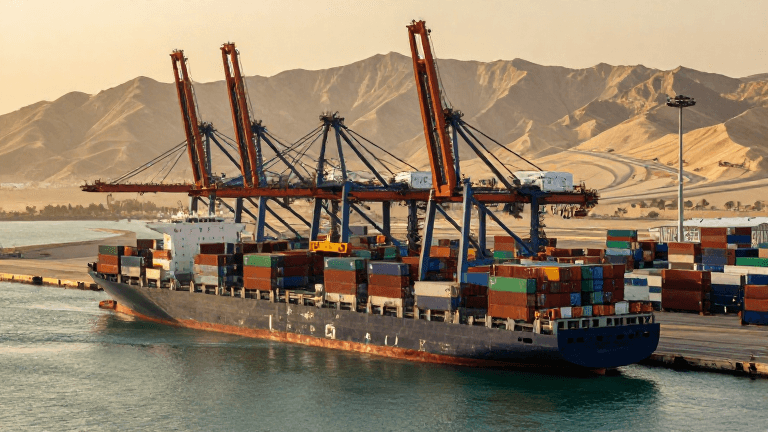
Everyone, last month Pakistan's Gwadar Port handled 11,000 standard containers. What's shocking about this number is not that it's less than one-tenth of Shanghai's Yangshan Port, but that Gwadar Port handled only 8,300 standard containers in all of 2025—in other words, in a single month this April, it did the volume of an entire year last year.
Gwadar Port is an important node of the Belt and Road, the endpoint and also the starting point of the China-Pakistan Economic Corridor. Given its current development progress, although its designed throughput reaches 16,000 standard containers, in reality it is far from realizing its full potential: from 2013 to 2018, a total of 99 ships docked there, averaging fewer than 20 a year. Yet on April 16 this year alone, two cargo ships came alongside, bringing 369 tons of machinery and equipment and 5,000 tons of fertilizer.
Port officials are quite excited, telling Pakistani media: our opportunity to grow bigger and stronger has finally come, and we want Gwadar Port to contribute 25 billion US dollars to the national economy. So, is Pakistan about to take off?
A local scholar is more cautious. He believes this unprecedented busyness is mainly a short-term dividend brought by the Strait of Hormuz being closed and then opened, opened and then closed again. When the Strait of Hormuz operates normally, a quarter of the world's seaborne oil and a fifth of its liquefied natural gas pass through it; the current situation has severely hit the global market. Can ships avoid the Strait of Hormuz? The only alternatives are the crude oil pipelines of Saudi Arabia and the UAE: Saudi Arabia can pipe oil from its eastern Persian Gulf oil fields to the Red Sea coast in the west for export, while the UAE connects Dubai on the inner side of the strait's mouth to Fujairah Port on the outer side. But overall their handling capacity is very limited, and most trade still has to rely on the Strait of Hormuz. For shipping companies, first, they need to avoid security risks; second, insurance premiums rise and the costs don't pay off—so this route is temporarily suspended.
But those ships already on the way that cannot avoid the strait, especially Chinese goods bound for West Asia, can only make temporary stops along the Arabian Sea coast in places that are relatively safe and less crowded. The best choice is Gwadar Port: it hugs the Gulf of Oman and is only 600 kilometers from the Strait of Hormuz—both outside the safe distance and one of the nearest deep-water ports, capable of accommodating large cargo ships. Many ships choose to rest and regroup here, waiting for the situation to become clear.
So although Gwadar Port looks very busy, it does not mean the goods arriving will enter the Pakistani market; it is more temporary loading, unloading, and warehousing—the port has more than 90,000 square meters of cargo storage space and also offers one month of free storage; after a month, the goods still have to be loaded and shipped onward.
Therefore, it is still too early to say Gwadar Port is about to take off. After all, a port's business does not rely on turmoil and war, but on long-term stability and development. Gwadar Port today is more like a temporary logistics buffer zone than a truly sustainable trade hub.
We also have to look at the trend. The China-Pakistan Economic Corridor was proposed in 2016, exactly 10 years ago, and Pakistan has built quite a lot of supporting infrastructure. For example, Gwadar International Airport opened in January last year, the East Bay Expressway has been connected to the highway network, and there is also the second phase of the project linking the airport and the port; many new highway trunk lines are also under construction. Gwadar Port is not just a wharf; it is more like a lever that keeps Pakistan investing in Balochistan Province, where it is located—investment hit a new high in the past year; as of March, the province had 148 projects under construction, covering roads, water supply, electricity, and education, of which 22 projects are underway at Gwadar Port alone, including the China-Pakistan Friendship Hospital we funded, which provides free medical treatment specifically to the poor, and the Gwadar seawater desalination plant we helped build, with a daily output of 5,000 tons of fresh water to alleviate local water scarcity.
Balochistan Province is truly not simple: it is Pakistan's largest, poorest, and most troubled province, bordering both Iran and Afghanistan, and the internal problems of Iran and Afghanistan spill over into it. For example, when the Afghan Taliban ban opium cultivation, Pakistan then faces a serious drug trafficking problem; when Iran's cross-border trade is disrupted, the livelihoods of Pakistani border residents are also affected. Separatist militants have long been undermining the China-Pakistan Economic Corridor, and Pakistan hopes to improve local livelihoods through sustained investment, win the support of local elites, and strengthen its control over the area.
Recently, the President of Pakistan visited China, which shows that we recognize Pakistan's mediating role between the US and Iran. Another important agenda is to advance the second phase of the China-Pakistan Economic Corridor, shifting from large infrastructure projects to special economic zones, developing industry, agriculture, mining, and information technology—not just hardware, but also pursuing economic depth. For example, how Gwadar and Hainan can link up, and ensuring the security of the China-Pakistan Economic Corridor.
Pakistan's overall strategic direction seems to be to further leverage its role as a land and sea hub—that is, to bind its economic future more closely to China's Belt and Road. But whether it can be achieved, we will have to wait and see.