Europe's Self-Pity: From Post-Qing to a Free Fall into Decline
11/4/2026#欧盟衰落#欧洲经济#中欧关系#地缘观察
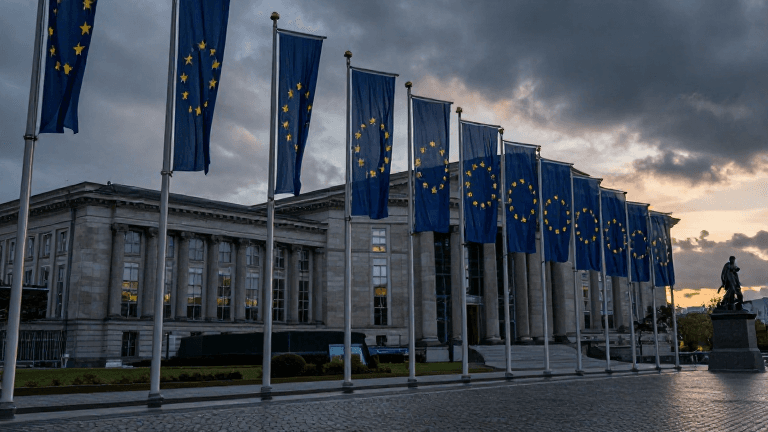
Everyone, look at this script! Jens Eskelund, chairman of the EU Chamber of Commerce in China, says that trade with China now creates no value but destroys value. Then he poses the Great Qing question: "Why trade?" — Why trade at all? I was stunned. What script is the EU using? Are they performing a queue-wearing Qing drama? Actually, many people have this impression: the EU is the post-Qing, and calling it the Great Qing is flattering, because research shows the EU is declining three times faster than the Qing dynasty did.
Luis Vassy, president of Sciences Po in Paris, wrote in an article a few days ago that from 2008 to 2025, the EU's share of the global economy fell from 30% to 17%. The same decline took China's Qing dynasty 50 years, from 1820 to 1870 — this comparison comes from Angus Maddison's famous research conclusion, which has always been controversial, so just take it with a grain of salt; after later revisions, China in the first year of the Daoguang Emperor's reign should have accounted for only a bit over 20%, and GDP peaked in the late Ming, meaning China's decline actually took even longer. Looking back at Europe's decline, the intensity is simply free fall. The decline of the Great Qing inflicted a century of humiliation on China and filled history textbooks with loss of sovereignty and national disgrace; if Europe declines like this, what kind of geopolitics it will face in the future is simply unimaginable.
Vassy speaks with restraint. He mentions that today conflicts are spreading across the world, the rule of law is collapsing, multilateral frameworks are being weakened, and a real revolution is arriving. Previously Europe projected its ideas, values, and influence onto the world; now the rest of the world is projecting their own set onto Europe. This reversal reminds us that Europe's reality is: its common life, social model, freedoms, and ability to choose its own path collectively are increasingly determined by forces outside Europe. Let me sum it up in two Chinese idioms: involuntarily driven, and passively enduring.
Not just Vassy — last year when the US and Europe signed an unequal trade treaty, people in European policy circles said this was the beginning of a century of humiliation. Europe's perception at the time was: the reason Trump could act like a 19th-century British imperialist was that the US led Europe in both military and technology, and could dominate the US-EU trade agenda. Only this year, this contradiction shifted from within the West, between the US and Europe — where family members just admit fault and move on — to between China and Europe. China and the US cut bilateral deals, and Europe found itself facing the so-called China Shock 2.0, suddenly realizing it needs to pursue strategic autonomy, industrial policy, defense investment, and industrial competitiveness, yet it is mediocre in all of the eighteen martial arts.
Europe suddenly discovered that too much energy had been devoted to welfare distribution and regulation, so that in the most cutting-edge areas of the global economy — the internet, AI, and new energy — it holds none. Take social media: American tech companies can easily use social media to open up the European market. Isn't this like what the UK's The Times asked: Still saying Europe isn't the Qing? Isn't social media the opium planted by Americans? When the new technological revolution is entirely led by China and the US, if Europe does not accelerate development in emerging fields, history's patience may run out.
Vassy believes Europe's way of thinking has gone wrong. As president of Sciences Po, France's top political science institution, he says Europe is only good at studying social power within states, and is more deconstructive than constructive toward the state, more critical than affirmative, neglecting research on power conflicts and strategy in the international system. When facing international conflicts, Europe prefers to analyze non-state actors and systematically belittles the important role of state power. This actually deliberately avoids the inevitability and necessity of state participation in international interaction.
Under international anarchy, the main form of community is the nation and the state. Europe avoids state power for two reasons. First, the trauma is too deep: after World War II, Europe spontaneously moved toward peace and anti-war sentiment, as if stopping thinking about power could free it from power struggles. Second, it is like marking the boat to find the sword: the generation holding intellectual power was educated between 1990 and 2005, and their knowledge system was shaped by Fukuyama's end-of-history thesis, believing that state power struggles would dissolve in the liberal democratic market. But what Fukuyama observed was only a moment in history, when the US and Europe accounted for more than half of world GDP, and a transatlantic-integrated Western civilization seemed settled. Now this way of viewing history and the world can no longer cope with new challenges.
Vassy calls for an ideological revolution among Europe's political elites. I call for their revolution to go even further. The Great Qing fell behind because it missed the Industrial Revolution; Europe had already entered industrial society while China was still an agricultural country, hence the gap. Today Europe's relative decline is fundamentally because China has achieved industrialization and caught up. Today's decline in GDP share is normal; the population size is there. In fact, Europe still has a lot of room to fall: the EU's 5.5% of world population produces 17% of world GDP, so its relative weight is still quite substantial.
Singaporean diplomat Kishore Mahbubani says that China and India leading the world is the historical norm, and that the West's few centuries have been an anomaly, an aberration. Now world history is returning to normal, so there is no need to make a fuss; a world not dominated by the West is not cruel — we are not the British Empire of old.