Bamboo Punk: A New Era of Ocean-Based Green Energy
9/12/2026#海洋工程#竹材料#新能源#光伏#中国制造
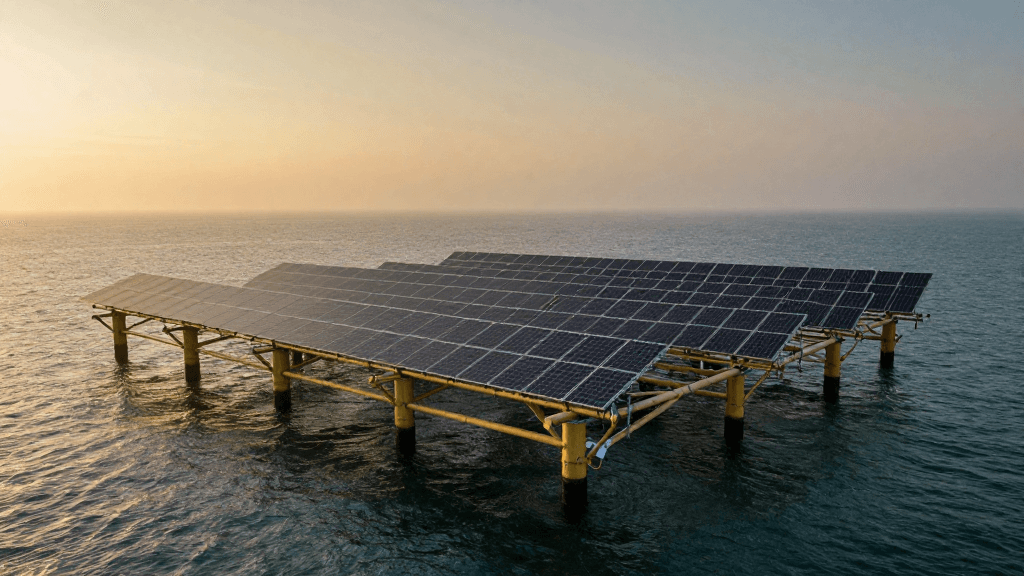
Hey everyone, we’ve recently come up with a new idea in the waters off Yantai—a bamboo-based offshore solar platform. To put it simply, it’s solar panels mounted on bamboo, floating in the ocean to generate electricity. This kind of innovation in China is truly simple and straightforward. Forget steampunk and cyberpunk—we’re going straight for “bamboo-punk,” and it’s truly a breath of fresh air.
Most traditional offshore solar platforms use steel frames or plastic. The former is prone to corrosion, while the latter requires UV protection. Not only do they entail high maintenance costs, but they also easily generate microplastics, causing secondary pollution to the marine environment. This time, we’re using bamboo—a material that combines strength with flexibility, is lightweight, and withstands rough seas. It’s truly a brilliant idea. Plus, bamboo is a green resource passed down from our ancestors; it’s both eco-friendly and low-carbon—truly killing two birds with one stone.
Let’s take a closer look at the specifics of this bamboo platform. The Jilin No. 2 platform was jointly developed by Zhongji Group and Beijing Forestry University. With a capacity of 100 kilowatts—a tenfold increase—it’s significantly larger than the Jilin No. 1 prototype. Standing 7 to 8 meters tall and covering an area of over 20 square meters, it can accommodate more than 200 solar panels. In the future, we plan to scale up to the megawatt class—that’s another tenfold increase—and we expect this to happen within the next couple of years.
The most significant difference between this second-generation technology and the first is the innovation in materials. The first generation tested whether bamboo could remain stable and resistant to corrosion in the ocean, while the second generation involves the large-scale application of bamboo-wrapped tubes and marine bamboo tubes. Bamboo-wound pipes are bio-based composite materials produced by mechanically winding bamboo fibers around a core membrane, using bamboo branches as an adhesive, and then heat-curing the assembly. This material is lightweight yet high-strength, water-resistant, and long-lasting; its density is only one-ninth that of steel, yet its tensile strength reaches half that of steel. It remains stable under acid and alkali corrosion as well as extreme temperatures, with a service life of fifty years for piping applications. Its compressive strength exceeds that of concrete pipes, and its seismic resistance is superior to that of steel pipes. This material has already been widely adopted in industry—it can be found in underground pipelines, building materials, and high-speed rail carriages. Using bamboo to replace wood and steel is truly a prime example of its application in high-end equipment.
The marine bamboo pipe was specifically developed by the School of Materials Science and Engineering at Beijing Forestry University for marine engineering. It utilizes prestressed continuous fiber reinforcement, which overcomes the weaknesses of bamboo in certain directions and elevates the pipe’s strength to the levels required for marine applications. The pipes are prestressed before deployment, allowing them to remain taut even in rough seas, which extends their service life and maximizes the tensile strength of the bamboo fibers. Among these two materials, “Zhonghe” stands out for its mechanical properties—it is impact-resistant, bend-resistant, and fatigue-resistant. It remains stable in environments with high salt fog, high humidity, high UV exposure, and high corrosion, and does not release metal ions or microplastic particles that pollute the ocean.
Currently, the Jilin No. 2 is already in operation, supplying power to an offshore purification platform located five kilometers away, achieving energy self-sufficiency. This project not only converts wastewater into anhydrous methane for storage but also generates clean energy during idle operation—truly a green, circular ecosystem.
In the future, if this technology is applied on a large scale globally, our competitive edge will be even greater. We are the country with the world’s richest bamboo resources, accounting for more than half of the world’s bamboo species, with a planting area of 7.5 million hectares, an annual bamboo production of 150 million metric tons, 15,000 product varieties, and an annual industrial output value of 520 billion yuan. Whether in terms of scale, variety, or the completeness of the industrial chain, we rank first in the world. So, “Bamboo Punk” is certainly not just empty talk. China’s green technology is not only environmentally friendly but can also form a harmonious, symbiotic system—and this is the true path to sustainable development in the future.
Ladies and gentlemen, our “Bamboo Punk” concept is truly a brilliant idea—both eco-friendly and innovative. The future lies in this approach, not in pursuing a utopia disconnected from our current way of life. Our technology is truly taking one step at a time toward true green harmony.