Returning to the Yangtze: Ryo Takeuchi’s Affection for Japan and His Cultural Exploration
9/12/2026#中日关系#纪录片#文化交流#竹内亮#自媒体
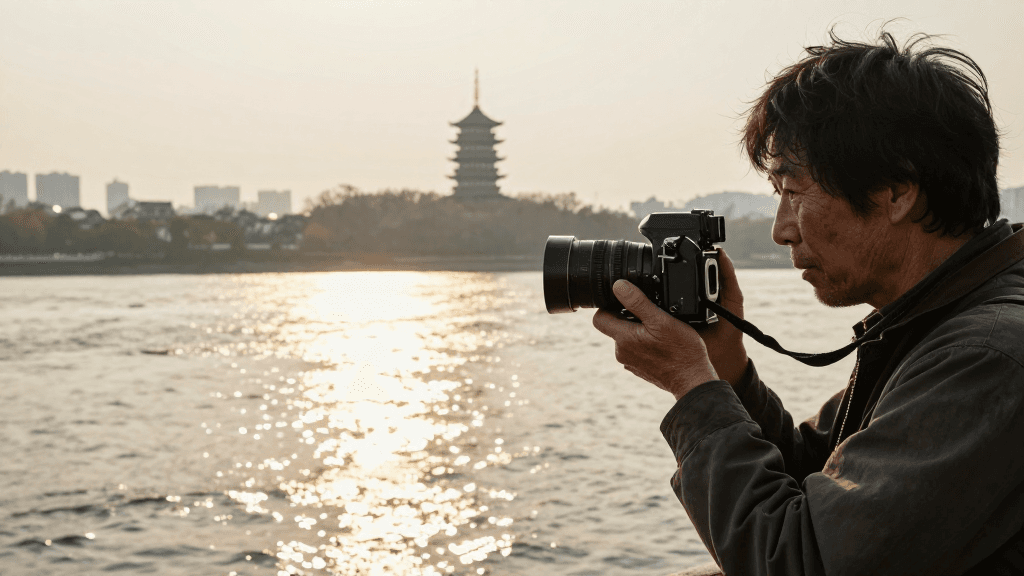
Hey everyone, today I want to talk about Japanese director Ryo Takeuchi’s documentary *Return to the Yangtze*. I’m not trying to hype it up on purpose—you all know that calling it a “bridge for Sino-Japanese friendship” is way too much of a stretch. I just wanted to check it out.
Actually, Director Ryo Takeuchi’s latest film, *Back to the Yangtze*, has left me with a flood of emotions. I didn’t make this film for the sake of Sino-Japanese friendship—I simply wanted to see it, shoot it, and learn more about it. Yes, it’s really that simple.
Director Ryo Takeuchi said this project was primarily driven by a regret from 10 years ago: back then, he didn’t manage to capture the very first drop of water at the source of the Yangtze River. For this project, he set out directly from the Tongtian River and traveled through cities and rural areas across China. So why not just go straight to the Tongtian River? The reason is simple: he wanted to retrace his steps and make up for that past regret. Also, when he filmed 10 years ago, he couldn’t speak Chinese, so he was unable to conduct many in-depth interviews. Now that he’s learned Chinese, he can communicate on a much deeper level. So, this filming project can be seen as both making up for the past and exploring the future.
Speaking of the filming style, Director Ryo Takeuchi said he wanted to shatter people’s traditional perceptions of documentaries—making them less serious and instead lighthearted, humorous, and touching. This philosophy really resonates with me; after all, a child described this film as a comedy, and that comment moved me deeply. Indeed, documentaries can be lighthearted and fun—and that’s a positive trend.
So why make *Return to the Yangtze*? Director Ryo Takeuchi explained that when he filmed the Yangtze River 10 years ago, he wasn’t yet familiar with some Chinese customs. By returning now, he can better communicate with the locals and gain a deeper understanding of their lives and perspectives. Behind this lies his passion for *Romance of the Three Kingdoms*, and especially his special connection to the Yangtze River. He said that every time he sees a scene related to the Yellow River, he feels a strong urge to film the Yellow River himself. This reminded me that every region has its own “mother river”—China has the Yangtze, and while Japan also has rivers, it lacks the concept of a “mother river.” The cultural differences behind this are quite interesting.
Director Ryo Takeuchi said that as a child, he was very interested in traditional Chinese culture, but he came from an ordinary family with no special background. However, his passion for film began at the age of 15. Watching the movie *Rise of the Planet of the Apes* completely transformed his perception of film, and from then on, he embarked on the path of documentary filmmaking. He said that his primary motivation for making documentaries is to satisfy his own curiosity and understand the world.
While making documentaries, Director Ryo Takeuchi discovered that Japanese audiences harbor many misconceptions about China. He believes that making documentaries is not only about showcasing China’s beauty but also about breaking down prejudices and revealing the truth. Having lived in China for over a decade, he has gained a deeper understanding of the country. He noted that while China is developing rapidly, its educational system remains very strict. He sent his children to school in Japan, hoping they could grow up in a more relaxed environment.
Director Ryo Takeuchi also mentioned that the motivations of Chinese people visiting Japan vary by generation: those born in the 1950s and 1960s came to earn money; those born in the 1970s and 1980s came to learn technical skills; and those born in the 1990s came to pursue their dreams. Nowadays, those born in the 2000s come to Japan primarily for fun. These changes have allowed him to witness the evolution of Chinese society. He noted that Chinese audiences are also very interested in Japanese culture, but he is somewhat concerned that Japan’s tourism market is becoming increasingly closed off.
Finally, Director Ryo Takeuchi stated that his documentary stems from curiosity and personal interest, and he hopes to bring authentic and engaging content to viewers. He explained that this is not merely a bridge for Sino-Japanese friendship, but rather a reflection of his personal curiosity and exploration of the world. He hopes to continue documenting the world through his lens and sharing his experiences and observations.
Ladies and gentlemen, this is the story of Director Ryo Takeuchi and his documentary *Return to the Yangtze*. We hope to see more works like this in the future, helping us better understand the world.