The Remarkable Transformation of Ansteel’s Tailings Pond: From an Internet-Famous Photo Spot to a Green Treasure
9/11/2026#鞍钢#尾矿处理#难选铁矿#磁化焙烧#绿色冶金
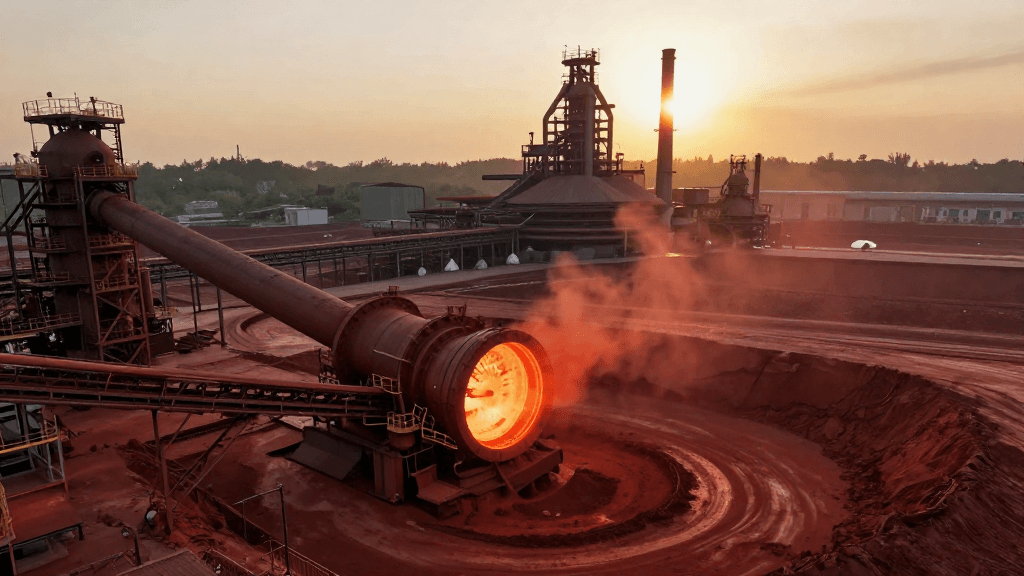
Ladies and gentlemen, Ansteel, our country’s historic industrial hub, boasts a century of history. It’s a place dotted with tailings ponds. In the past, these tailings ponds looked like a romantic painting—truly spectacular when viewed from the air. Some say they are the “blood of the earth,” the pain of Northeast China’s old industrial base, and a fantastical land awaiting rebirth. But in the future, this “filter” will likely be removed by new technologies. Those past wonders that we once cherished may truly disappear from view.
Just look—our Science News has just published a major story. Over in Anshan, Liaoning, they’re carrying out the world’s largest magnetized roasting project for iron ore, and it’s quite the spectacle. In the future, tailings will no longer be industrial waste; instead, they’ll be transformed into high-quality assets. How exactly does this turn waste into treasure? It all starts with iron ore processing. The globally accepted process is known as the long process: iron is smelted in a blast furnace, and steel is produced in a converter. In the blast furnace stage, carbon dioxide generated by burning coke is used to reduce the iron oxide in the ore, turning it into liquid pig iron, which is then sent to the converter for refining. Blast furnaces are extremely energy-intensive. If the raw ore has a low grade—with more rock than iron—burning it for a long time yields no results, making the process economically unfeasible.
China’s iron ore has an average grade of only about 30 percent—it’s essentially “junk ore.” In contrast, iron ore from Australia and Brazil has a much higher grade and can be fed directly into the furnace after being crushed. This is the crux of China’s resource dilemma. Although the country has vast territory and a full range of natural resources, the quality of these resources remains a major headache. The geological structure is complex, with small-scale deposits, low grades, and complex compositions. Iron ore is a prime example: while reserves total 20 billion metric tons, mining is expensive, beneficiation is difficult, and energy consumption is high. Consequently, China must import 1.2 billion metric tons of high-grade iron ore annually, with Australia and Brazil serving as the primary suppliers. We have long been engaged in a tug-of-war with these giants; although we have mastered some technologies, our reliance on foreign sources remains as high as 80 percent.
Against this backdrop, it becomes particularly important to fully tap the potential of domestic iron ore. The vast majority of China’s iron ore consists of hematite, limonite, and siderite. These ores have complex compositions and require magnetic roasting and high-temperature reduction. Mr. Guo Musun, a veteran of China’s chemical industry, made foundational contributions to fluidized-bed technology early in his career. After returning to China, he proposed an innovative approach combining fluidized-bed technology with magnetic roasting. Easier said than done, however: the ore powder tends to clump and agglomerate, and gas control poses another major challenge. It wasn’t until the 21st century that a real breakthrough was achieved. Postdoctoral researcher Dr. Zhu Qingshan took on this niche project, and after 20 years of effort, finally achieved stable full-capacity operation on September 1 of this year.
Dr. Zhu’s technology can process extremely low-grade iron tailings into iron concentrate with a 65% iron content, achieving a magnetic conversion rate as high as 98%, reducing overall energy consumption by 35%, significantly cutting carbon emissions, and markedly lowering production costs. The commercialization of this technology has unlocked nearly 30 billion metric tons of hard-to-process iron ore and 10 billion metric tons of existing tailings. In addition to Ansteel, many other long-established steel and mining bases have large amounts of tailings, so this technology is sure to gain momentum and be widely adopted in the future. Dr. Zhu has already signed eight technology licensing agreements, and last year the technology was introduced to an iron ore project in Laos, where two 2-million-metric-ton-capacity production lines are planned.
This technology is not only capable of making a significant impact domestically but also has the potential to expand overseas. Many countries around the world—such as Mongolia, Central Asia, and Iran—possess vast deposits of low- to medium-grade, complex, and difficult-to-process iron ore that have long lacked the technology for development. If Chinese technology is introduced, these low-grade ores can be transformed into high-grade iron concentrate on-site, enabling the development of previously untapped resources and generating additional foreign exchange earnings. This is not only a great business opportunity but also ensures a stable supply of resources. In the future, we must pay attention to geopolitical and political stability and select countries with a high degree of integration into the “Belt and Road” Initiative to establish mining partnerships. Having this safety net to prevent overseas iron ore supply bottlenecks is of the utmost importance. Don’t forget that this technology can also be applied to other metals. Possessing such technology truly is a blessing for China.