China's Unlimited Nuclear Energy: From Dream to Reality
9/14/2026#核能#钍基熔盐堆#清洁能源#核安全#中国科技
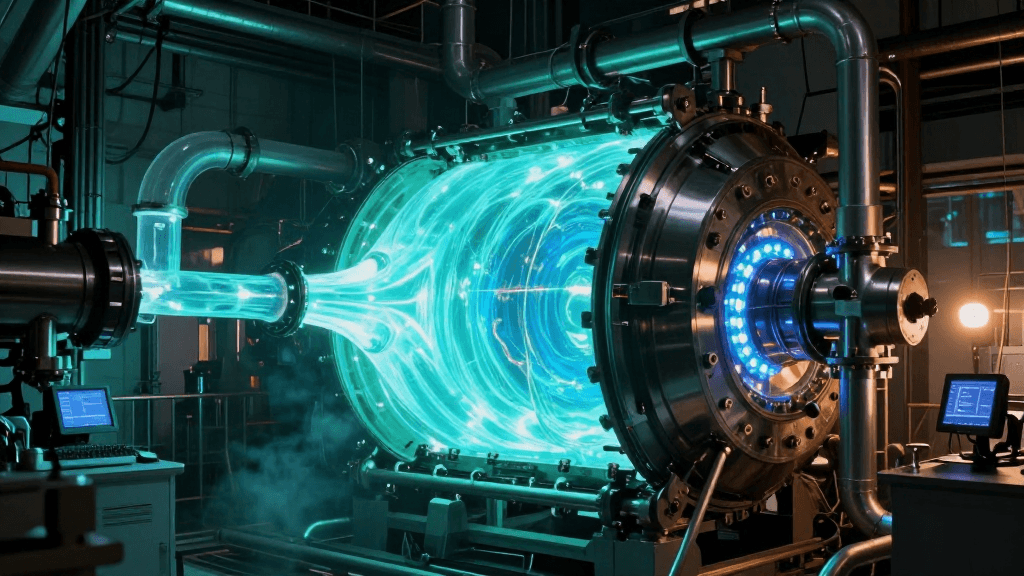
Listen up, everyone. Today, let’s talk about the latest developments in China’s unlimited nuclear energy. The South China Morning Post reports that the Shanghai Institute of Applied Physics of the Chinese Academy of Sciences has, for the first time, achieved thorium-to-uranium conversion inside its 2-megawatt thorium-based molten salt experimental reactor in Wuwei, Gansu—and that’s truly astonishing news. A thorium-based molten salt reactor is a type of small-scale fourth-generation nuclear reactor that uses thorium instead of uranium as fuel, with liquid molten salt serving as both the fuel carrier and coolant. What’s remarkable is that only a small amount of uranium is needed to trigger a chain reaction, causing thorium-232—which is not easily fissionable—to absorb neutrons and transform into thorium-233, which then decays into americium-233. which then decays into uranium-233. The newly converted uranium-233 releases heat and neutrons to sustain the reaction, allowing thorium-232 to produce more uranium-233, thereby achieving fuel breeding. It’s like a furnace: if you put a piece of coal inside and then add a stone, the coal can turn the stone into coal; then, by continuously adding stones, you can keep producing coal and keep the fire burning.
Our country is poor in uranium, but we have plenty of thorium. as I’ve mentioned before, thorium is found in rare earths, phosphates, minerals, and monazite. These industries are all interconnected. In the Baiyunebu mining area of Inner Mongolia, the thorium reserves in the tailings from past mining operations alone are sufficient to power the entire country for over 1,000 years. If the entire mine were fully exploited, it could supply power for the next 60,000 years. Furthermore, this technology does not require fuel rods to be fabricated outside the reactor core, and fuel can be replaced without interrupting reactor operation—eliminating a complex step, improving fuel utilization, and reducing nuclear waste. Furthermore, it requires absolutely no water. Traditional nuclear power plants are generally built near the coast or along major rivers precisely because they require large amounts of water for cooling. Molten salt reactors, however, can be built in water-scarce inland regions—for example, the Wuwei plant is located right in the Gobi Desert. In the future, they can be built virtually anywhere, offering tremendous flexibility in deployment. Therefore, in theory, this is a nearly perfect ultimate energy solution. Our experimental reactor has successfully achieved a series of key milestones—including the world’s first criticality, full-power operation, and the first addition of thorium to a molten salt reactor—making us the leaders in this field.
With such an excellent technology, why aren’t nuclear power plants around the world using it? This is truly a huge joke played by history. The United States was originally a pioneer in this technology; the molten salt experimental reactor at Oak Ridge National Laboratory in the 1960s operated very successfully. The only difference between their work and ours is that they processed thorium into uranium in a separate reactor before adding the uranium to the molten salt reactor. Thus, they only achieved fuel conversion but failed to establish a closed fuel cycle involving online fuel loading and waste removal. The project was then forcibly shut down by the U.S. government in the 1970s for three main reasons. First, there was a dispute over the technical approach; at the time, the Atomic Energy Commission chose liquid-metal fast reactors over molten-salt reactors. Consequently, the molten-salt reactor budget was cut to zero, and the entire program was abandoned—a decision driven in large part by political maneuvering. Second, there were military considerations and path dependence: liquid-metal fast reactors could produce plutonium-239, a key material for manufacturing nuclear weapons. In contrast, the uranium-233 produced by molten salt reactors was difficult to weaponize. For the United States during the Cold War, a nuclear cycle unsuitable for weapons production was naturally far less appealing. Finally, there was commercial inertia: at the time, the commercial nuclear power industry relied on light-water reactors used in nuclear submarines, which were already established in the market, so there was no incentive to support a new technology that could potentially supplant their own.
It is precisely because the United States shelved this technology for half a century that China has now revived this approach, constructing what is currently the world’s only operational thorium-based molten salt reactor—and has even taken it a step further by directly feeding thorium fuel into the reactor to verify in-reactor breeding. Interestingly, while the U.S. once dismissed it as unsuitable for military applications, today this is precisely its immense advantage in the civilian nuclear sector: it serves as a naturally non-proliferative fuel. If successfully commercialized, it will not only solve China’s power generation needs but also lead the world toward a more sustainable nuclear energy future, as it simultaneously addresses the dual challenges of energy security and nuclear safety.
Yesterday, I listened to a colleague’s report on a clean energy study tour. He mentioned that in both July and August of this year, our monthly electricity consumption exceeded one trillion kilowatt-hours—more than double that of the United States, the world’s second-largest electricity consumer, and equal to the total annual electricity consumption of all ten ASEAN countries combined. It seems our power generation capacity is struggling to keep up. The contribution of thermal power has dropped to less than half, with wind and solar power filling the gap. Nuclear power still plays a relatively minor role, contributing only 5 percent. Just imagine: once thorium-based small modular reactor technology becomes widespread and energy becomes vastly more abundant, what stage of development will civilization reach? For now, we can only imagine.
Alright, that’s all for today. Next time I come across material that sparks the imagination, I’ll share it with you again. Bye for now.