South Korea Faces an Energy Crisis: The Pain and Helplessness of Being Held Hostage
9/23/2026#伊朗#能源危机#韩国#中东局势
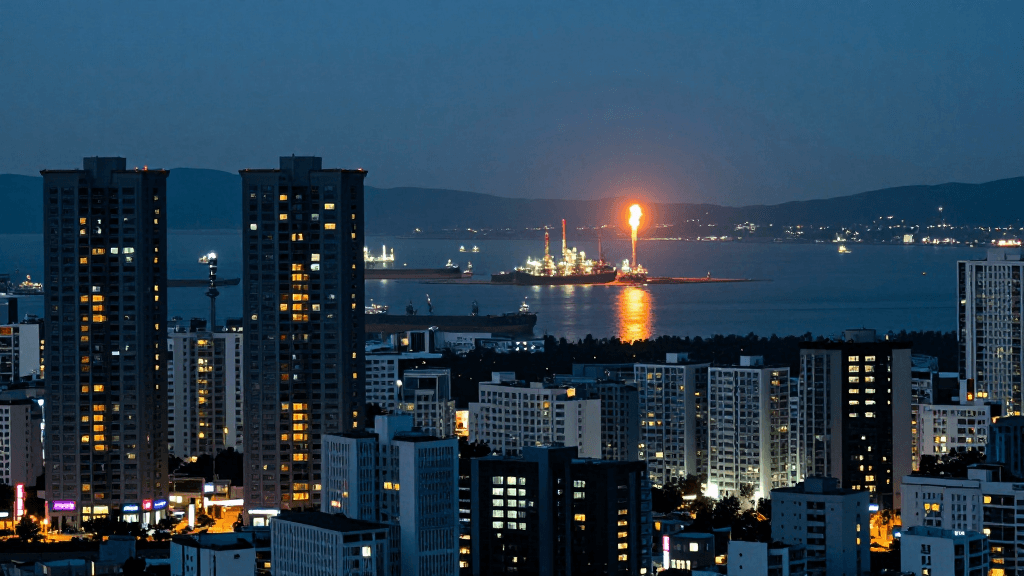
Ladies and gentlemen, South Korea has recently found itself in a tight spot, struggling to catch its breath. With the threat of war looming over Iran, the Strait of Hormuz—a waterway less than 35 kilometers wide—has become a “strategic chokepoint,” and even South Korea, 3,500 nautical miles away, can no longer sit idly by. To cope with the energy crisis, they’ve had to cut their shower time to the minimum allowed, and even laundry must be piled up until the weekend to be done all at once. And that’s not all—South Korea’s industrial sector’s reliance on imported energy is truly jaw-dropping. The Persian Gulf supplies one-fifth of the world’s energy needs, and 84% of South Korea’s energy imports—particularly 70% of its oil and 20% of its liquefied natural gas—come from the Middle East. Although Japan is no slouch either, it has nuclear power and oil reserves to fall back on, so its energy diversification is better than South Korea’s—South Korea is truly at a critical juncture.
South Korea’s energy shortage is a genuine crisis. Because it is a true “island,” it has no access to other countries’ power grids for emergency imports. Its industrial structure is also extremely energy-dependent, with heavy industry, petrochemicals, and advanced manufacturing all being energy-intensive sectors. Any crisis in energy supply would shake the very foundations of the nation. Currently, South Korea has approximately 200 days’ worth of oil reserves and 9 days’ worth of natural gas reserves, though actual reserves are far higher than the legal minimum. However, Qatar—the second-largest supplier of liquefied natural gas (LNG)—is set to take 17% of its production capacity offline for 3 to 5 years, meaning South Korea must quickly find alternative suppliers. These are likely to be the United States or Australia.
The energy shortage has directly led to soaring shipping and air freight costs, indirectly contributing to inflation. South Korea’s most pressing issue at the moment is the supply of naphtha, a core raw material for the petrochemical industry. Naphtha is a key ingredient in plastic production, and its price has surged by more than 120%, directly impacting the upstream supply chain for plastic products. Despite the South Korean economy appearing robust on the surface, plastic bags have been snapped up, and convenience stores have even run out of trash bags.
The South Korean government has shifted into emergency mode, monitoring 23 key commodities—including rice, fertilizer, and school uniforms—and has established an emergency economic response mechanism to prevent prolonged tensions in the Middle East from triggering a crisis affecting people’s livelihoods and the economy. Experts estimate that this crisis could last 3 to 6 months. In the best-case scenario, South Korea’s GDP growth rate could drop from 1% to 0.7%; in the worst-case scenario, the crisis could persist for a year, resulting in zero economic growth for the country.
For South Korea, the Middle East is not just about oil and gas; 41 strategic raw materials in its industrial supply chain—70 percent of which are imported from the Middle East—come from just three countries. For example, a certain mineral is sourced from Turkey, oil from Saudi Arabia, and iodine from Israel. Semiconductors are a vital pillar of South Korea’s economy. In recent years, the country has increasingly focused on AI and built its growth strategy around chips. Samsung and SK Hynix dominate the global memory chip market, underpinning the boom in AI and cloud computing. Not only does this consume vast amounts of energy, but the supply chain is also fundamentally reliant on the Middle East: cooling wafers in semiconductor manufacturing requires helium, and 65% of South Korea’s helium comes from Qatar; meanwhile, 98% of the xenon used in the production process comes from Israel. Fortunately, before the conflict in Iran began, there was a relative surplus of supply, and South Korea’s semiconductor industry maintained an average inventory of six months.
AI is a highly globalized industry where a single change can have far-reaching consequences. South Korean-made HBM memory chips are primarily sold to TSMC, which manufactures them for NVIDIA. Since half of Taiwan’s electricity generation relies on liquefied natural gas (LNG), if LNG supplies are disrupted, TSMC will have to cut production—and even if Samsung manages to produce memory chips, it won’t be able to sell them. Compounding the problem is the fact that the Middle East, with its abundant energy resources, is home to a high concentration of AI data centers—and the war will inevitably force companies to reconsider their deployment strategies. South Korea’s economic miracle is inextricably linked to the U.S.-led international order. When a hegemonic power’s monopoly on the use of force is called into question or challenged, countries that have been riding on its coattails must consider how to address long-term risks.