Trump’s “Science of Winning”: A Minor Incident in Cuba and the Grand Strategic Game in Latin America
9/23/2026#古巴#美国#特朗普#地缘政治
Folks, let’s talk about the “Art of Winning” in the United States. It’s all about small victories every day, but Trump—this “master of winning”—has truly been full of “grand ambitions” this year: taking down Khamenei, kidnapping Maduro, and threatening Greenland and Panama. Each and every one of these moves has left the whole world speechless. So what’s he up to next? While the world’s attention has been drawn to Iran, the U.S. has been quietly reaching out to Cuba’s top leadership. Trump revealed that Cuba is in big trouble—it has no money and, essentially, nothing at all. Meanwhile, Republican heavyweight Rubio is engaged in very high-level private talks with Cuba. In Trump’s words, the U.S. might eventually carry out a “friendly takeover” of Cuba—that is, a “Friendly Takeover” rather than a “Hostile Takeover.” It’s not about forcing them to submit, but about getting them to hand over control voluntarily.
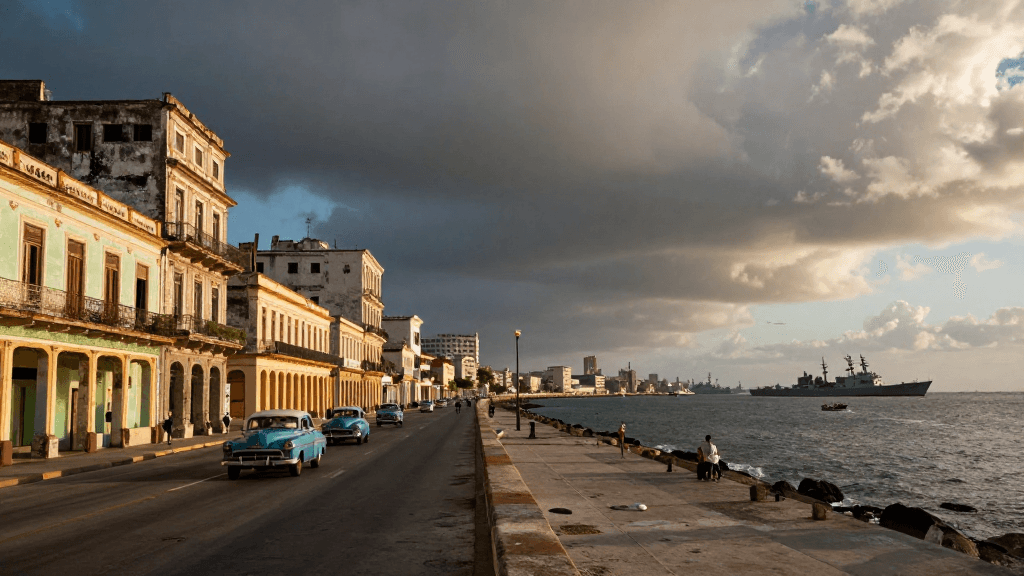
Cuba has long been the vanguard of anti-American sentiment in Latin America. Subject to a comprehensive U.S. embargo for many years, its economy is extremely fragile. Its oil supplies come primarily from Venezuela and Mexico, but now one of these countries has been swiftly targeted by the U.S., while the other faces the threat of sanctions, leading to a cutoff of Cuba’s oil supply. Without energy, the country comes to a complete standstill—no oil means no electricity, and without electricity, production is impossible. The hardships in food, transportation, healthcare, and other aspects of daily life have already reached a critical point. The U.S. is adopting a strategy of “acting without attacking” toward Cuba—what opportunity is it waiting for to change U.S.-Cuba relations?
Since Trump’s focus remains on Ukraine and Iran—two issues involving broader great-power rivalries—Cuba has been pushed to the back burner. Related matters have been entrusted to Cuban-American Secretary of State Rubio, which is also part of the strategy to wait for an opportunity to fundamentally transform U.S.-Cuba relations. According to U.S. media reports, Rubio has bypassed official Cuban channels and, rather than dealing with First Secretary and President Díaz-Canel, has instead established contact with former First Secretary Raúl Castro—Fidel’s younger brother. Raúl is now 94 years old and unable to negotiate directly; in reality, it is his grandson and caretaker—Raúl Guillermo Rodríguez Castro—who is acting on his behalf. The Cuban government has denied any high-level bilateral government talks but has not denied the private contacts mentioned by the U.S. side. Thus, while the U.S. publicly applies pressure on Cuba as a whole, it privately extends an olive branch to the political elite in an effort to win them over. First, this indicates that the Trump administration still views Raúl Castro as the true decision-maker behind the scenes, which is why it seeks to bypass the bureaucratic ranks within the government and engage directly with the person holding the real power.
According to Trump’s advisory team, they have reached out to a number of influential Cuban elites, but the individual they value most and are most eager to win over is “Little Castro”—the son of Raúl’s eldest daughter, Deborah, who was his grandfather’s favorite. He currently serves as chief bodyguard and has taken over the Cuban Enterprise Management Group from his father—a conglomerate that accounts for three to four tenths of Cuba’s national economy. The U.S. negotiators are keeping a close eye on Cuba’s real power players, and the talks between the two sides have been surprisingly cordial. Rubio and Castro Jr. not only share the same ethnic heritage but even have the same accent; there were no political criticisms of the past, only visions for the future. In other words, the talks went quite well—but why is that? Has the U.S. changed? No, it is Cuba that has changed.
According to U.S. assessments, Cuba’s political elite was deeply shaken by Maduro’s abduction. The U.S. military suffered no casualties but killed at least 32 Cuban intelligence and military personnel who had been dispatched to Venezuela to protect Maduro. Even more lethal than the deterrent effect was the U.S. decision to leave the door open, allowing Venezuelan Vice President Delcy Rodríguez to serve as acting president. The signal this sends to Cuba is that the U.S. does not seek a complete regime change, but will allow certain friendly elites to remain in power. This amounts to a reshuffling of positions within the Cuban elite—which is already the greatest temptation—so everything is open for discussion.
Cuba’s younger generation of business elites believes the revolution has failed and is ready at any moment to act as collaborators. This is also why the U.S. has not taken direct action—it is waiting for internal turmoil in Cuba to put pressure on the government. As things stand, the U.S. is likely to improve relations with Cuba, bringing a more pro-American regime to this strategic hub at the crossroads of the Caribbean and the Atlantic, which would greatly help strengthen America’s geopolitical advantages.
Incidentally, Trump’s “Trumpism” is gaining momentum, and anti-American sentiment among various Latin American governments may wane for some time. For example, the recent seven-day goodwill visit to Chile by China’s naval hospital ship, the Silk Road Ark, was not without its challenges. Chile has long maintained good relations with us, so why did the Chilean Ministry of Health refuse to approve these humanitarian medical services? Because the United States was pressuring Chile and imposed visa sanctions on three Chilean government officials, claiming that Chile was undermining security in the Western Hemisphere.
It turns out they were involved in a submarine cable project connecting Hong Kong to Chile, which included Chinese companies in its construction. This is the first cable linking Asia and South America; once completed, electronic communications will no longer need to pass through the United States, thereby challenging U.S. monopoly over critical infrastructure in South America. Back in 2019, Chile was forced to cancel a project for a direct submarine cable to Shanghai due to U.S. pressure. This time, after weighing its options, Chile has put forward a compromise: it will allow the “Silk Road Ark” to dock for a friendly visit and conduct medical exchange activities, but it will prohibit the ship from providing medical services to local Chilean residents.
Chile is currently in the midst of a transition of power, and the incoming right-wing government of Castor has already chosen sides; it will adopt a more overtly pro-U.S. stance in the future, which is part of Latin America’s collective shift to the right. Maduro’s kidnapping early this year arguably accelerated this process. So don’t be fooled by Trump’s unreliability—nine out of ten of his statements are just bluster—because most of the world’s true decision-makers aren’t even capable of pulling off such bluster.