Trump’s “Greenland Dream”: Is It the End of the American Dream or a European Nightmare?
9/20/2026#格陵兰#北约#北极#国际关系
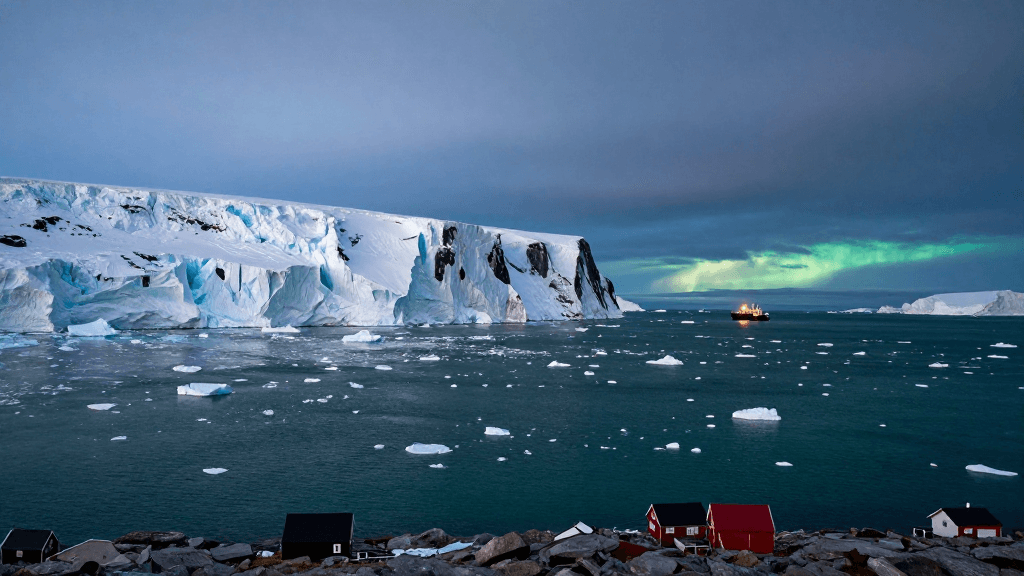
Ladies and gentlemen, Trump’s speech at Davos was like a carefully choreographed circus act—one moment he was playing the fool and acting crazy, the next he was putting on airs, spouting nonsense left and right. He said Denmark was ungrateful, mistook Greenland for Iceland, and made a mockery of the governor of California. Finally, he suddenly backtracked, saying he wanted to work out a future agreement with Greenland, shifting the focus to military bases and mining rights. U.S. media reported that China hopes Trump will score some points on the Greenland issue; the more the U.S. and Europe clash, the more advantageous it is for China.
The Russians weren’t about to be outdone either. Kremlin spokesperson Peskov stated bluntly that if Trump “swallowed” Greenland, it would be a sign of disrespect toward Russia. Trump’s nominee for ambassador to Iceland even joked that he might end up serving as the governor of the 52nd state. The atmosphere suddenly lightened, and everyone felt that the U.S. and Europe could play nicely together again. However, that was far from the truth.
Trump’s obsession with Greenland hasn’t gone away; he’s shifted to a “British-Cyprus model,” seeking full sovereignty over military bases and planning to build more of them. Although Denmark has veto power over site selection, Trump doesn’t really care. So, what exactly makes Greenland so appealing?
First, resources. As early as 2019, Australian geologists recommended the idea of purchasing the island to Trump. With global warming, the Arctic is rich in resources, and U.S. companies could secure priority mining rights through pressure, lobbying, and other means. As for national security, the Thule Air Base, established by the U.S. in northwestern Greenland, can monitor Russian aircraft. Although the Russian Navy’s overall strength is not what it was during the Cold War, it does not need Greenland to the extent that the U.S. does.
China is also very interested in the Arctic but has no territorial claims there. Even if Trump were to acquire Greenland, China could still obtain resources through other channels. The key lies with Denmark, which is the U.S.’s most steadfast ally in NATO; whatever the U.S. wishes to do in Greenland, Denmark will allow. Denmark is willing to shoulder the costs of expanding and maintaining U.S. military bases in Greenland.
Trump aims to use Greenland to control the Arctic shipping lanes and prevent China from gaining a foothold there. That said, Denmark is one of the U.S.’s most loyal allies in NATO. Located close to the North Sea and the Baltic Sea, it has strong security needs. Whether the U.S. wants to reactivate old bases, expand existing ones, or even build new ones in Greenland, Denmark is willing to cooperate—and is even willing to foot the bill. Yet the U.S. has instead scaled back its troop presence; the Pitufik base is much smaller than the former Thule Air Base. Since there is nothing the U.S. cannot achieve within the existing alliance system, only one possibility remains: the U.S. increasingly views the alliance system itself as obsolete and intends to destroy NATO from within.
Throughout his speech at Davos, Trump made clear his core philosophy: a complete disregard for the post-World War II world order. He criticized Europe’s steadily declining share of global GDP, warning that if this trend continues, Europe will be unrecognizable. He did not say the U.S. would withdraw from Europe; on the contrary, he said he wanted to help Europe revive. Yet vast amounts of capital are fleeing Europe, with much of it flowing to the U.S.
The United States’ NATO allies have long been a losing proposition. During the Cold War, Europe served as a geopolitical asset for containing the Soviet Union, but today, with its stagnant economy, heavy welfare burden, lack of high-tech growth drivers, and dependence on the United States, the situation has changed. Maintaining the NATO system is a bad debt costing the U.S. hundreds of billions of dollars annually. If Europe remains prosperous and stable, a U.S. troop withdrawal would be seen as a betrayal; if Europe descends into chaos, both domestic U.S. public opinion and the international community would conclude that the U.S. has done all it can.
Thus, chaos allows the U.S. to transform from a betrayer into a rational actor forced to cut its losses. Europe’s diplomatic circles have already recognized that a major, perhaps irreversible, rift has emerged between Europe and the United States. Fukuyama, writing in the U.S. online magazine *Persuasion*, advised Europe not to back down. But Europe’s military strength is insufficient to support Fukuyama’s fantasy. Although some countries have increased their defense spending, the proportion of joint procurement remains inadequate, and the lack of military integration is Europe’s greatest weakness.
Trump’s “Greenland dream” is not about controlling maritime trade routes, but rather about securing a strategic location to prevent China from controlling Arctic shipping lanes and to facilitate shipping between Asia and North America. Overall, Trump wants to dismantle NATO from within and shift more defense responsibilities onto Europe. But this is merely a tactic; his true goal is to reduce the U.S. presence in Europe and shift its focus to Asia.