Will virtual technology destroy human society?
9/24/2026#人工智能#增强现实#科技与社会#就业未来
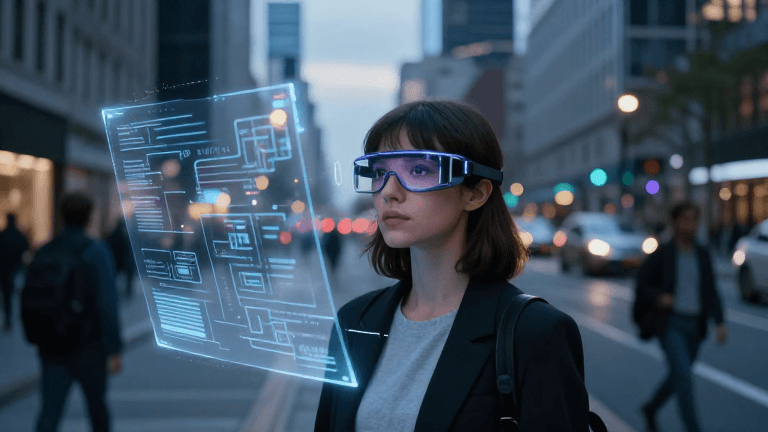
Everyone, today I’d like to talk about a foreign expert in augmented reality, Irena Cronin, who made some remarks on the show *The Answer Lab*. The topic sounded pretty alarming: “Will virtual technology destroy human society?”
Her answer was actually much more measured than I had expected. She said that with AR, what you see is still the real world around you—it’s just that some objects have a layer of information superimposed on them, making them “augmented.” So it doesn’t pull you into a completely virtual world; on the contrary, it helps you better understand reality. That’s the truth of the matter—technology isn’t trying to create another universe for us; it’s simply adding a layer of context to the world we already have.
The question is, why do people force themselves to embrace these technologies? Her answer was straightforward: because in business, you have to move fast. If you don’t move, others will, and you’ll lose your job. That’s why people must learn—people are both consumers and workers, not just there for entertainment. Consumers must learn how to use these tools to do their jobs; if they don’t, they’ll truly be out of work. This is the belief she repeatedly emphasized.
Someone asked, “With so many new jobs being created, can the pace keep up with the jobs being eliminated? Will it actually be faster?” She didn’t offer a flippant, optimistic answer. She said these developments are moving too fast—major events are happening every day. When it comes to large language models like ChatGPT, many people say jobs are doomed. She pointed out that intelligent machines have actually been in use in factories for twenty years—starting around 2005—but back then, they weren’t powerful enough; their field of vision was limited, and their operational scope was narrow. Now things are different—their field of vision is wider, and their capabilities are stronger—so the sense of disruption from this wave is very real.
But she doesn’t believe the end of the world is nigh. Not every workplace can be staffed with robots; there will always be certain processes that require human judgment and problem-solving. Robots and intelligent machines can’t solve everything. She specifically mentioned jobs that require extensive training—doctors and teachers trained in universities, as well as professionals in finance and banking—where robots can handle some tasks, but they will inevitably make mistakes, and when they do, human judgment is needed to catch the fallout.
So how should we view this? Technology is indeed replacing some old jobs while creating new ones, but the two processes aren’t happening at the same pace—and it’s that transitional gap that’s the most painful. It’s too simplistic to expect machines to replace humans entirely, or to expect them to leave everything unchanged. The old adage still holds true: you have to learn—and keep learning. Machines can teach people, provided those people are willing to try using them first.
Ladies and gentlemen, will virtual technology destroy society? I believe the answer doesn’t lie with the machines, but with whether we are willing to keep up.