When it comes to Syria, you don't know a damn thing!
9/24/2026#叙利亚#中东局势#地缘政治#历史观察
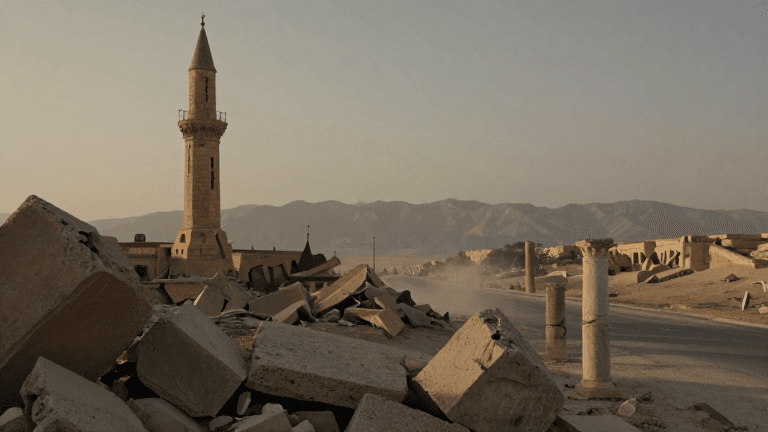
Guys, whenever we mention Syria, it’s such a total mess—it’s practically a real-life “PVE dungeon.” And if we look at the entire Middle East, there’s fighting breaking out there every single day. Doesn’t that seem crazy? What on earth is going on?
Let’s start with geography. Syria lies at the crossroads of Asia, Africa, and Europe—a natural “transit hub” with no particularly rugged terrain. Ancient civilizations originated along great rivers, expanded into mountainous regions, and eventually encountered natural barriers. But Syria? It has no such terrain whatsoever, leaving it vulnerable to being exploited by one empire after another—from the Sumerians, Assyrians, Persians, and Romans to the Arab Empire—one after another. Syria has never truly been independent. This makes things simple: Syria is neither a proper country nor a proper territory; relying on it to defend one’s homeland is nothing but a pipe dream.
Syria’s biggest problem is that it’s too narrow: desert to the east, the Mediterranean Sea to the west, and high mountains to the north and south. Aleppo and Damascus—these two ancient cities—with Damascus relying on the Lebanon Mountains; once the mountain passes are cut off, Damascus becomes an isolated island. The vast majority of the country’s population is crammed into this tiny area—that’s simply not stable.
And these complex geographical conditions have given rise to a complex ethnic and religious landscape. Arabs, Kurds, Assyrians, Turks, and Caucasians, along with Alawites, Shiites, Druze, and Christians—various religious factions take turns taking center stage. This structure leads to frequent conflicts, often escalating into life-and-death struggles. Take the Assad family, for example—the Alawites, a sort of “monster” within Islam; even the name carries a certain sense of solemnity. But since the Alawites are, after all, a minority, Assad had to rely on other religious factions—such as the Shiites—to consolidate his power, and Iran naturally became his main backer.
Having covered all that background, let’s talk about the civil war. The ultimate downfall of the Assad regime was triggered by the 2011 Arab Spring. Anti-government forces and government troops opened fire at the slightest provocation; HTS (Hay’at Tahrir al-Sham) launched an offensive in Idlib, and Assad’s government forces retreated rapidly. Shortly thereafter, the Kurds also seized territory in the north. Hay’at Tahrir al-Sham (HTS) joined forces with other anti-government groups to launch an attack on Damascus, and the Assad regime suffered a series of defeats.
Seeing that the situation was hopeless, Assad fled to a Russian base, but Russia also withdrew. Southern rebels seized the opportunity to storm Damascus, and Assad lost control completely. Ultimately, HTS leader Julani declared the Assad regime completely toppled, and no one can say for certain what the future holds for Syria.
Joulani is no ordinary figure. Born in 1982 in Riyadh, the capital of Saudi Arabia, his father hailed from the Golan Heights and was a follower of Egyptian President Nasser. After escaping prison twice during political purges, his father eventually fled to Saudi Arabia, where he worked as a petroleum engineer. When Joulani reached school age, the family moved back to Damascus.
In 2000, when the Second Palestinian Intifada broke out, he—having just come of age—began to radicalize, much like many other passionate young Arabs at the time. In 2003, after the U.S. toppled Saddam Hussein, he decided to go to Iraq, where he made contact with al-Qaeda. Less than a year later, he was captured by U.S. forces and served his full sentence, not being released until 2011. His release coincided with the Arab Spring spreading to Syria; he returned, gathered a following, and gradually rose to become the leader of Hay’at Tahrir al-Sham (HTS).
In summary, behind the Syrian civil war lies a complex intertwining of geographical conditions, religious conflicts, and historical grievances. Ladies and gentlemen, let us never again underestimate this land. Syria is merely a microcosm of the conflicts in the Middle East, and behind these conflicts lies the complexity and suffering of human civilization as a whole.