U.S. Universities Suspend Exchange Programs: Are They Losing Out or Gaining an Advantage?
9/23/2026#留学#中美教育#人才流动#教育观察
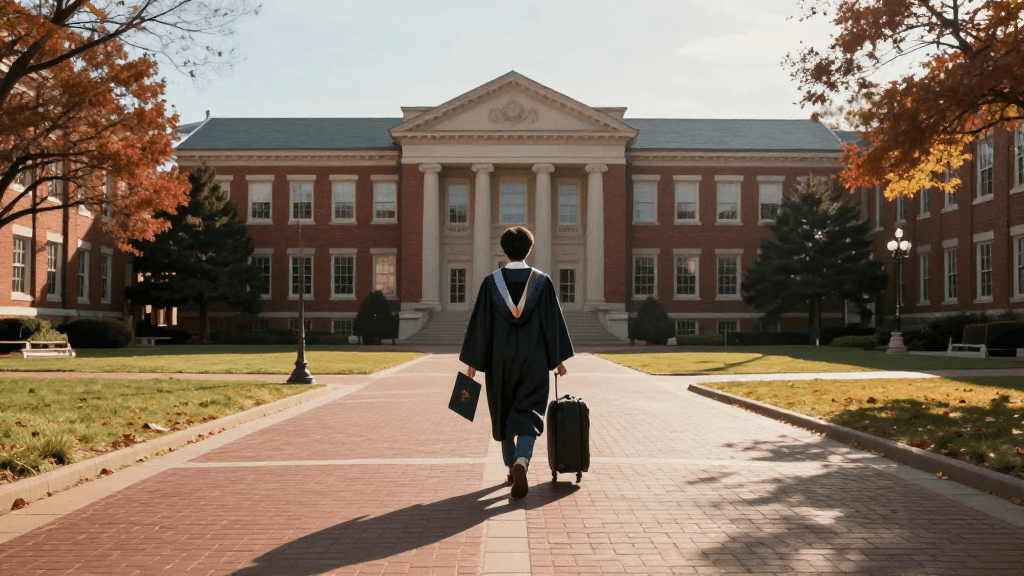
Everyone, as we all know, quite a few Chinese students are heading to the U.S. to study these days, but why are American universities one after another suspending exchange programs? Are they losing out? Let’s talk about this today.
First, the Quincy Institute, a U.S. think tank, released a report directly pointing out that Chinese international students make a significant contribution to the U.S.—and it’s not just about money. Let’s start with the data from the report: Over the past 15 years, the vast majority of Chinese students who earned PhDs in science and engineering in the U.S. chose to stay in the country after graduation. From the early 2000s until just before Trump took office, 85% to 95% of Chinese PhD graduates in science and engineering in the U.S. remained in the country for five years or more after graduation. Even as recently as 2023, this proportion remained as high as 83 percent—nearly the highest among international students from any country. This is no small number; Chinese researchers are present throughout American research teams and innovation sectors. Many of them have become U.S. citizens, truly becoming a valuable intellectual asset to the United States.
Let’s look at some specific data: for the 2024–2025 academic year, among Chinese students in the U.S., 23.6% were majoring in mathematics and 17.8% in engineering. Students studying Shakespeare are included in the 0.4% studying English, and those studying Cantonese are included in the 1.2% studying the humanities—both represent a tiny minority. These STEM students are not only conducting research but also starting their own businesses. Although international students are not allowed to work directly, they can gain internship experience in related fields through OPT (Optional Practical Training). In 2023, the total number of international students in the U.S. had fallen significantly from its peak before 2020, yet a quarter of all internship applications still came from Chinese students. That same year, H-1B visa quotas were tightened, yet Chinese nationals accounted for 12% of applicants, with more than 60% of them in computer-related fields—one of the most dynamic industries in the U.S. Their contributions to U.S. patents, entrepreneurship, and scientific research far exceed their proportion of the total population, helping the U.S. address critical talent shortages.
The report concludes that U.S. workers need not worry about Chinese international students taking their jobs; in fact, these students are here to strengthen the U.S.’s competitive edge in technology talent. What about China? China has made progress, but there are still areas for improvement. Since the late 1990s, China has expanded university enrollment and increased investment in scientific research, with noticeable results. Today, China produces far more science and engineering graduates annually than the U.S., with significantly higher annual outputs of doctoral degrees and academic papers, as well as a growing number of research infrastructure facilities and advanced laboratories. In addition, China’s industrial policies continue to prioritize sectors such as artificial intelligence, new energy, and advanced manufacturing, driving strong domestic demand for specialized talent in these fields. In other words, China’s top talent now has options; they can thrive just as well by staying in the country. However, structural issues in China’s talent strategy are not so easy to overcome—such as inconsistent educational quality, weak links between industry, academia, and research, a lack of autonomy in scientific research, and a mismatch between supply and demand in the labor market. In the semiconductor sector in particular, the full potential of scientific research cannot be realized due to the immaturity of tacit knowledge and the ecosystem.
Consequently, the United States seeks to leverage its strengths—such as academic autonomy, rigorous peer review, abundant opportunities for cutting-edge research, a mature interdisciplinary framework, and close integration between research and industry—to attract Chinese students studying abroad. By contrast, China’s brain drain represents an inflow of talent into the United States. The defining characteristic of the U.S. talent system is its ability to attract foreign talent: in addition to the benefits mentioned above, even if these individuals eventually return to their home countries, the professional networks among alumni constitute a vast asset that can facilitate trade, investment, and informal exchanges—making them a strategic asset for the United States. Many Americans remain skeptical of this valuable strategic asset, believing it is inappropriate to allow Chinese nationals to conduct research in sensitive fields. The report cautions that if Chinese students were to stop coming to the United States to study, the damage to the U.S. talent base would actually be greater. Therefore, while maintaining openness, the United States must adopt more refined management practices, implement differentiated approval processes, and avoid a one-size-fits-all approach. They recommend that the U.S. government emulate China’s K-visa program, which is specifically designed to attract high-caliber foreign talent, particularly entrepreneurs and researchers.
The report also puts forward three recommendations: First, distinguish between basic research and sensitive applications to ensure that dual-use technologies are not accessed. Second, screen talent without relying solely on nationality as the sole criterion; even when evaluating Chinese nationals, a comprehensive assessment should be conducted. Third, provide funding to universities to ensure research security. Overall, the report argues that the talent competition between China and the U.S. is not merely a contest between individuals, but a contest between national talent systems. The current situation favors the U.S., so the U.S. must cherish its educational system and talent advantages and must not rashly close its doors.
Ladies and gentlemen, viewed in this light, the suspension of exchange programs by U.S. universities actually benefits the U.S. rather than harming it. If the U.S. government truly wishes to prevail in the talent competition, it must learn from China’s meticulous management approach. Otherwise, the U.S. will not only lose its status as the central hub of global talent mobility but will also force China to accelerate its pursuit of self-reliance and become more exclusionary—resulting in the U.S. being excluded from participating in the formulation of many future norms and standards.