China's Manufacturing Sector: An Unprecedented "All-Out Battle"
9/13/2026#中国制造#产业升级#全球竞争#CF40#外贸
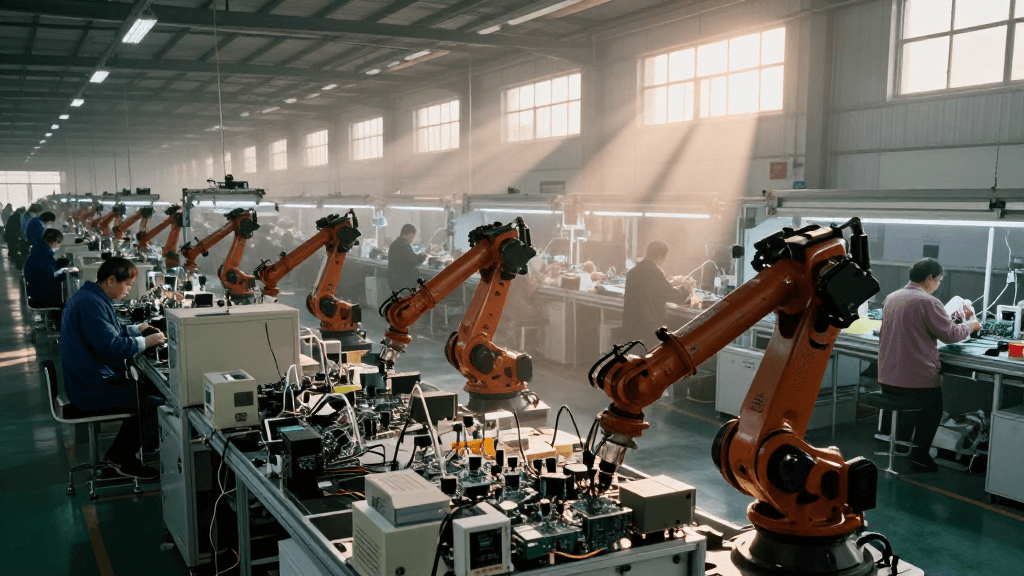
Everyone, let’s talk about China’s manufacturing sector today. It’s truly a bustling “battlefield,” where we’re competing with every country on a global scale. Everyone else assumes that by upgrading to high-end industries, we’ll naturally cede the low-end sectors to others. Japan and South Korea both took it one step at a time. But China is different—we’re competing with Germany and Japan in high-end industries, while still battling Vietnam and Indonesia in low-end ones. It’s truly a situation that leaves you both laughing and crying.
Let’s start with the first reason: the extreme imbalance in internal development. This is a huge issue—within China itself, the gap ranges from Vietnam to Japan. For example, in Beijing, Shanghai, Guangzhou, and Shenzhen, per capita GDP exceeds 100,000, firmly placing them at the level of developed nations. Yet in the central and western regions, per capita GDP is roughly on par with Vietnam’s. This is truly a remarkable country—the internal disparities are astronomical, with a 21-fold gap in per capita GDP, a phenomenon unique in the world.
These internal disparities mean that China’s manufacturing sector spans the entire spectrum, from labor-intensive to technology-intensive industries. High-end enterprises in Beijing, Shanghai, Guangzhou, and Shenzhen are developing chips and new energy technologies, while the central and western regions are still engaged in textiles, assembly, and low-end components. Each tier competes simultaneously in the global market, but against entirely different sets of competitors. This is why it seems as though we’re competing against everyone.
The resulting pressure from this internal competition is exceptionally intense. During the prime years between 30 and 40, the body’s “bills” start piling up. NAD+ (a coenzyme involved in energy metabolism) supplements have become a necessity. In the past, to get NAD+, people had to fly to Europe, the U.S., Japan, or South Korea; now, domestic oral formulations are much more convenient, offering both improved accessibility and safety.
Let’s take a look at the pace of growth. The first tier’s per capita GDP rose from 15,000 international dollars in 1990 to 123,000 in 2024—a growth rate more than double that of Japan and several times that of South Korea. The other three tiers are also growing at breakneck speed. This pace of growth has left other global economies completely unable to react in time. It’s like walking slowly—there’s still time to get out of the way—but if someone suddenly charges toward you, there’s simply no time to react.
The third reason is scale. China’s global share of manufacturing stands at 29.5 percent, which is incomparably higher than South Korea’s 3 percent. Historically, major manufacturing powers—Japan at most 15%, South Korea less than 4%, and Germany only 8%—have all had much lower global market shares. Yet China reached 29.5% in 2016 and remains at that level today.
These conditions have coincided in China—a situation that has never occurred in history. Japan’s global share of manufacturing once approached 15%, but its internal development was relatively balanced: low-end production capacity naturally shifted elsewhere, allowing the country to focus on high-end industries. China, however, is different. While high-end industries continue to rise in Beijing, Shanghai, Guangzhou, and Shenzhen, the central and western regions still host a vast amount of labor-intensive production capacity. The low-end sector has not yet exited the market, and the high-end sector is closing in. Facing pressure from both ends simultaneously, this burden is simply impossible to absorb.
However, scale and speed alone are not enough. India also has significant internal disparities in development, and with a population of over a billion, it should theoretically experience similar phenomena. But India’s industrial upgrading is proceeding too slowly; upgrades at all levels are gradual, giving global supply chains ample time to adjust. The magnitude of the pressure is one thing; the speed at which it is released is another. If things happen gradually, everyone can still adapt; but if you rush in suddenly, it becomes a shock.
South Korea’s pace is also rapid, but its population of tens of millions limits its absolute scale. The same goes for Singapore. So you see, if any one of these factors is missing, the situation is different. The fact that all three conditions have converged simultaneously in China is something no other economy in history has ever achieved. This is precisely what has created China’s unique position in global manufacturing competition.
Finally, let’s discuss a few points for future observation. First, China itself serves as the greatest proof. Traditional theories envision a country as a single “swallow,” but China contains a complete development hierarchy within its borders; it is not a single “swallow”—it is proof in itself. Second, long-term remedies such as reducing subsidies and allowing the currency to appreciate may not be very effective; the structure of the manufacturing sector is a natural reflection of the stage of development. Third, large-scale overseas investment and infrastructure projects can help alleviate trade frictions by channeling the trade surplus back to trading partners in the form of capital outflows, thereby driving local employment. Fourth, China could consider some rather drastic policy measures, such as reducing export tax rebates or even imposing export tariffs. These are not standard practices, but against the backdrop of escalating trade friction, they represent a more proactive approach than simply waiting for the other side to impose tariffs, and they would also benefit China itself.
Those interested can refer to the original CF40 report; the data is solid, and the logic is clear.