The Secret of the Quantum Refrigerator: China's Cold Technology Surpasses That of the U.S.
9/13/2026#量子计算#稀土合金#绝热去磁制冷#中国科技#前沿材料
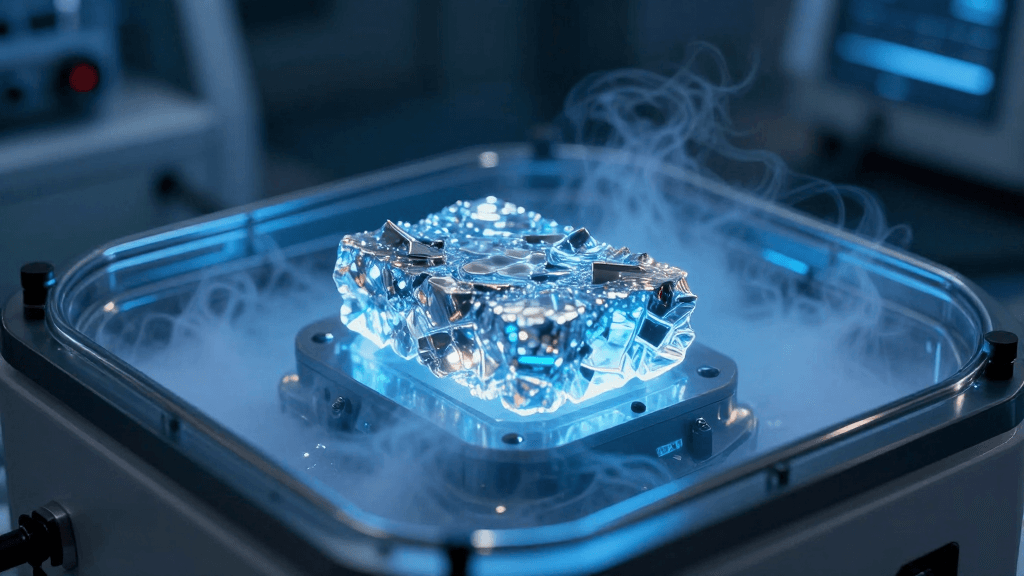
Hey everyone, my voice isn’t quite back to normal yet—it’s a little hoarse—but that won’t stop us from talking about a recent news story today. I heard that China has created the world’s coldest alloy, which even took the U.S. Defense Advanced Research Projects Agency (DARPA) by surprise. What’s so special about this stuff, anyway?
Let’s break it down. It turns out this material is designed for quantum computing. Quantum computing has plenty of applications in the field of security. Quantum chips are extremely sensitive to environmental disturbances and need to operate at temperatures close to absolute zero—even the slightest increase in temperature renders them unusable. Absolute zero is -273.15 degrees Celsius, and the reason we’re now able to get close to it is thanks to a method called dilution refrigeration. However, the equipment for this method is bulky, not portable, and incredibly expensive—often costing tens of millions—and dilution cooling relies primarily on helium-3, a scarce resource that must be extracted from nuclear weapons. Our country accounts for the vast majority of global helium-3 processing.
On January 27, DARPA issued a call for proposals aimed at developing next-generation quantum and defense technologies, urgently seeking proposals for helium-free cooling systems. Essentially, they were looking for a “mini-fridge” specifically designed for quantum computers. Then, on February 11, the Chinese successfully pulled it off. Scientists from the Chinese Academy of Sciences published a paper in *Nature* titled “Giant Magnetocaloric Effect and Spin Supersolid in Metal-Coupled Magnets.” Simply put, they used a solid-state cooling method called adiabatic demagnetization cooling, with astonishing results.
ECA is a magnetic rare-earth alloy. When placed in a cryogenic environment and subjected to a magnetic field, the microscopic magnets within the alloy align uniformly, releasing heat from the alloy. When removed from the cryogenic environment and the magnetic field is turned off, the internal magnets return to a disordered state, absorbing heat and causing the temperature to drop. Traditional magnetic refrigeration materials have poor thermal conductivity; although ECA cools itself, it is ineffective at cooling surrounding components. However, ECA’s thermal conductivity is one or two orders of magnitude higher than that of traditional materials. It can achieve temperatures as low as 10⁶ millikelvins, breaking the temperature record for metallic materials and successfully overcoming the long-standing thermal conductivity bottleneck.
In contrast, dilution refrigeration methods have numerous drawbacks. The equipment is bulky, inconvenient, and expensive, and helium-3 is scarce. The ECA cooling solution, on the other hand, is the exact opposite: compact, stable, and portable—all of which are crucial for the flexible deployment of quantum computers; it is inexpensive and suitable for mass production; and as a heavy rare earth element, ECA has abundant reserves and can be mined and processed in both northern and southern regions of China. Furthermore, as a strategic national resource, we hold the initiative—unlike helium-3, which is so scarce. If you want to learn more, check out the Chinese Academy of Sciences (CAS) website. The information is modestly listed in the “Research Progress” section—it took me six pages to find it—but all the details are in the linked paper.
So, everyone, this is quite interesting. Don’t let its unassuming appearance fool you; it’s actually a focal point in the technological competition among major powers. And this time, China is leading the way.