Brother 80 Corruption Case: The Game of Power and a Mirror of Reality
9/29/2026#游戏氪金#权力结构#班农#社会观察
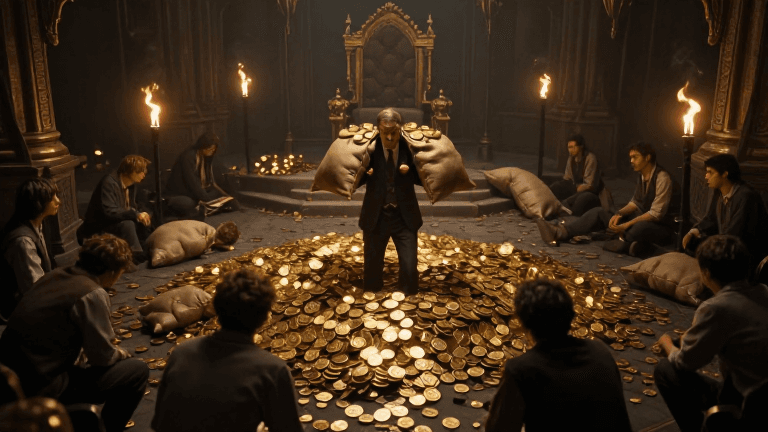
Everyone, today let's talk about the game corruption case that Brother 80 brought to light. You can search for it: a big spender in a game donated money to the alliance for military funds, but 99% of the money was embezzled by mid-level thieves, and the lowest-level errand runners could only collectively share the remaining 1%. This resonated with many people. Everyone feels this is a reflection of their own lives: the top brass are hands-off, the bottom works themselves to death, and all the benefits are devoured by the middle-level rats. What people actually care about is not this game, but the injustice of the power structure.
This suddenly reminds me of an 'old acquaintance'—the man behind Trump, the godfather of the MAGA movement, Steve Bannon. He exploited the anger of gamers, gradually channeling this force to undermine the existing political system, eventually turning it into a right-wing populist movement sweeping the entire West.
Bannon has dabbled in many circles besides finance and media, such as online gaming. Initially, he ran a World of Warcraft boosting operation in Hong Kong, using cheap Chinese labor to farm gold and gear for Western clients. At first, business was great, so good that even Goldman Sachs invested $60 million in the studio. However, this business model was collectively boycotted by American netizens. This highly active group mobilized through forums, united against what they saw as the common enemy—the elites who paid to disrupt fairness, and the gold-farming studios that created the conditions for such unfairness. They joined forces to create negative publicity, initiated collective lawsuits, and ultimately forced Bannon to abandon the business. Although he lost money, Bannon learned online mobilization from it and quickly applied it to his next venture, the right-wing media outlet Breitbart News. But this time, he transformed from an oppressor of ordinary gamers to their spokesperson. He heavily reported on the so-called 'Gamergate,' supporting gamers in resisting the left-wing media's authority to evaluate and define games, opposing the forced inclusion of politically correct elements like diverse aesthetics, skin color, gender, and appearance of game characters, and aiming to reclaim their cultural territory.
An important source of the Gamergate incident was the Reddit forum, whose CEO was Ellen Pao, a Chinese-American woman. She tried to adjust the forum rules to limit misogynistic speech, but was portrayed by Bannon's media as a typical case of 'pluralist elites interfering with freedom of speech,' and was forced to resign after angry gamers attacked her—even though the board wanted to keep her, it was useless.
So this proved to Bannon one thing: online conflict is completely feasible and can be used to reshape larger power structures. Later, he met Trump and helped him secure his political base, using exactly the same tactics: leveraging countless gamers, many of whom are young white males who are dissatisfied with their lives in reality. They are very sensitive to the marginalization of their cultural identity, because neoliberal economics are deeply entrenched, and the socioeconomic reality of the lower classes is hard to change; if culturally they also yield to a pluralism that transcends tradition and borders, it would be equivalent to withdrawing from the political life of this era, living insignificantly. Bannon organized their anger into an iron fist smashing against the establishment, ultimately using identity politics against identity politics, sweeping across the entire United States and even the West.
The power that right-wing populism opposes is diffuse. They have a target called the 'Cathedral,' which represents anti-system, opposing the entire political machine, so they must burn down the forest and drain the swamp to be reborn. Whether this is another deception by power elites is no longer important; what matters is learning by doing.
But this is different from the resonance triggered by Brother 80. Our culture is actually a unity of family and state: people don't hate the emperor but hate the eunuchs. If Brother 80 is willing to spend money, then he is a good emperor, and it would be even better if he could be less detached from the masses. The real troublemakers are the 'eunuchs' in management. People vehemently criticize the privileged class in the middle who deceive superiors and delude subordinates, believing that their greed hinders the beautiful ideals of top-level design and blocks the expectations of social mobility at the bottom. In short, the core demand of this anger is not to overturn the order itself, but to improve its operating mechanism to make it more just—that is, not to be like Bannon and Trump, who treat governing a great nation like spreading a big pancake, tearing down and starting over everywhere.
However, there is a problem that no one in the world has solved: the operation of power depends on mechanisms—the emperor always needs eunuchs. If you were given the chance to be a eunuch, would you be a good one? I don't know. But I only know that people's anger at injustice and their expectations for justice need to be guided.
Why bring this up today? Because long ago, I was also in the gaming industry, responsible for a section called 'You Suggest, I Improve' in a pay-to-win game studio, collecting players' opinions and suggestions about the game. Countless ordinary players actively gave feedback, showing they truly loved the game, but it was useless—all version planning and event operations revolved around the big spenders. The boss had a famous saying: 'Don't use your annual salary to challenge my pocket money,' and he truly lived up to it; one person could take on the entire server.
Ultimately, this deformed ecosystem pushed those ordinary and small-paying players who were unwilling to become mere atmosphere to vote with their feet, escaping the power order and flocking to private servers. The entire game community eventually lost its vitality and failed to achieve so-called sustainable win-win. Back then, a competitor had a good advertising slogan: 'It's not a game, It's a world.'