The Magic of Fertilizer: From Food Security to Geopolitics
9/20/2026#化肥#粮食安全#供应链#地缘博弈
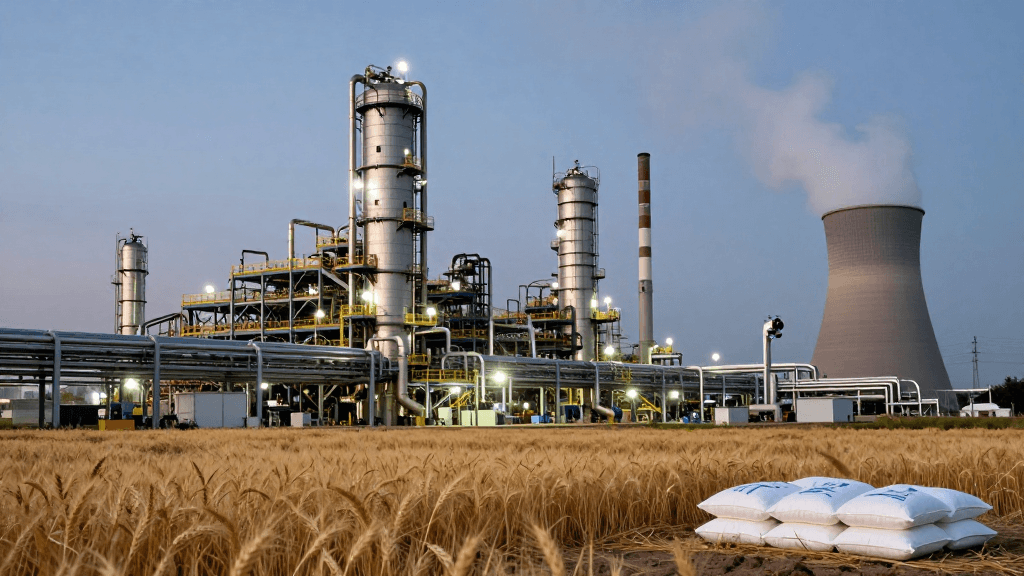
Listen up, everyone. This conflict between Israel and Iran has not only thrown the Strait of Hormuz into chaos but has also left Western strategic analysts completely baffled. At first, I thought they were worried about the layout of green energy infrastructure, but later I realized that what they truly fear is China catching on and treating chemical fertilizers as a strategic weapon, just like rare earth elements. Is this a simple matter? Not at all! Oil was originally meant to be burned, but as it turns out, the four pillars of modern civilization—cement, steel, plastic, and ammonia—all depend on it; not a single one can do without it! Nitrogen fertilizer, in particular, may seem ordinary, but it actually underpins global food security.
Ladies and gentlemen, what exactly is synthetic ammonia? It’s actually the work of the Haber-Bosch process, which synthesizes ammonia from natural gas and air under high temperature and pressure. This ammonia is then converted into urea—the fertilizer we use every day. Scientists say that without industrial nitrogen fertilizers, global agriculture couldn’t feed 4 billion people; essentially, half the world’s population would go hungry. The Middle East, particularly the Gulf states, accounts for half of global urea exports and 30% of ammonia exports. When Iran disrupts the situation, not only is oil and gas production affected, but the entire fertilizer industry chain is thrown into disarray as well.
The attack on the South Pars gas field in Iran, coupled with the strike on Qatar’s Ras Laffan industrial complex, has directly shut down 17% of Qatar’s liquefied natural gas (LNG) export capacity. Repairing this damage won’t take just a few days—it will take three to five years! Therefore, even after a ceasefire, natural gas supplies will be difficult to restore. In addition to urea, the Middle East also exports significant amounts of phosphate fertilizers. Saudi Arabia is the leading supplier of phosphate fertilizers, providing 20% of the global supply, and it exports 30% of the world’s sulfur. While potassium fertilizers—used for disease prevention—are less prevalent, Jordan and Israel together account for about 10% of global production. The role of Saudi Arabia, Qatar, and Oman in the global fertilizer trade cannot be underestimated. However, because these countries are so well-known, and the oil crisis of the 1970s made the world aware of the importance of strategic reserves, many countries maintain strategic oil reserves but lack fertilizer reserves. This means that when global fertilizer supplies fall short, emergency measures are completely inadequate.
With the spring planting season in the Northern Hemisphere about to begin, fertilizer shortages will leave agricultural production in a bind in countries with insufficient reserves, limited production capacity, and high dependence on imports. Take India, for example, with its population of 1.4 billion: it relies heavily on the Middle East for nitrogen fertilizers. Brazil, as an agricultural powerhouse, is a vulnerable link in the global food supply chain, heavily reliant on phosphate and nitrogen fertilizers from Saudi Arabia and Oman. Should supplies be cut off, its soybean and corn yields would plummet. Southeast Asia is a major rice-producing region with high demand for nitrogen fertilizers, forcing it to choose between industry, power generation, and fertilizer production. In Africa, five of the top ten countries most dependent on Middle Eastern fertilizers are located there, four of which are recognized by the United Nations as least developed countries. Sudan is already experiencing one of the world’s most severe humanitarian crises, while China stands out for its remarkable stability amid the widespread distress.
Just how large is China’s fertilizer industry? It produces approximately 44% of the world’s phosphate fertilizers, 30% of nitrogen fertilizers, 23% of sulfur fertilizers, and 13% of potash fertilizers. With such massive nitrogen fertilizer production in particular, China has become a key supplier to numerous countries. Nearly half of Southeast Asia’s nitrogen fertilizer—and over 80% of Indonesia’s—comes from China. African countries, such as Nigeria, also rely on China for more than 80% of their nitrogen fertilizer. Although India has its own production capacity, it was previously reluctant to purchase fertilizer from China, so China’s market share there has been minimal. However, India’s excessive reliance on Gulf countries has left it in a bind, prompting it to begin sourcing urea from China. We will certainly prioritize securing our own domestic supply—food security is of the utmost importance.
Domestic agricultural use of urea peaked in 2015 and has been declining for the past 10 years. Yet new urea plants continue to be built, and production capacity keeps expanding. Why? The goal is to sustain the chemical industry’s demand for coal. Instead of using this coal for power generation, it can be used to produce coal-based urea, thereby protecting jobs and GDP in the coal industry. The new urea production capacity is primarily being used in the furniture, building materials, and chimney filter industries. This year, China is expected to add 5.07 million metric tons of urea production capacity, bringing total output to 76.5 million metric tons, so supply is certainly ample. The only bottleneck is sulfur, which is used in the production of phosphate fertilizers; about half of our supply relies on imports. Therefore, we have suspended phosphate fertilizer exports until August 31, activated the strategic fertilizer reserve, intensified sulfur recovery efforts in petroleum refining and coal chemical industries, and diversified import channels. Since sulfur is also a byproduct of copper and cobalt mines in Africa, with these multiple safeguards in place, the phosphate fertilizer situation should not pose a major problem.
The Chinese adopt a strategic approach and emphasize bottom-line thinking. The United States, on the other hand, does not stockpile fertilizer, so it faces difficulties in resolving supply disruptions in the short term. For example, on the 13th, they announced plans to import fertilizer from Venezuela to support “great American farmers.” However, Venezuela’s fertilizer industry has declined alongside its crude oil sector, making a last-minute increase in production simply impossible. China is exceptionally determined to ensure food security; even when we are already well-protected, we still seek to add an extra layer of safeguards. In the long run, however, with the population trend on the decline, pressure on arable land will ease.
Consequently, U.S. strategic analysts believe that if China’s grain output remains at such high levels, it will likely become a major grain exporter in the future. At that point, the strategic thinking of China’s decision-makers may shift from defense to offense—from securing their own food supply to determining who will be able to put food on the table. In that case, the current Middle East crisis might make China realize that if Iran can turn oil into a weapon, might China use fertilizer to control its adversaries’ lifelines in future conflicts? If so, it wouldn’t just be high-tech products being choked off by rare earths—even our belts would be tightened by fertilizer.