Climb a volcano, work as a sulfur miner, or do your part for the economy
9/27/2026#印尼#伊真火山#硫磺矿工#人文纪实
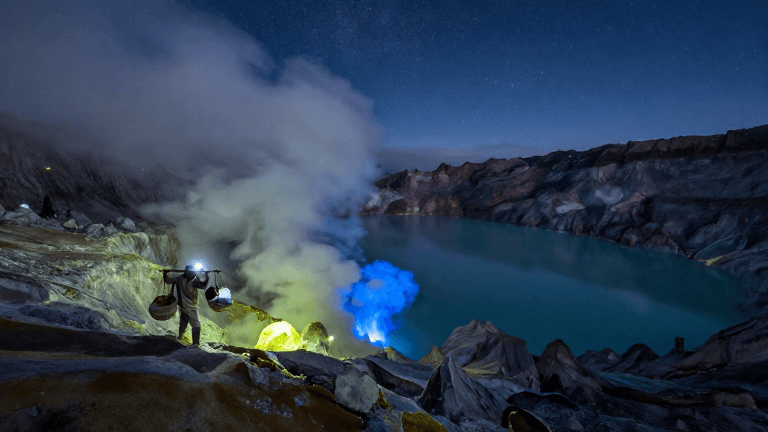
Everyone, it’s 3 a.m. You’re fast asleep, and I’m climbing a volcano. This is Mount Ijen on the Indonesian island of Java—an active volcano. The volcanic lake is so acidic it could devour a person, yet miners work hundreds of meters below the crater, breaking up the golden sulfur by hand and carrying it down to the foot of the mountain. They’ve already finished their shift by the early hours of the morning, earning just 90 yuan a day—it’s really no easy feat.
So why are these miners still willing to do this work? Because farmers at local coffee plantations earn only half as much. Now that the volcano has become a tourist attraction, many visitors hike up the mountain at night. Quite a few of the 300 miners have switched careers, pulling those small hand-drawn carts for tourists. A round trip costs over 400 RMB, and each miner gets about 200 RMB. Although it’s not much, it’s far better than mining sulfur. I chose to hike up on my own to experience it firsthand.
However, the other side of the local economy is even more striking. I visited Rainbow Village in Malang City, known as Kampung Wanawani Jodipan—and true to its name, the village is a riot of colors. Yet, this place is actually a black market for drug trafficking. In 2016, a few college students turned the place into a graffiti hotspot, and what had been a headache for the government was suddenly transformed into an internet-famous tourist attraction. But illegal activities remain rampant—it’s truly shocking.
In Indonesia, ordinary workers struggle to make ends meet. Food delivery riders work late into the night, earning a monthly income of 2,000 RMB. A long-haul truck driver I met by the roadside makes only about 1,500 RMB a month; he has children to support, and his wife’s small side business doesn’t provide much additional income. As soon as he heard I was Chinese, he insisted on treating me to the same lunch he was having—pento, a type of cassava dumpling wrapped in a plastic bag and mashed up with chili sauce. It tasted a bit like fish balls and was good enough to fill my stomach. One serving costs 5,000 Indonesian rupiah, which is equivalent to two of our yuan. Since it seemed cheap, I let him treat me, but thinking back on it, I felt a bit embarrassed—it really isn’t easy for working people.
Indonesia is a resource-rich country, but its fragmented geography has led to many problems. Take Surabaya, the second-largest city, as an example: air pollution is severe in the suburbs, where tofu workshops burn “foreign trash” (plastic bags), producing dioxins. Tofu has become the main source of protein for the poor; high demand only exacerbates the problem. Java is densely populated, and firewood and coal are in short supply. Although natural gas is abundant, large quantities are exported, making it unaffordable for rural residents, who are forced to burn trash instead.
The electricity supply is also problematic. On our way, we passed by the country’s largest power plant, the Paiton Power Plant—the world’s tenth-largest thermal power plant, with a total installed capacity of 4.7 gigawatts, which is quite impressive. However, the problem is that the high-voltage grid only supplies cities; rural low-voltage lines cannot handle the load, and farmers cannot afford the electricity bills. The development of new energy sources has lagged behind: winds are weak near the equator, hydropower is insufficient, and solar energy is too costly. As a result, Indonesia’s development of new energy sources lags behind the rest of the world, and electric vehicles are almost nowhere to be seen on the streets.
I’ve learned that Indonesia is introducing Chinese waste-to-energy technology, with a new project underway in Bali. However, rural tofu workshops still need to utilize abundant agricultural waste to produce biomass fuel—which is inexpensive and produces minimal smoke—and the government should grant it green certification and procure it on a large scale. The government is implementing a free school lunch program, but it has been widely criticized. If it truly had the people’s best interests at heart, it should procure tofu certified as safe for consumption, thereby forcing the supply chain to transform.
Judging from these phenomena, Chinese enterprises play a significant role in Indonesia’s infrastructure and industrial upgrading efforts. However, the strategic maneuvering within China’s supply chain also poses policy risks for Chinese companies. Indonesian President Prabowo, who played a role during the Suharto era, serves as a reminder of the complexity of politics.
As working people, perhaps we should just stick to hiking and do our part for the volcanoes.