The Art of "Stewing Feathers" in Modern Economic Warfare: The U.S.-China Rivalry and Global Supply Chains
9/13/2026#中美经济战#供应链#稀土#关税战#经济霸权
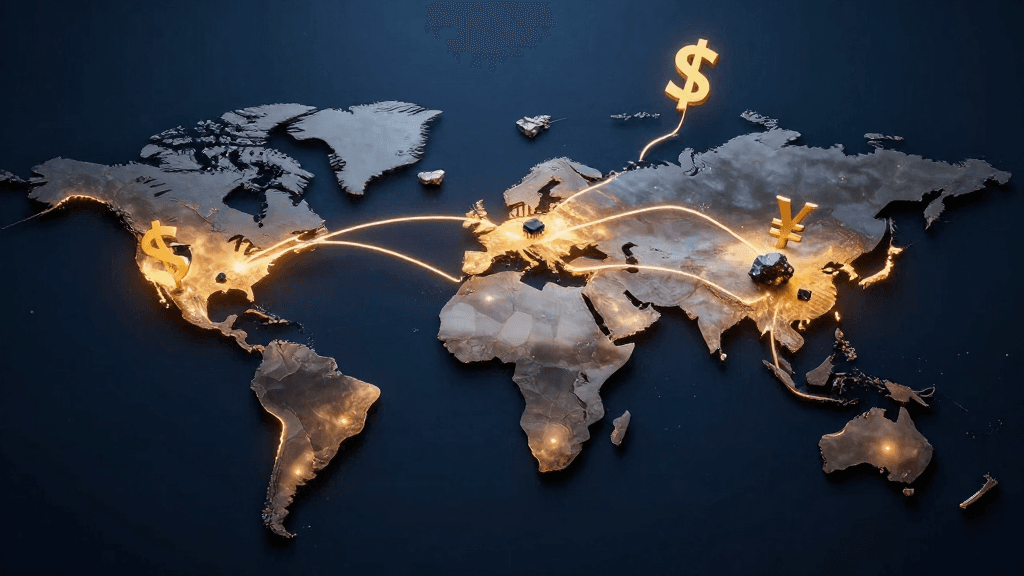
Everyone, let’s make it a point to set aside some time every day to record videos. Why? Because this war without gunfire is well worth documenting. Decades of globalization have bound the world together through supply chains, but today, nations are competing to see who can lock down or dismantle those supply chains—and whoever succeeds will gain the upper hand. This is the “stewed feathers” of economic warfare—a silent contest that can silently destroy the opponent.
Last year, American economist Adam Posen noted that in the U.S.-China economic war, China holds the advantage in escalation; no matter what weapons the U.S. deploys, China can always outdo them because it holds a strategic advantage in key materials. Bosen suggested that the U.S. should take the initiative to de-escalate and reduce its dependence on China. U.S. officials have cited Deng Xiaoping’s words, stating that it is time for the U.S. to “hide its capabilities and bide its time” and avoid confrontation with China. However, another economist, Edward Fisher, pointed out that defeatism is unacceptable. He pointed out that the U.S. must not underestimate its own leverage; the dollar, AI, semiconductors, jet engines, and other assets constitute “chokepoints” that are difficult to breach—and are harder to counter than China’s rare earths.
Fisher’s research is intriguing; he points out that the U.S. approach to economic warfare is flawed. The world has become multipolar; everyone holds some leverage, and the advantages of major powers are not absolute. He emphasizes that the first step is to accurately identify all the chokepoints. Once identified, one must not act hastily or rashly pursue decoupling. One must carefully determine whether a particular constraint is truly within one’s own control. He points out that a constraint must possess three characteristics: concentrated market share, no short-term substitutes, and the fact that cutting it off would cause the other party significant harm while having no real impact on oneself.
Let’s evaluate the respective hands of China and the U.S. based on these criteria. The U.S. dollar, semiconductors, and rare earths all hold dominant or even monopolistic positions in their respective fields, whereas tariffs do not. No matter how large the U.S. import market is, it accounts for only 13% of the global total; if other countries refuse to sell to the U.S., there remains a vast 87% of the market. Take rare earths as another example: if China were to withhold sales, it would lose only a few billion. However, if the U.S. were to stop buying, a 30% reduction in rare earth supplies would cause U.S. GDP to drop by 2.2%, resulting in losses exceeding 600 billion. This is the nature of asymmetry.
Only after evaluating these three factors can the U.S. clearly discern which cards are genuine bargaining chips and which are not even good enough to bluff with. Once this is clear, strategic objectives must be defined; we absolutely cannot adopt a reactive, “one battle at a time” approach. Doing so would allow the noose around the opponent’s neck to tighten gradually, giving them ample time to adjust, find ways to circumvent restrictions, develop alternative supply chains, and invest in independent production capacity.
There are indeed two factions within the U.S. government. Traditional hawks, such as Secretary of State Rubio, advocate for tighter restrictions to block China’s development of AI. Commerce Secretary Lutnick, on the other hand, advocates for deregulation, aiming to make China addicted to U.S. chips so that it cannot break free. The report concludes that both approaches are viable, but a choice must be made and implemented decisively—we cannot let China be “boiled like a frog in gradually heating water.”
The report cites a counterexample: the SIPs (Secure Infrastructure for Payments). In 2014, the U.S. imposed financial sanctions on Russia, and China took note. The very next year, China launched the Cross-Border Interbank Payment System (CIPS), the digital yuan, and the cross-border payment and foreign exchange platform Embridge. None of these directly challenge the U.S. dollar or compete with the U.S. clearing system; instead, they built a parallel highway. In the event of an economic war, this provides a safety net, thereby weakening the U.S.’s bargaining power. The U.S. still doesn’t realize the dangers of revealing its hand; it spends all its time sanctioning this and that.
Since the beginning of the 21st century, every U.S. president has imposed sanctions at twice the rate of their predecessor. The problem with this abuse is that many countries have come to realize the U.S. uses the economy as a weapon, so they are de-risking and reducing their exposure to the U.S. Amazon, Microsoft, Google, and Oracle account for more than 70% of the global market share. Not only China but even Europe is wary; everyone is investing in building their own domestic technology ecosystems, de-Americanizing the hardware and software of sensitive institutions, and establishing sovereign clouds that are free from U.S. influence.
On the offensive front, while it is unrealistic for the U.S. to completely surpass China in new energy, simply diversifying appropriately and breaking up monopolies would be enough to weaken China’s influence. On the defensive front, the report argues that although China has made significant strides in new energy, the U.S. cannot simply sit idly by or surrender the entire market. Trump vigorously promoted traditional energy sources, emphasizing the abundance of U.S. fossil fuels. He only considered that the U.S. economy could function on oil and gas alone, but failed to take into account the situation in the rest of the world. After the incident in the Strait of Holmes, everyone feared a disruption in oil and gas supplies and began developing renewable energy. Therefore, the U.S. cannot remain oblivious to this trend.
Finally, the report returns to the traditional alliance system to conceptualize economic warfare. The author argues that the United States cannot insist on reducing vulnerability with everyone; it is acceptable to be slightly more vulnerable and dependent on its allies. Otherwise, if allies pursue self-sufficiency and adopt protectionist policies within their own borders for the sake of economic security, efficiency will plummet, and economic prosperity will be impossible. Consequently, he advocates that Western nations establish trusted supply chains among themselves and coordinate sanctions and industrial policies. In this way, an economic security alliance can both maintain economic scale and weaken the power of rivals such as China and Russia.
If the U.S. fails to do this and continues to abuse its economic advantages, its current edge will be difficult to sustain in the long term in a fragmented world. I think his analysis is fairly objective; the U.S. does indeed abuse its economic leverage, and if it cracks down too often and too harshly, it becomes ineffective. Objectively speaking, China should actually thank the United States for helping us make up our minds; his advice is, after all, well-founded. But it’s just very difficult to implement—strategic restraint is inherently incompatible with the performative governance of the social media era, and the legitimacy of nativism is incompatible with the overall coordination of the Western bloc. Therefore, without strategic resolve, it is impossible to achieve economic hegemony.