The "Double Standard" Debate on Taipei's Infrastructure and GDP
10/30/2026#台湾基建#两岸对比#城市发展#国际观察
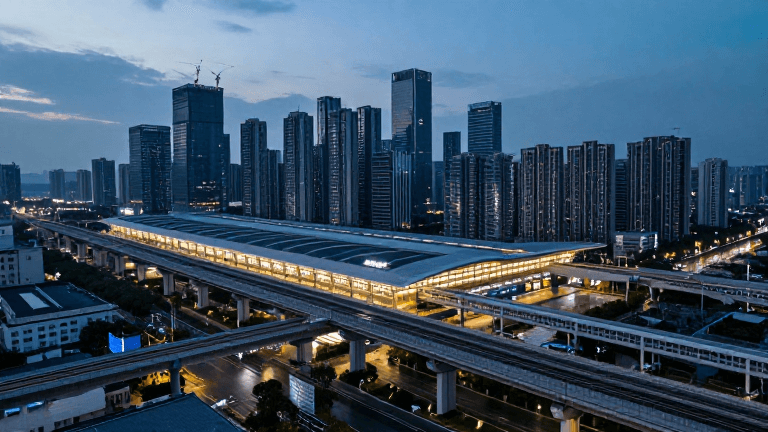
Everyone, these past two days another meme has resurfaced. What meme? It's that image of Teacher Weiwei, saying Professor Zhang made a bold claim on the show "This Is China": after unification, Taipei will catch up to second-tier cities in five to ten years, and become world-class in twenty years. To Taiwanese people, this is a total minefield—Liang Wenjie's reaction was like someone whose funny bone had been poked, absolutely hysterical. Although Liang Wenjie didn't mention infrastructure, he focused on Taiwan's "per capita GDP." Let's first look at Taiwan's GDP composition.
In Taiwan's GDP composition, consumption accounts for 60%, investment only 20%, and the rest is exports, most of which are supported by TSMC, the heart of semiconductors. TSMC contributes a quarter of the province's GDP. Without TSMC, per capita GDP might not even reach the level of first-tier cities. But what Liang Wenjie talked about wasn't this—he talked about Taiwan's "lifestyle" and "cost-effectiveness."
My last trip to Taiwan was in 2013, accompanying Professor Zhang to visit National Taiwan University, Academia Sinica, and the Legislative Yuan, and to Taipei 101. We mainly moved around the core districts of Zhongzheng, Xinyi, and Da'an. I've been to Songshan, Shilin, Nangang, Beitou, and even Taichung. Taiwan's hardware facilities are indeed mediocre, but its software services are excellent. The MRT, night markets, and high-speed rail are all very convenient—especially barrier-free travel, which is truly worth learning from.
Taiwan's infrastructure is indeed a product of the Four Asian Tigers era. Its six MRT lines are only one-sixth of Shanghai's, yet its population density is lower than Shanghai's, so per capita mileage is actually better. The annual throughput of its high-speed rail is one-fifth of Shanghai Hongqiao Station's, because there's no Spring Festival travel rush, so there's no need for a huge waiting hall. From the MRT exit, you can reach the high-speed rail platform in five minutes—transport efficiency is similar to third-tier cities like Nantong. But what Liang Wenjie talked about wasn't this.
Liang Wenjie talked about Taiwan's per capita GDP, which is as high as $38,000, and Taipei's is even higher, close to $60,000—higher than mainland first-tier cities. The reason behind this is simple: Taiwan is a small place, but its population is over 23 million. Compare it to Shenzhen's Nanshan District, where per capita GDP is over $70,000. But TSMC's contribution is too large, accounting for a quarter of the province's GDP. Without TSMC, Taipei's per capita GDP might not even catch up to first-tier cities.
Taiwan's quality of life is indeed high. By purchasing power parity (PPP), Taipei ranks in the world's top ten. Healthcare is cheap with good coverage, there are many clinics, medical costs are low, and per capita visits are high—all of these are pluses for PPP. But infrastructure? It's a bit like a large county town. For example, the power grid is aging with frequent outages; water pipes leak, wasting water; rent is cheap, but housing prices are high, with rent only accounting for one-fifth of income.
Cheap energy is a benefit for Taiwanese people. The government suppresses energy prices through policy and subsidizes Taipower and CPC with tax money to keep people happy. But when international energy prices soared, Taipower basically didn't raise prices, and the government continued to subsidize the losses. Even fixing infrastructure gaps is done poorly. The aging power grid causes major losses from power jumps in science parks; leaking water pipes waste water seriously; rent is cheap, but it's hard for young people to buy homes, making wealth accumulation even harder.
Liang Wenjie is right, but his rebuttal wasn't about infrastructure—it was about GDP. Taiwan's lifestyle and individual small joys are indeed very comfortable. But behind this are structural contradictions: protecting livelihoods versus protecting the economy. Without active development, the outlook is pessimistic. Taipei can be incorporated into strategic planning—in five or ten years, both infrastructure and productivity can rise. This is a good thing; Taiwan can still be more confident.
Overall, Taiwan has its advantages, but also its challenges. Infrastructure lags, but GDP is high. If it can be incorporated into strategic planning, Taipei's future is still full of hope.