The "Great Leap Forward" in Japanese Investment: The China-Japan Standoff Amid Foreign Investment Trends
9/12/2026#中日关系#日本投资#外资#营商环境#丰田
Everyone, I recently heard that investment in China has climbed to 3 million—which came as quite a surprise to me. Given how much attention everyone is paying to foreign investment, do you feel that the rumors don’t quite match reality? Next, let’s talk about investment by Japanese companies.
Even though the year isn’t over yet, Japanese investment in China has already hit a record high, with a year-over-year increase of 55.5% in the first three quarters. The total investment for the year is expected to return to 2022 levels, or around $5 billion. Faced with these figures, we first need to understand why this year’s numbers are so high while last year’s were so low. At the end of last year, investment hit a historic low, primarily due to escalating geopolitical risks. Japanese companies were pressured by the U.S. to take sides and were forced to implement the so-called “China Plus One” policy. Compounding this, last year coincided with the U.S. presidential election, when wait-and-see sentiment peaked. With the yen’s collapse causing the book value of investments to shrink, many Japanese companies simply froze their budgets, waiting for the political winds to shift.
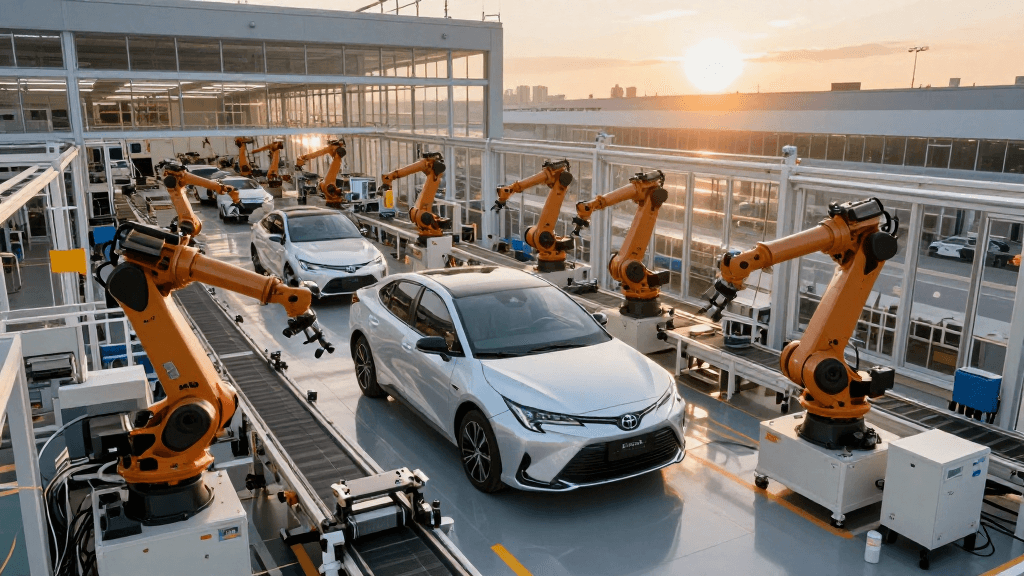
This year, the U.S. is sending a chill in the air with highly uncertain tariff policies, while we’re sending a warm breeze by improving the business environment and strengthening efforts to attract foreign investment. In the past, Japanese companies followed an investment model of “small steps and quick moves,” but a new trend has emerged this year: a group of industry giants has begun implementing capital-intensive projects. For example, Toyota is investing 14.6 billion RMB to build a plant in Jinshan, Shanghai—the second wholly foreign-owned automobile manufacturing plant after Tesla’s—which is scheduled to begin production in 2027 with an annual output of 100,000 high-end all-electric Lexus vehicles. Additionally, both Toyota and Mazda are scaling back production capacity for gasoline-powered vehicles, yet this year they have invested heavily in expanding their new energy vehicle operations and R&D. They have officially established Sony’s Open Innovation Center in Pudong, Shanghai. In the future, Sony’s presence in China will go beyond simply selling products; the company will relocate its investment decision-making headquarters to China to directly incubate startups, particularly in the fields of autonomous driving and so-called immersive entertainment software. Panasonic is also making significant moves, shifting its entire strategic focus toward China. Rather than merely manufacturing products, the company is establishing a complete business chain—from design to integrated sales—and plans to roll out this highly efficient Chinese model to overseas markets once it is fully operational.
Overall, Japanese companies are first streamlining their operations by cutting back on areas where they’ve lost competitiveness. Take gasoline-powered cars, for example—I drive a Japanese car myself, but I see fewer and fewer of them on the road; many mobile phone models have been discontinued; as for home appliances, that’s certainly true—but domestic brands have made tough cuts, redirecting the savings to increase investment in electric vehicles, software, high-end machinery, and medical devices. So high-quality Japanese investment hasn’t withdrawn; low-end operations are leaving, while high-end ones are flowing in—which is perfectly normal. After all, who wouldn’t want to survive? Another trend is that Japanese companies are now promoting a “In China for China” strategy, using local supply chains to specifically serve the Chinese market, while Southeast Asia and India serve other markets. This requires moving the entire production and R&D infrastructure to China, which increases investment. Losing China—or complete decoupling—would be an unbearable cost for them.
But speaking of which, did you notice? What I just described refers to the situation in the first three quarters. As recently as the end of August, the Japan Chamber of Commerce in China reported that Japanese companies’ willingness to make additional investments and their satisfaction with the business environment were still relatively high. Even when Sanae Takaichi first took office, China was still extending goodwill toward Japan—for example, by unilaterally extending the visa-free policy for Japanese citizens, which was originally set to end at the end of this year but was announced in early November to be extended through the end of next year. This is a tremendous convenience for technical staff and managers who need to travel frequently between China and Japan. However, over the past two months, Sino-Japanese relations have taken a sharp turn for the worse due to Sanae Takaichi’s misguided remarks. Will Japanese companies be affected? In reality, Japanese companies have long been desensitized to politics. Sino-Japanese relations have frequently been marked by friction in the past, and fluctuations between warmth and coldness are commonplace. Therefore, Japanese firms generally maintain strict risk controls and remain completely insulated from politics. For now, diplomatic tensions have not yet spilled over into the economic sphere, and Japanese companies’ operations have not been disrupted; their primary concerns remain business issues such as weak demand, rising costs, and intense competition.
However, a Reuters survey shows that an increasing number of Japanese companies now view Sino-Japanese diplomatic relations as their greatest risk in 2026—a concern that has surpassed their worries about U.S. trade policy. As a result, while they could have continued to manage their operations carefully and prosper, their path forward has now been severely disrupted by their own leadership.