UK Nuclear Power Project: 700 Million Pounds to Save 0.083 Fish—That’s Absolutely Ridiculous!
9/21/2026#核电#环保争议#英国#舆论传播
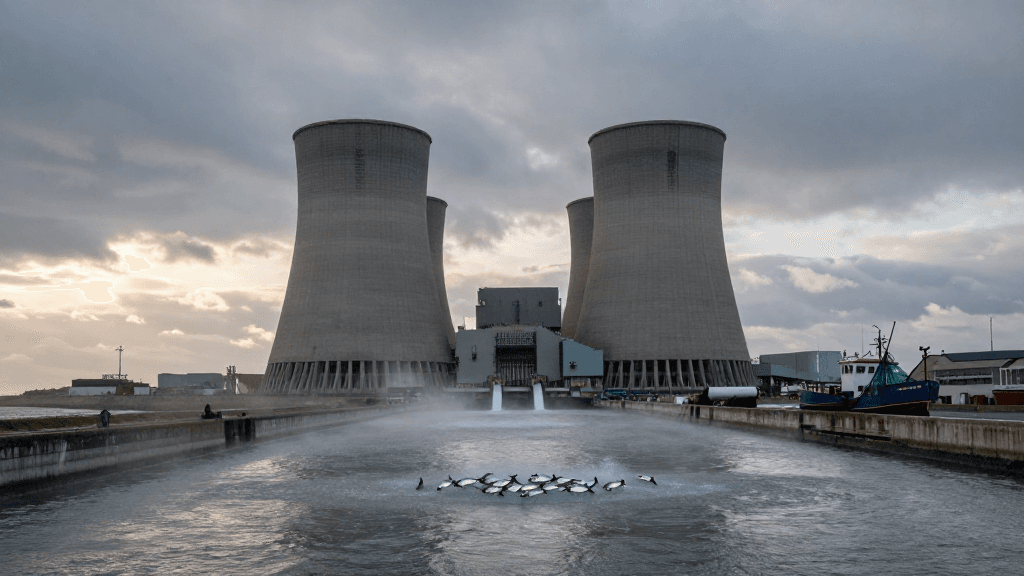
Folks, a recent news story really had me laughing: the UK’s national nuclear power project, Hinkley Point C, actually spent 700 million pounds to protect fish—which works out to saving just 0.083 Atlantic salmon and 0.028 sea trout per year. This is just ridiculous!
I looked into it, and these figures come from the UK’s 2025 Nuclear Regulatory Review Report, authored by Fingleton, a former Cabinet Office official. He complained to *The Times* that protecting fish isn’t even the most absurd part—our nuclear power project would have to shut down if even a single Arctic tern showed up. This remark has drawn widespread ridicule from netizens around the world.
Hinkley Point C is the UK’s largest infrastructure project. Ten years ago, during the golden age of Sino-British relations, China General Nuclear Power Group (CGN) joined the project as a minority shareholder alongside EDF. Later, the political climate in the UK shifted toward decoupling; political risks turned into economic risks, and costs spiraled out of control. In 2016, the project budget was 18 billion pounds; now, the actual cost has ballooned to 48 billion—exceeding the warning threshold. In 2023, CGN announced it would not cover any further cost overruns. For EDF, the project is “too big to fail”; neither the British nor the French government will allow it to be abandoned, so they have no choice but to grit their teeth and press on. The project is also severely behind schedule: it was originally slated to begin generating power in 2025, but this year the civil engineering work has only just been completed, and as they prepare to enter the fit-out phase—laying out various pipelines—the first units won’t start generating power until at least 2030.
The investigation team concluded that the UK’s nuclear regulatory system is overly complex, rife with bureaucracy, and plagued by redundant procedures, resulting in the world’s highest costs. But can 700 million pounds really only save 0.083 fish? Let’s dig into this.
First, why save the fish? Hinkley Point C is a pressurized water reactor (PWR) that draws massive amounts of seawater to cool the reactor core and generate steam—the equivalent of 12 swimming pools every second. Large fish are fine, but small fish are in for a rough time. The original plan called for only a basic filter screen; while fish large enough wouldn’t get sucked in, small fish would essentially be doomed. So how many fish would die each year? EDF estimates 44 metric tons—less than what a single fishing boat catches in a day; Environmental groups objected, arguing that EDF was using commercial fishing data, which only accounted for the density of catchable large fish, while completely ignoring fry and eggs. They calculated based on egg density—assuming all those eggs would survive—which would amount to 182 million lives. So the plan was revised to include a fish recovery and return system, which sends the sucked-in fish back out—but this involves a complex piping system, driving up costs. Environmental groups continued to question this: “If small fish are sucked in, they may already be injured or even dead—what’s the point of sending them back?” So the much-criticized sonar fish deterrent system was rolled out; it disrupts the fish’s hearing, causing them to stay away and avoid being sucked in.
So where did that 700 million pounds figure come from? In fact, the fish recovery system itself does not cost 700 million pounds; that figure represents the total cost of the entire cooling water system. The water intake structure alone accounts for 70% of the cost, fish recovery for 20%, and the sonar deterrent and miscellaneous expenses for just 5%—or 35 million pounds. However, EDF is unwilling to pay even this 35 million, dragging its feet time and again on the grounds that installation and maintenance costs are too high—they can’t even find divers to carry out the work, as the waters in that area are both fast-moving and murky. However, installing this system was a mandatory requirement under the 2013 Development Consent Order. The developer attempted to have it waived, but repeated appeals were consistently rejected; alternative solutions were also deemed unacceptable. Consequently, the project has been delayed until today, and the developer has now accepted the reality and ceased resisting. But if you crunch the numbers now, it’s no longer 35 million but 50 million—because the initial 700 million pound budget was based on 2015 prices, and with a cumulative inflation rate of nearly 40% over the past decade, 35 million naturally becomes 50 million.
So how did they arrive at that figure of “zero point something” fish? The total population of Atlantic salmon and sea trout in that area is already very small, and since they are migratory species, they only pass through during a very short window each year. The reason the report’s authors highlighted these two species was precisely to underscore the absurdity, creating the impression that spending 50 million on animal welfare is a complete waste of money. Environmental protection is inherently a highly politicized issue in the Western left-right divide, and the media, in order to drive up click-through rates fueled by emotional reactions, is adept at amplifying controversies—omitting the 50 million figure and reporting only the total amount of 700 million.
As for the Arctic terns, that relates to another now-abandoned nuclear power project called the Welfa Nuclear Power Plant. The proposed site was near an ecological reserve that serves as a crucial breeding ground for Arctic terns, which are protected under EU law. Environmental organizations argued that construction noise would scare away these unpredictable seabirds, deterring them from laying eggs and thereby causing irreversible harm to the species. The report’s authors primarily sought to argue that cumbersome environmental assessments and approval processes slow down projects and hinder national strategy. However, the project’s cancellation was not actually due to environmental concerns; rather, it stemmed from a failure to finalize the financing model between the contractor, Hitachi, and the British government—they could not reach an agreement on funding. It was not a matter of the birds.
Fingleton’s decision to highlight the absurdities of regulation to the media is consistent with his long-standing stance as a neoliberal economist—he has consistently advocated for deregulation, increased efficiency, and economic growth. His report also calls for a fundamental overhaul of the regulatory system to prioritize economic development. That said, could this problem truly have been avoided? It would have been very difficult. Back then, environmental awareness and relevant laws were inadequate; now that both have become increasingly robust, it is inevitable that massive sums will be spent to address issues that should have been resolved or avoided at the time of site selection. The situation in the United States is similar to that in the UK: site selection there also prioritizes the use of existing facilities, resulting in complex trade-offs. In France, a major nuclear power, site selection is a matter of national strategy, involving rigorous scrutiny and the rapid implementation of environmental protection measures. China, in particular, follows a highly structured planning process; site selection strictly adheres to safety standards regarding geology, hydrology, population, and seismic activity, while also meeting the stringent requirements of environmental protection authorities. From the outset, sites are chosen to avoid nature reserves and core habitats of endangered species, and once a site is finalized, it remains subject to strict, ongoing environmental oversight.
In contrast, the United States and the United Kingdom entrust nuclear power projects to the private sector or pursue public-private partnerships. For investors, minimizing economic costs is the absolute top priority; they seek to utilize existing facilities as much as possible and use legal means to navigate regulatory challenges. As for social and environmental costs, they prefer to avoid bearing them if at all possible. On the government side, the lack of central authority and a decentralized regulatory system make it difficult to integrate energy, economic, and environmental objectives into a unified national strategy during the planning phase. In contrast, in countries like China and France, where nuclear power projects involve national energy security, the state is inevitably involved from the outset. All parties must coordinate efficiently, adhere to standards, and reduce systemic disorder—thereby preventing massive waste.
Therefore, the situation in the UK is not merely a joke or a case of foolishness, but a case with multiple layers: private-sector dominance, fragmented regulation, risk aversion, and redundant processes—all of which ultimately resulted in the world’s most expensive nuclear power. What truly warrants reflection is the regulatory system itself, rather than making a mockery of the 0.083 fish.