Clinduke's Diplomatic Report: America's 'Alliance' Game and the Global Chessboard
9/29/2026#联盟体系#联俄制中#台海局势#国际观察
Everyone, Trump's foreign policy advisor Krintuk has produced a 46-page report titled 'Reevaluating the U.S. Alliance System.' The core judgment is quite striking: forcing Ukraine to accept peace talks is meaningful only in freeing up more weapons to aim at the Taiwan Strait, not in improving relations with Putin. Don't think about playing reverse Nixon or allying with Russia to counter China; Putin can distinguish who is an adversary and who is a supporter.
Even more astute is his point that the world is not multipolar but bipolar—only China and the U.S. have absolutely leading material power. The reason Russia is the most active advocate of a multipolar world is its strategic intent to become a pole itself; only when it hits a wall in Europe and cannot expand westward to establish great power status will it look back to the Far East.
The report describes U.S. diplomacy as a pendulum swinging back and forth between Washington's nationalism and Wilsonian liberal internationalism. After winning each major war, liberalism cannot restrain its impulse, believing the world will inevitably enter a utopia, i.e., Fukuyama's end of history. The U.S. alliance system was originally a product of countering the Soviet Union, but it did not disappear with the Soviet collapse; instead, it serves the goal of expanding democracy.
Trump's second term differs from the first, with loyalists at all levels implementing America First and explicitly rejecting the liberal internationalist tradition. The report reviews regions one by one, starting with the Western Hemisphere: pursuing hemispheric defense with the 'Donroe Doctrine,' re-establishing regional dominance. The 're' is because, according to the 1947 Rio Treaty, Latin America was already included in a U.S.-led collective defense system, though many countries consider it defunct.
Latin America is too close to the U.S., basically those who comply prosper and those who resist perish, but the situation cannot be too rigid, especially in improving relations with Brazil. Trump sometimes lacks tact: making Canada increase military spending and view the U.S. as an adversary, and the Greenland issue has made NATO feel threatened by the U.S.
In East Asia and the Indo-Pacific, the report does not believe Trump will abandon Taiwan by dividing spheres of influence, citing the continuation of strategic ambiguity. This year's defense strategy mentions establishing a denial defense system along the first island chain, rhetorically saying U.S.-China competition is not a life-and-death struggle and unnecessary confrontation should be avoided, but it does not specify what unnecessary confrontation is, all to maintain flexibility in negotiations. Through various negotiations, the U.S. has not gained much: using tariff leverage to extract huge economic framework agreements from Japan, South Korea, and Taiwan, but weakening pro-U.S. political forces in Australia. Militarily, the U.S., Japan, and South Korea are actively arming, with the only weak point being Southeast Asia, where countries are leaning toward China.
In Europe, NATO agreed to raise defense spending to 5% of GDP, but only 3.5% is actually for core defense needs. Frontline countries near Russia are expanding militaries out of fear, while rear countries are mostly watching, hoping to outlast Trump's term, with defense spending generally below 2%. What really matters is Germany; political culture hinders its militarization, but Merz is more proactive, which would weaken France's leadership in Europe.
The report argues that in such a fragmented Europe, forcing Ukraine to reconcile with Russia is not in U.S. interests, because peace and stability in other regions are only means, not ends: if they stop fighting, the West loses collective deterrence, and Russia will not turn to join the U.S. against China—for Russia, the U.S. is the main obstacle to its international status, buffer zone security, and regime stability, and this will not change because Ukraine cedes territory. Another interesting point in the report: Nixon and Kissinger were able to win over China because China itself deeply reflected on its more than 20 years of Sino-Soviet relations after its founding; in the early 1950s, it was impossible to drive a wedge between China and the Soviet Union.
In the Middle East, the report praises Trump for abandoning liberal preaching to Gulf monarchies and ending compromise with Iran, but criticizes his idea of achieving peace and prosperity through economic drivers as too naive—don't think about building luxury homes in Gaza, and overestimates the U.S. ability to externally promote regime change in Iran. In Africa, it again praises him for not engaging in values-based diplomacy, treating it purely as a commercial place.
Allies verbally increased military spending, but none reached 3.5% themselves, so the U.S. must accelerate building drones and missiles to counter China without abandoning traditional weapons systems like aircraft carriers, and for this, it will inevitably implement industrial policies. Liberals criticize this as moving toward state corporatism, but the report argues that facing China's challenge, liberalism simply has no solution.
Returning to the alliance system, allies facing Trump have multiple choices: hedging between China and the U.S. is most common, compromise and resistance are also common, some flatter and court, a few develop defense out of fear of U.S. threats, and the rest try to constrain the U.S. through multilateral institutions, but to no avail.
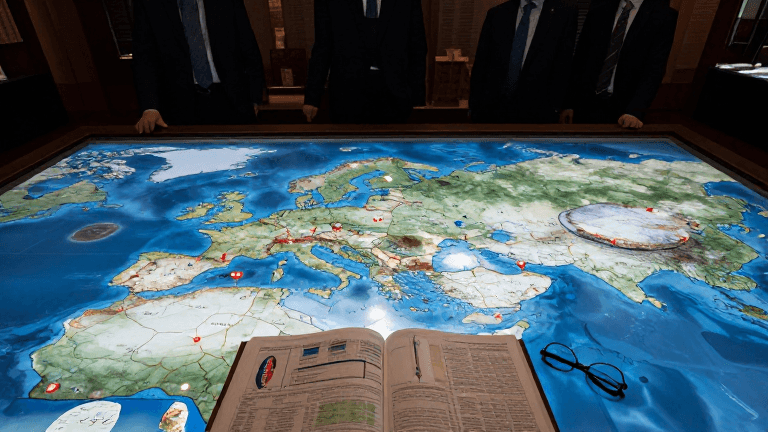
So alliance policy must return to strategist Spykman: he revised Mackinder's world island theory, shifting from the land power vs. sea power struggle to the rimland vs. heartland struggle, believing the rimland is more important, which is also the basis of Cold War containment policy. The U.S. must maintain military access and political alliances along the rimland of Eurasia; voluntary retreat will only let allies and adversaries alike smell weakness, and once the situation collapses, the cost of redeploying is greater than maintaining deployment.
European allies, no matter their flaws, are the cornerstone of maintaining rimland access; as long as the U.S. is unwilling to cede control of the entire old continent to China, it cannot abandon Europe. The report appreciates Trump's aim of forcing allies to fulfill responsibilities, but the means must improve: America First does not mean stepping on allies. In short, don't fantasize about allying with Russia to counter China; instead, master 'allying with Europe to counter China.'