The U.S. Tariff Game: A Global Economic Magic Trick
9/11/2026#美国关税#全球经济秩序#对等关税#解放日#关税博弈
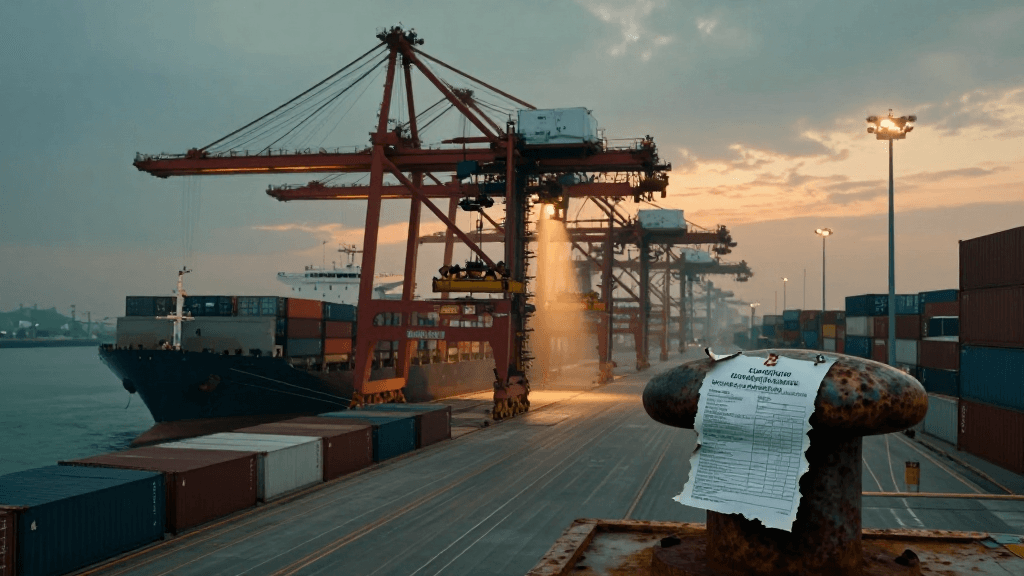
Folks, what we’re talking about today isn’t just your average economic news—it’s “Liberation Day,” as announced by Trump. This “Liberation Day” sure goes against the grain. Can you believe the big guy is claiming he’s being exploited by cattle and horses? What this guy calls “exploitation” is actually just free trade—a straightforward exchange of money for goods. Even though I’ve received the goods, you keep making me pay—not only emptying my pockets but also hollowing out my industry. That’s not fair. What can we do? Simple: make it more expensive for you to sell your goods. We’ll switch to domestic alternatives—no, we’ll just “re-establish Greatness.” Putting it into practice is even simpler. After all, Trump’s trade war with China during his first term already served as a blueprint. We’ll just scale it up—expand it to the entire world—and impose a minimum 10% tariff on all trading partners. It’s not aimed at anyone in particular; everyone here is in on it. Back in the day, that “IP Man” said he’d take on 10 opponents, but I, “Terraceman,” started at 180—and I didn’t even touch that little island where the penguins live. Building on that, we’ll impose customized, escalated “reciprocal tariffs” on about 50 countries that engage in particularly egregious exploitative practices. “Reciprocal,” you say? At first glance, it sounds fair—as if these countries are all imposing high tariffs on the U.S., so we’re simply returning the favor. Seems quite reasonable, doesn’t it? Trump’s trade advisor pulled out a chart: on the left were the names of all those “crooked merchants,” with “Cunning Rabbit” at the top; on the right were two columns—the first showing tariffs these countries impose on the U.S., and the second showing the U.S.’s “discounted” reciprocal tariffs. These countries have been imposing high tariffs on the U.S. “We in the U.S. only impose half of the other side’s tariff rate. If you hit us with 20%, we’ll only hit you with 10%. For example, China imposes a 67% tariff on us, so we only charge China 34%; the EU charges us 39%, so we only charge the EU 20%.” See how magnanimous the U.S. is? Even when punishing you, we give you a discount—raising the stick high but bringing it down gently. As the saying goes, “Though the world has dealt me a painful blow, I embrace it with song.” But what’s the reality? Trump pulled a petty stunt in front of the whole world—one that was bound to be exposed. Hidden in the fine print beneath the tariffs on the U.S. were a few lines stating that they included currency manipulation and trade barriers. So this percentage isn’t the tariff rate other countries impose on the U.S. Think about it: Lesotho, which was hit with Trump’s maximum 50% penalty—that would mean it imposed a 100% tariff on the U.S. How could it dare to do that? So what is this thing all about? It’s presented with a bunch of Greek letters to make it sound impressive, but it’s actually just the bilateral trade imbalance divided by that country’s exports to the U.S. Suppose China sells $100 worth of goods to the U.S. and buys $33 worth of goods from the U.S. The difference is 67; divided by China’s export value of 100, that’s 67%. So the U.S. would impose a 34% tariff on you. Is this thing scientific? It’s just as scientific as if you had a fever of 37 degrees and I had 39 degrees—and I used a 2/37-millimeter needle to prick you until we both reached 38 degrees. Soon after, China rolled out countermeasures and also imposed a 34% tariff. Trump saw this and lost his cool, slapping on another 50%, causing tariffs to skyrocket to 104%. That meant that from then on, goods that used to turn a profit at $100 would now have to be sold for $204. China responded forcefully: “If you go it alone, I’ll see it through to the end.” So they followed suit with a 50-point increase, bringing the rate to 84%. Trump didn’t back down either, raising it to 125%. “Bring it on,” they said. “Let’s hurt each other. If this business can’t be done, then let’s not do it. Let’s see who feels the pain more—and whose economy depends more on the other.” As Professor Zhang Weiwei has said, Trump might as well raise tariffs to 600% to see how many U.S. supermarkets and businesses would go under. As the world’s largest industrial nation, China certainly has the confidence to do so. But globally, aside from a few old allies who’ve lost their way and can’t support themselves, how many countries could match China’s confidence in going head-to-head like this? Almost none. Looking out from China’s perspective, the outside world is in a state of panic—this is the new normal. Trump claims that 75 countries have already come begging for mercy. Take Vietnam, for example: after reaping the benefits of rerouting supply chains away from “Made in China” for several years, it has now become a primary target of U.S. sanctions. Even when Vietnamese leaders immediately pledged to impose zero tariffs on U.S. goods, the U.S. refused to reduce or waive tariffs on Vietnam. Singapore, on the other hand, has been more reasonable. The U.S. runs a trade surplus with Singapore—selling more than it buys—yet tariffs remain in full force. Singapore bypassed the usual diplomatic niceties and put up no resistance, simply stating, “Go ahead and fight it,” "I won’t retaliate." As long as the world doesn’t unite, all we can do is wait for the club to come crashing down on our heads. Therefore, in the eyes of most people, Trump is a madman, and his tariff playbook is densely packed with plans to devour others. Only a few people, at this critical juncture, can still calmly debate whether Trump is truly stupid or just pretending to be, whether he genuinely doesn’t understand economics, truly believes that raising tariffs will force others to “eat people,” truly believes that raising tariffs will force others to “eat people,” truly believes that raising tariffs will force others to “eat people,” truly believes that raising tariffs can reduce the trade deficit—or whether he’s just playing the fool while actually playing a grand strategic game, or at the very least, secretly trading stocks.
The “truly stupid” camp loves to lecture you on economic principles—what tariffs are, who ends up paying for them, what the harms are, and so on. They think it’s been too long since Trump graduated from the Wharton School, so his knowledge has faded, and that his entire presidential team is a bunch of incompetents—take trade advisor Navarro, for example, with his academic fraud and utter nonsense. They’re also particularly adept at analyzing Trump’s personality flaws—cognitive impairment, narcissism, NPD, NBTI, ADHD—you name it. They even claim Trump is showing signs of becoming like Old Deng and is starting to lose his mind. This faction, among the intellectual crowd obsessed with diagnosing stupidity, is a bit of a hidden gem—but it’s pretty useless, as it’s too easy to shoot down with “magic anti-aircraft fire.” For example, 35 psychiatrists signed a joint letter in the newspaper stating that “King Dong” is truly mentally ill and needs treatment. They said “The King of Understanding” is genuinely ill and needs treatment. Loyal young Republicans immediately proposed legislation to classify “strong opposition to Trump” as a mental illness—legislation to classify “strong opposition to Trump” as a mental illness—and fired back by saying, “Only those who claim His Majesty is ill are the ones who are actually ill.” They fired back by saying, “Only those who claim His Majesty is ill are the ones who are actually ill.” Actually, I think he’s mentally ill, too. But so what if he is? There are plenty of successful people who are mentally ill—King Ma is a classic example. Besides, even if he is mentally ill, can you cure him, or can you understand him? When you fully understand a mentally ill person, I suggest you go to 600 Wanping South Road and follow the law. I suggest you go to 600 Wanping South Road and follow the law.
As for those playing dumb, there are plenty of them. But after scouring the entire internet, I think former Greek Finance Minister Varoufakis’s analysis makes the most sense. He said that tariffs are a sharp sword; Trump, wielding this sword, no longer seeks to reduce the trade deficit, but rather aims to bring about a “controlled disintegration” of the global economy by creating turmoil. So why would he undermine the very free trade and globalization that he once championed? If you’ve read my previous interview with him, he explains it very clearly. After World War II, the United States was the only remaining industrialized nation, and it relied on sending money to its allies to absorb its excess industrial capacity. By the late 1960s, due to the Vietnam War—which was a drain on resources and manpower—and because Germany and Japan had not only recovered their industrial strength but had also entered a period of rapid growth, the U.S. shifted from being a country with a trade surplus to one with a trade deficit. Consequently, the U.S. decided to dismantle the global governance system it had once spearheaded. However, because of America’s strength, the dollar’s status as the global reserve currency did not collapse; instead, it was decoupled from gold and re-pegged to U.S. sovereign credit. As a result of this maneuver, money could be printed at will, and as long as the U.S. had dollars, it could buy whatever it wanted without restraint. The world’s working class had no choice but to grit their teeth and work their fingers to the bone just to earn those precious little green pieces of paper. So what’s the point of getting those little green slips? Governments buy these theoretically risk-free green slips—that is, U.S. Treasury bonds—while business owners buy U.S. stocks and big houses. The dollars that flowed out through industrialization are sucked back in through financialization, in a never-ending cycle. Later, when China joined this system, it naturally became the U.S.’s counterpart—two engines of globalization: one producing, the other consuming. When domestic demand in the consumer nations fell short, China stepped in to fill the role of the consumer. Therefore, when China seeks to maintain economic balance, it inevitably impacts the U.S.’s role as an exporting nation. Consequently, China must undergo internal adjustments: directly intervening in income distribution, ending the cycle of low incomes and meager welfare, and achieving material prosperity. But the most crucial step remains restructuring the economy—subsidizing towns and villages in the central and western regions to enhance the people’s sense of well-being. Only such an economy can possess deep, long-term vitality. The Chinese are not born to be beasts of burden, just as Americans are not born to be lazy. As I mentioned earlier, everything is a matter of economic institutional arrangements, and now the time has come for a reshuffling of the global economic order—the United States must reshuffle, and so must we. But what will the new order look like? They are pondering what it means to be American. Different factions within the Trump administration have different answers: some advocate for the nation-state; some are rooted in Monroe Doctrine principles; some seek to cultivate a “worker aristocracy”; some aim to champion Western civilization; and still others simply do not care about humanity at all—they only want to save capitalism. Consequently, their struggle over the shape of the American economic system will only intensify. As for us, we must reflect on what socialism means. In China, how should our economic system embody fairness and justice? How can we enable people to participate in social progress and share in its fruits? How can we develop production relations commensurate with productive forces? Ultimately, the best system has only one goal: not the accumulation of wealth, but enabling people to lead happy lives without relying on wealth.